'%3e%3cg%20transform='matrix(0.737731,0,0,0.737731,1584.657279,93.052323)'%3e%3cg%20transform='matrix(1,0,0,1,-73.197369,-28.78343)'%3e%3cg%20transform='matrix(2.327683,0,0,2.327683,-115.888888,-940.785017)'%3e%3cpath%20d='M610.12,610.782L535.09,610.782L535.09,570.757L618.413,570.757L610.12,610.782ZM628.935,570.757L697.713,570.757C709.523,570.757%20720.131,571.523%20729.536,573.054C738.94,574.585%20746.923,577.373%20753.485,581.42C760.046,585.466%20765.077,591.043%20768.576,598.151C772.076,605.26%20773.825,614.391%20773.825,625.545C773.825,632.107%20772.841,638.504%20770.873,644.737C768.904,650.971%20766.006,656.548%20762.179,661.469C758.351,666.39%20753.758,670.491%20748.4,673.772C743.041,677.052%20736.863,679.13%20729.864,680.005L729.864,680.661C741.018,683.723%20749.603,689.574%20755.617,698.213C761.632,706.852%20764.639,716.858%20764.639,728.231C764.639,740.917%20762.179,752.071%20757.258,761.695C752.337,771.318%20745.721,779.301%20737.409,785.644C729.098,791.987%20719.584,796.798%20708.867,800.079C698.15,803.36%20686.886,805%20675.076,805L580.368,805L581.484,799.615L609.457,665.57L687.543,665.57C696.947,665.57%20705.094,663%20711.984,657.86C718.873,652.72%20722.318,645.011%20722.318,634.731C722.318,625.545%20719.858,619.257%20714.937,615.867C710.015,612.477%20703.399,610.782%20695.088,610.782L620.636,610.782L628.935,570.757ZM638.101,764.975L672.779,764.975C684.59,764.975%20694.268,761.804%20701.814,755.461C709.359,749.119%20713.132,739.714%20713.132,727.247C713.132,721.123%20711.875,716.312%20709.359,712.812C706.844,709.313%20703.618,706.633%20699.681,704.774C695.744,702.915%20691.37,701.767%20686.558,701.33C681.747,700.892%20677.044,700.673%20672.451,700.673L651.88,700.673L638.101,764.975Z'%20style='fill:rgb(25,23,20);'/%3e%3c/g%3e%3cg%20transform='matrix(1,0,0,1,0,220.238764)'%3e%3cpath%20d='M1259.334,480.922L1129.63,480.922L1129.63,387.757L1278.681,388.212L1259.334,480.922Z'%20style='fill:rgb(0,120,111);'/%3e%3c/g%3e%3cg%20transform='matrix(1,0,0,1,0,452.077913)'%3e%3cpath%20d='M1210.953,480.922L1129.63,480.922L1129.63,387.757L1230.395,387.757L1210.953,480.922Z'%20style='fill:rgb(0,120,111);'/%3e%3c/g%3e%3cg%20transform='matrix(1,0,0,1,0,336.158338)'%3e%3cpath%20d='M1235.144,480.922L1129.63,480.922L1129.63,387.757L1254.586,387.757L1235.144,480.922Z'%20style='fill:rgb(0,120,111);'/%3e%3c/g%3e%3c/g%3e%3c/g%3e%3c/g%3e%3c/svg%3e)
The plate cost is real. So is the prep list.
Food cost lives in a spreadsheet nobody has opened since the menu changed. The mother sauces are in one binder, prep lives in someone’s head, and the Sunday order rides on memory and a walk to the cold room.
BatchDash runs the same engine for a kitchen: recipes with sub-recipes, a cost per portion built from your delivery prices, a prep board checked against stock, and orders grouped by supplier with their lead times honored.
What costing software does for a kitchen
It prices a dish from your own delivery notes and keeps that figure current as the invoices move. Prep sheets come out sized to the service, the week is checked against what is actually in the walk-in, and the margin on a menu stops being an annual exercise.
Cost per portion, from your own invoices
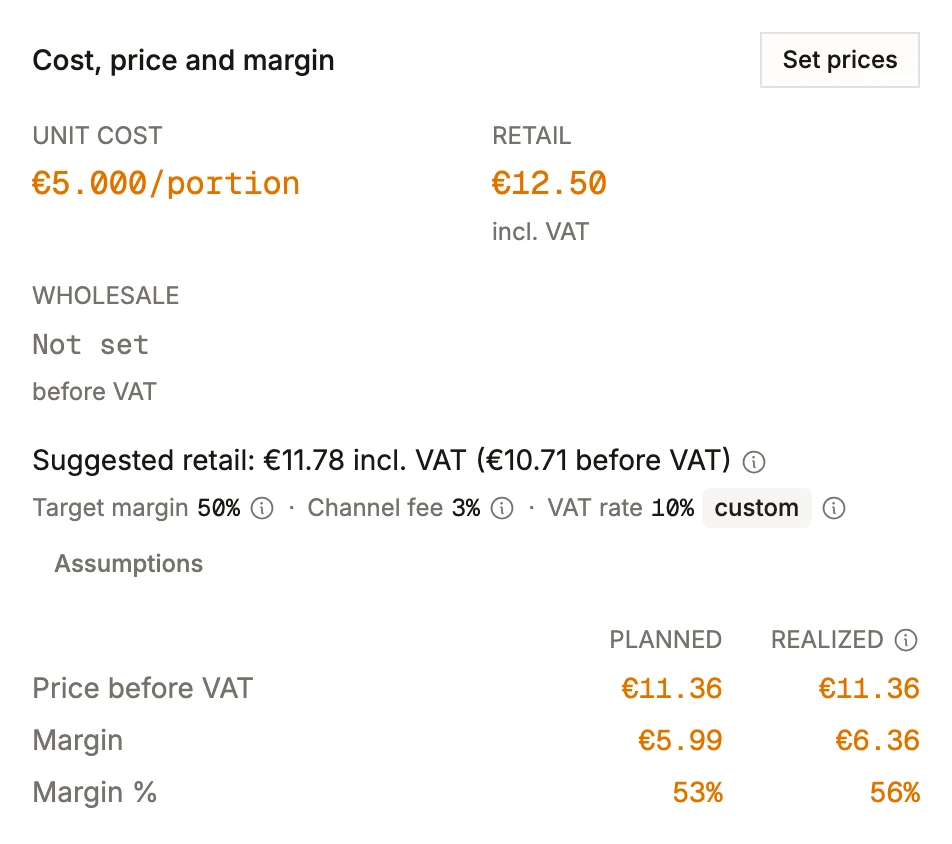
A menu item is a recipe with a portion size, so every dish carries its own cost: the weighted average of what you actually paid, delivery fees folded in, sub-recipes expanded, the minutes recorded on the batch, the overhead your kitchen carries. Beside it sits the price you charge and the margin between them, what you planned against what the dish has really been selling for. It moves the day the mozzarella does.
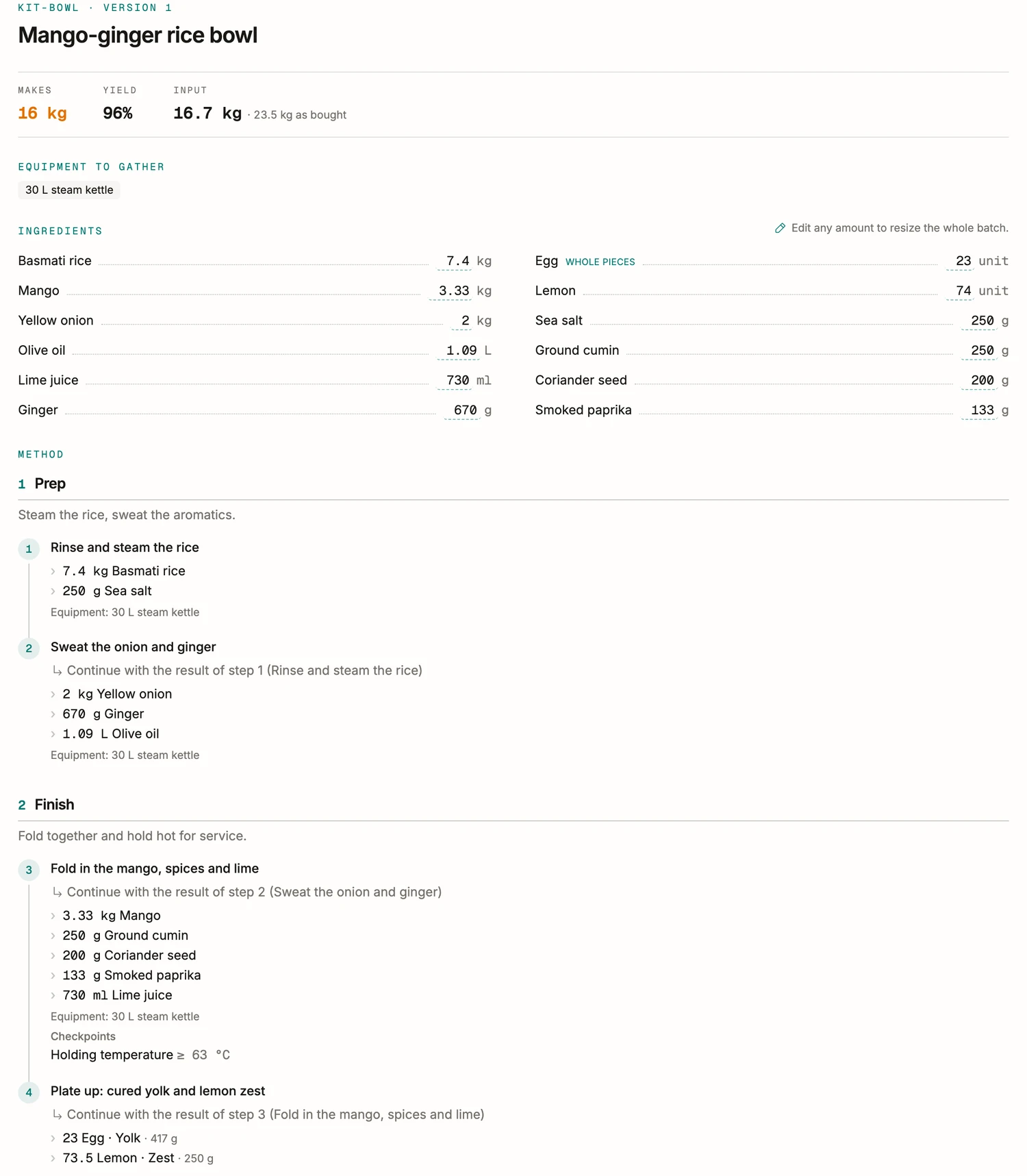
The prep sheet for one service
Ask the recipe for forty portions and it prints forty portions: 7.4 kg of rice, 1.09 L of oil, 23 eggs, rounded to what a kitchen actually weighs. The steps are in order with the equipment each one needs and the holding temperature the pass has to keep. Two lines ask for a part rather than the whole thing, the yolk and the zest, and the sheet says both what leaves the crate and what ends up in the dish.
Prep, service and days off on one board
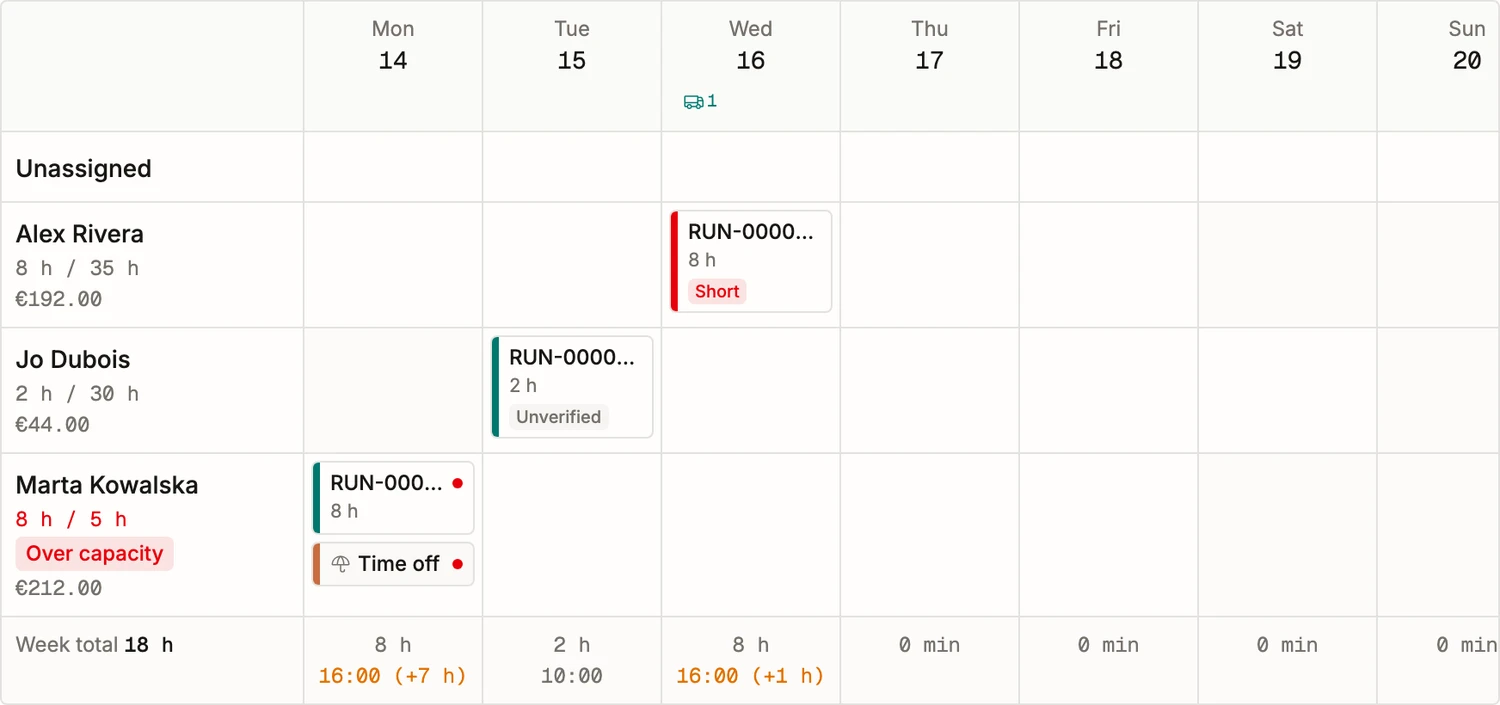
Base sauces, mise en place, packing for an event and somebody’s Tuesday off all sit on the same week, per person. Each row shows the hours planned against that person’s capacity and what those hours cost. A batch that will run short of an ingredient says so before the day does, and the days carrying a delivery or an order-by deadline are marked.
The order writes itself, and you argue with it
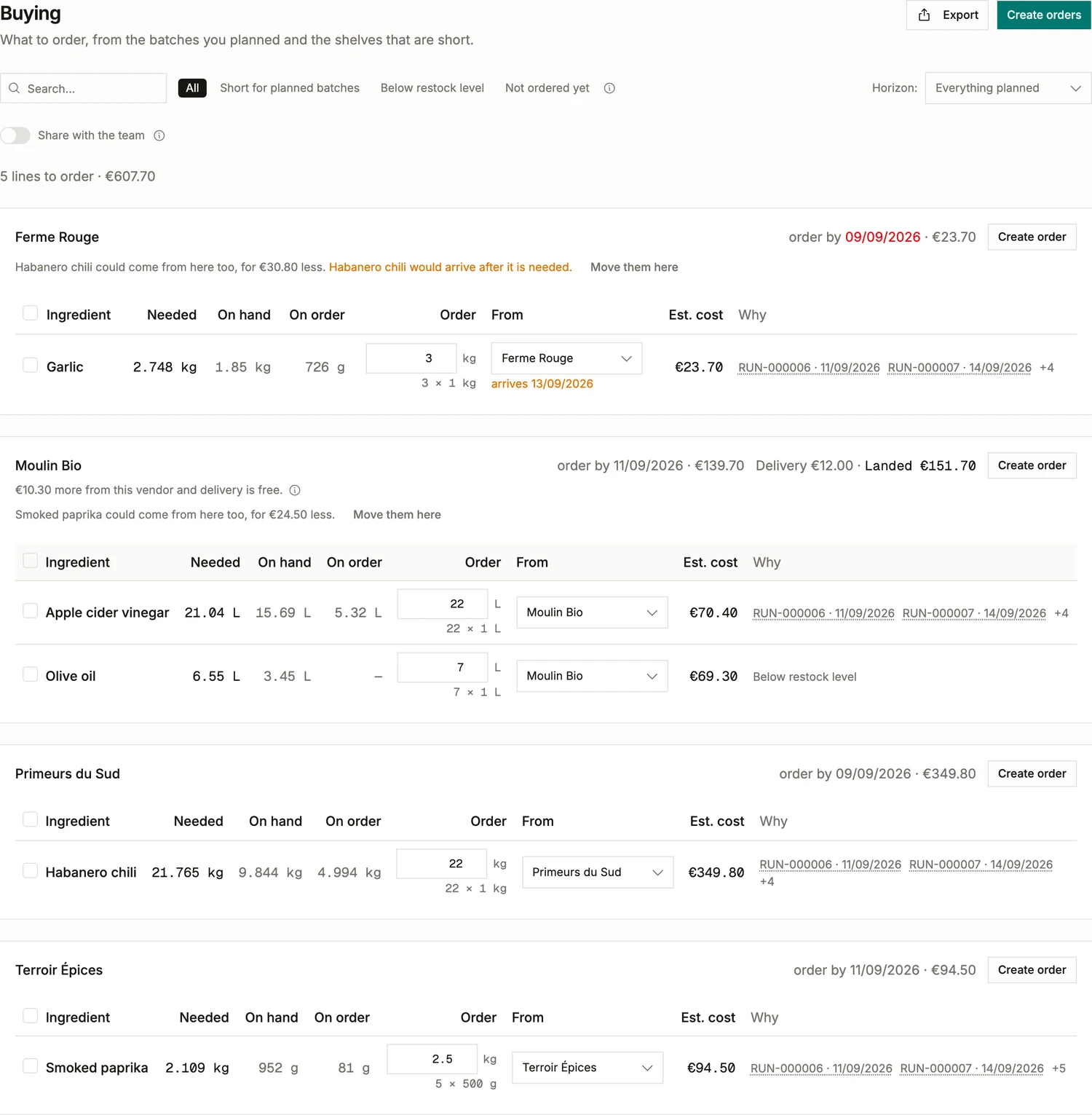
The list comes from the week you planned and the levels you set, grouped the way you actually order:
- Per supplier, with pack sizes and minimums honored, so the quantity offered is one you can order.
- Order-by dates walked back from each supplier’s lead time. A missed one reads in red.
- Every line says why it is there. One click writes a draft order per supplier; a person reviews and sends, and nothing is emailed by the system.
And the walk-in stops being a guess
Every delivery, every batch and every count writes one line in a ledger you can read, so a number on screen walks back to the invoice behind it. Count a shelf on a phone and the difference is booked with its value and the person who counted. Losses take a reason, so the end of the month can tell a cold-room failure from a portion that was too generous.
What is in the dish, in writing
Allergens are read off the ingredients rather than remembered, at any depth, so a sauce carrying butter puts milk on the dish without anyone typing it. A batch’s declaration prints in the language the menu is in. When a supplier substitution changes an ingredient, the dishes using it change with it.
Questions we hear before the first batch.
- How is a plate cost computed?
- From the weighted average cost of each ingredient, at the quantity the recipe uses, with yield taken into account. Trim and cooking loss are inside the figure, so it is a cost per portion served.
- Can I print prep sheets for a service?
- A recipe sheet scales to the number of covers and prints with its steps, its checkpoints and its quantities. Per-line scale rules decide what grows with the batch and what stays fixed.
- What happens when a supplier raises a price?
- The delivery moves the average cost, every dish using that ingredient is recosted, and the margin report shows which ones moved. Nothing is retyped.
- Can the team use it without training?
- A cook opens a run sheet and works down it. Roles decide who can change a formula and who can only run one.