'%3e%3cg%20transform='matrix(0.737731,0,0,0.737731,1584.657279,93.052323)'%3e%3cg%20transform='matrix(1,0,0,1,-73.197369,-28.78343)'%3e%3cg%20transform='matrix(2.327683,0,0,2.327683,-115.888888,-940.785017)'%3e%3cpath%20d='M610.12,610.782L535.09,610.782L535.09,570.757L618.413,570.757L610.12,610.782ZM628.935,570.757L697.713,570.757C709.523,570.757%20720.131,571.523%20729.536,573.054C738.94,574.585%20746.923,577.373%20753.485,581.42C760.046,585.466%20765.077,591.043%20768.576,598.151C772.076,605.26%20773.825,614.391%20773.825,625.545C773.825,632.107%20772.841,638.504%20770.873,644.737C768.904,650.971%20766.006,656.548%20762.179,661.469C758.351,666.39%20753.758,670.491%20748.4,673.772C743.041,677.052%20736.863,679.13%20729.864,680.005L729.864,680.661C741.018,683.723%20749.603,689.574%20755.617,698.213C761.632,706.852%20764.639,716.858%20764.639,728.231C764.639,740.917%20762.179,752.071%20757.258,761.695C752.337,771.318%20745.721,779.301%20737.409,785.644C729.098,791.987%20719.584,796.798%20708.867,800.079C698.15,803.36%20686.886,805%20675.076,805L580.368,805L581.484,799.615L609.457,665.57L687.543,665.57C696.947,665.57%20705.094,663%20711.984,657.86C718.873,652.72%20722.318,645.011%20722.318,634.731C722.318,625.545%20719.858,619.257%20714.937,615.867C710.015,612.477%20703.399,610.782%20695.088,610.782L620.636,610.782L628.935,570.757ZM638.101,764.975L672.779,764.975C684.59,764.975%20694.268,761.804%20701.814,755.461C709.359,749.119%20713.132,739.714%20713.132,727.247C713.132,721.123%20711.875,716.312%20709.359,712.812C706.844,709.313%20703.618,706.633%20699.681,704.774C695.744,702.915%20691.37,701.767%20686.558,701.33C681.747,700.892%20677.044,700.673%20672.451,700.673L651.88,700.673L638.101,764.975Z'%20style='fill:rgb(25,23,20);'/%3e%3c/g%3e%3cg%20transform='matrix(1,0,0,1,0,220.238764)'%3e%3cpath%20d='M1259.334,480.922L1129.63,480.922L1129.63,387.757L1278.681,388.212L1259.334,480.922Z'%20style='fill:rgb(0,120,111);'/%3e%3c/g%3e%3cg%20transform='matrix(1,0,0,1,0,452.077913)'%3e%3cpath%20d='M1210.953,480.922L1129.63,480.922L1129.63,387.757L1230.395,387.757L1210.953,480.922Z'%20style='fill:rgb(0,120,111);'/%3e%3c/g%3e%3cg%20transform='matrix(1,0,0,1,0,336.158338)'%3e%3cpath%20d='M1235.144,480.922L1129.63,480.922L1129.63,387.757L1254.586,387.757L1235.144,480.922Z'%20style='fill:rgb(0,120,111);'/%3e%3c/g%3e%3c/g%3e%3c/g%3e%3c/g%3e%3c/svg%3e)
The batch is done. What exactly did you make?
The pots are washed and the answer is already evaporating: what actually went in, who ran the cook, whether the pH check happened, what it cost. By the time an auditor, a customer or your own curiosity asks, the recipe has moved on and the batch cannot testify.
A finished BatchDash batch seals its record: the recipe as it ran, the weighed quantities, the parameters and checks, the lots in, the lot out, and the real cost. Edit the recipe tomorrow, the record does not move. It is the production history your certifier keeps asking whether you have.
Written while the batch is running
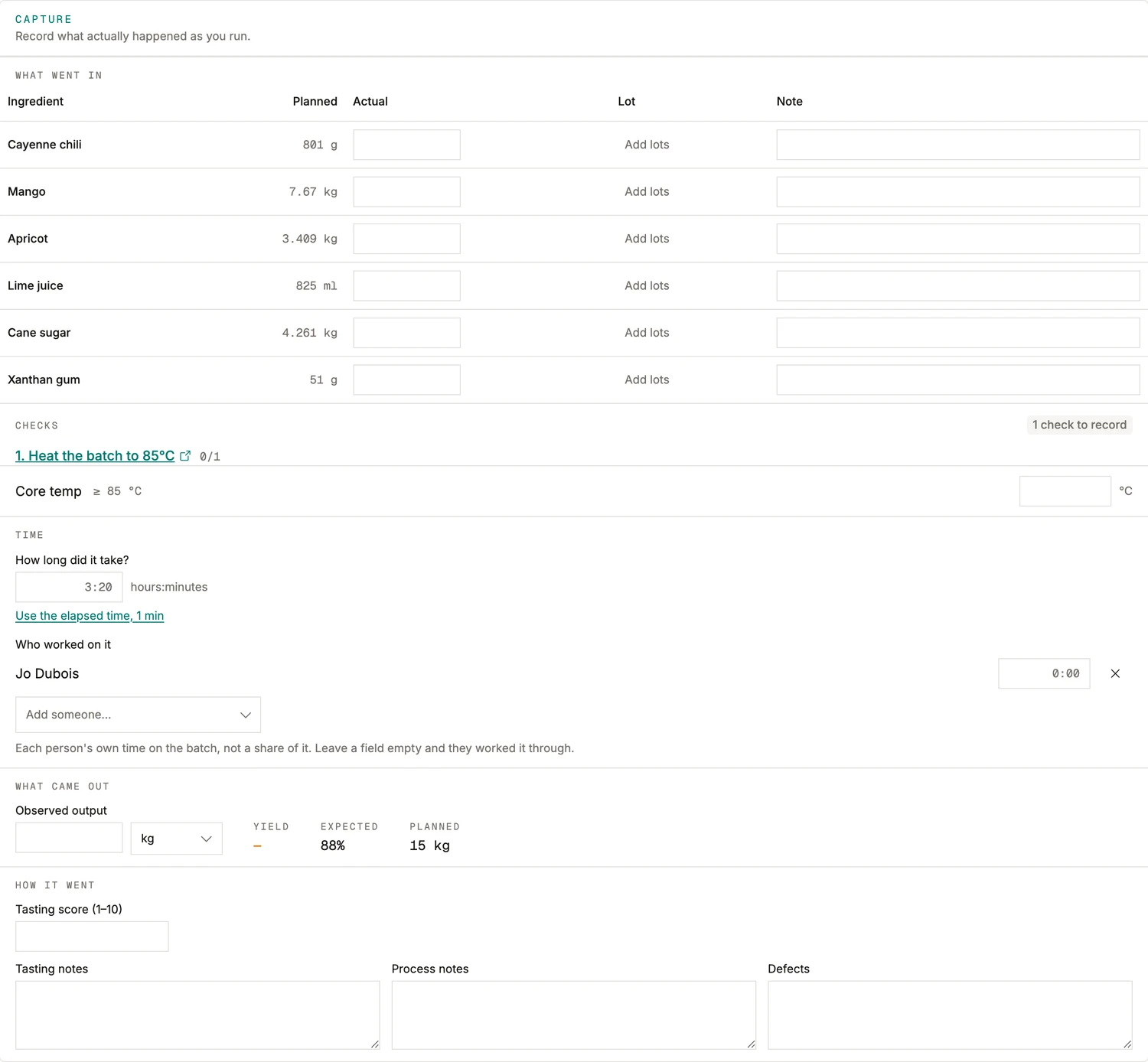
The run page is the worksheet. What was planned sits beside a box for what actually went in, and the lots it came from go on the same row. The check the recipe demanded is there with its target and an empty field, and it stays counted as outstanding until somebody fills it. Time is per person and it is their own time on the batch rather than a share of it, with a link to take the elapsed clock if one was running. Then what came out against the yield you expected, and how it went: a score, tasting notes, process notes, defects.
Sealing is a decision, not a formality
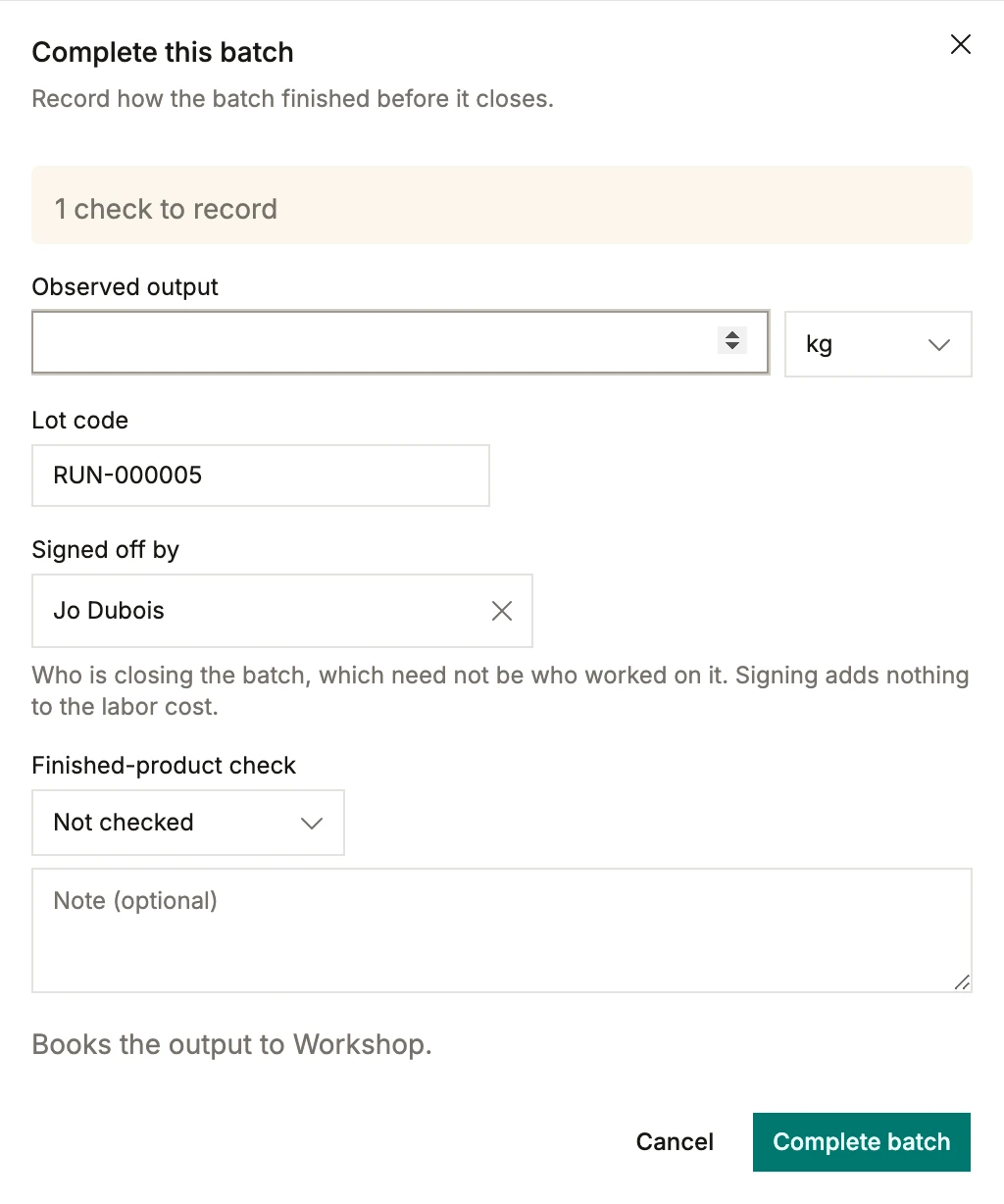
Closing a batch asks for the three things that turn a worksheet into a record: what came out, the lot code it will answer to from here on, and whether the finished product passed. It names who is signing, which need not be whoever did the work, and says plainly that signing adds nothing to the labor cost. A check still outstanding is on the dialog before you press the button, not discovered afterwards. And it tells you where the output is about to land.
And then it stops changing
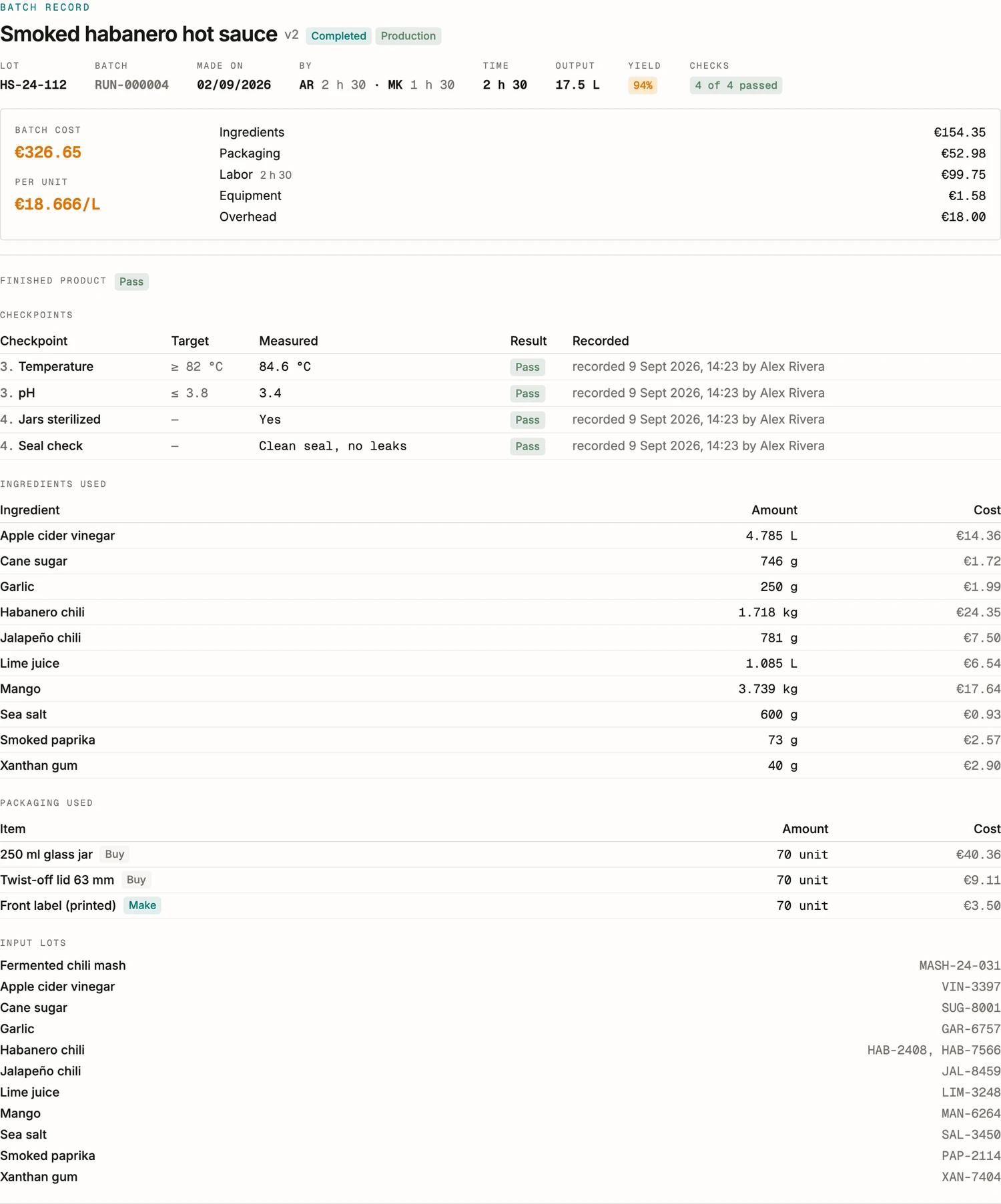
The sealed record is the recipe as it ran. The lot, the operators and the hours each of them put in, the yield against the plan, and every check with its target, its reading, and the name and minute it was recorded at. Under that: what was actually consumed and what that cost, the packaging that went on it, and the supplier lot behind every single line. Edit the recipe tomorrow and none of it moves.
Sealed with its own price tag
Expected cost is a plan; the record keeps what the batch really cost:
- Ingredients at the ledger cost of the lots actually drawn.
- Labor from recorded minutes, per operator, at each one’s rate.
- Equipment amortization for the tools the steps really used.
- Yield included: 17.5 liters out of an 18-liter plan reads as its true per-liter cost.
Trials that cost you nothing but the tasting
A test batch runs against real stock, because trials that pretend to consume nothing teach nothing. Score it by tasting; if it stays an experiment, revert it and the consumed stock comes back at the cost it left. The bench notes and the score stay, so even the dead ends leave knowledge behind.
Everything downstream points back at it
The lot printed on the label is this record’s lot. The trace walks from a delivery note into this batch and back out to the customer who received a jar of it. The margin on the product reads this batch’s real cost rather than its plan. A record nobody can reach from the thing that made them ask is a filing cabinet; this one sits in the middle of the system, which is the only reason it stays true.