'%3e%3cg%20transform='matrix(0.737731,0,0,0.737731,1584.657279,93.052323)'%3e%3cg%20transform='matrix(1,0,0,1,-73.197369,-28.78343)'%3e%3cg%20transform='matrix(2.327683,0,0,2.327683,-115.888888,-940.785017)'%3e%3cpath%20d='M610.12,610.782L535.09,610.782L535.09,570.757L618.413,570.757L610.12,610.782ZM628.935,570.757L697.713,570.757C709.523,570.757%20720.131,571.523%20729.536,573.054C738.94,574.585%20746.923,577.373%20753.485,581.42C760.046,585.466%20765.077,591.043%20768.576,598.151C772.076,605.26%20773.825,614.391%20773.825,625.545C773.825,632.107%20772.841,638.504%20770.873,644.737C768.904,650.971%20766.006,656.548%20762.179,661.469C758.351,666.39%20753.758,670.491%20748.4,673.772C743.041,677.052%20736.863,679.13%20729.864,680.005L729.864,680.661C741.018,683.723%20749.603,689.574%20755.617,698.213C761.632,706.852%20764.639,716.858%20764.639,728.231C764.639,740.917%20762.179,752.071%20757.258,761.695C752.337,771.318%20745.721,779.301%20737.409,785.644C729.098,791.987%20719.584,796.798%20708.867,800.079C698.15,803.36%20686.886,805%20675.076,805L580.368,805L581.484,799.615L609.457,665.57L687.543,665.57C696.947,665.57%20705.094,663%20711.984,657.86C718.873,652.72%20722.318,645.011%20722.318,634.731C722.318,625.545%20719.858,619.257%20714.937,615.867C710.015,612.477%20703.399,610.782%20695.088,610.782L620.636,610.782L628.935,570.757ZM638.101,764.975L672.779,764.975C684.59,764.975%20694.268,761.804%20701.814,755.461C709.359,749.119%20713.132,739.714%20713.132,727.247C713.132,721.123%20711.875,716.312%20709.359,712.812C706.844,709.313%20703.618,706.633%20699.681,704.774C695.744,702.915%20691.37,701.767%20686.558,701.33C681.747,700.892%20677.044,700.673%20672.451,700.673L651.88,700.673L638.101,764.975Z'%20style='fill:rgb(25,23,20);'/%3e%3c/g%3e%3cg%20transform='matrix(1,0,0,1,0,220.238764)'%3e%3cpath%20d='M1259.334,480.922L1129.63,480.922L1129.63,387.757L1278.681,388.212L1259.334,480.922Z'%20style='fill:rgb(0,120,111);'/%3e%3c/g%3e%3cg%20transform='matrix(1,0,0,1,0,452.077913)'%3e%3cpath%20d='M1210.953,480.922L1129.63,480.922L1129.63,387.757L1230.395,387.757L1210.953,480.922Z'%20style='fill:rgb(0,120,111);'/%3e%3c/g%3e%3cg%20transform='matrix(1,0,0,1,0,336.158338)'%3e%3cpath%20d='M1235.144,480.922L1129.63,480.922L1129.63,387.757L1254.586,387.757L1235.144,480.922Z'%20style='fill:rgb(0,120,111);'/%3e%3c/g%3e%3c/g%3e%3c/g%3e%3c/g%3e%3c/svg%3e)
Three files, one serum, and no two of them agree.
A cosmetic lives in a formula spreadsheet written in percentages, an INCI list somebody assembled by hand, and a batch notebook the safety assessor wants to see. Every reformulation means reworking all three. They drift, and the drift is exactly what an audit finds.
BatchDash keeps the formula, its versions, its batches and its label data on one gram-based engine. The INCI list and the batch record come out of the work instead of being written up afterwards.
What cosmetic manufacturing software does
It holds a formula in percentages, prices it from what you paid for each ingredient, and turns it into a batch that draws on real stock and leaves a record behind. In cosmetics that record is not optional: the INCI list, the batch number, the dates and the quantities made are what a product information file and a safety assessor ask for. BatchDash produces them from the work itself, so there is no second pass at the end of the day.
Percentages on the page, grams on the bench
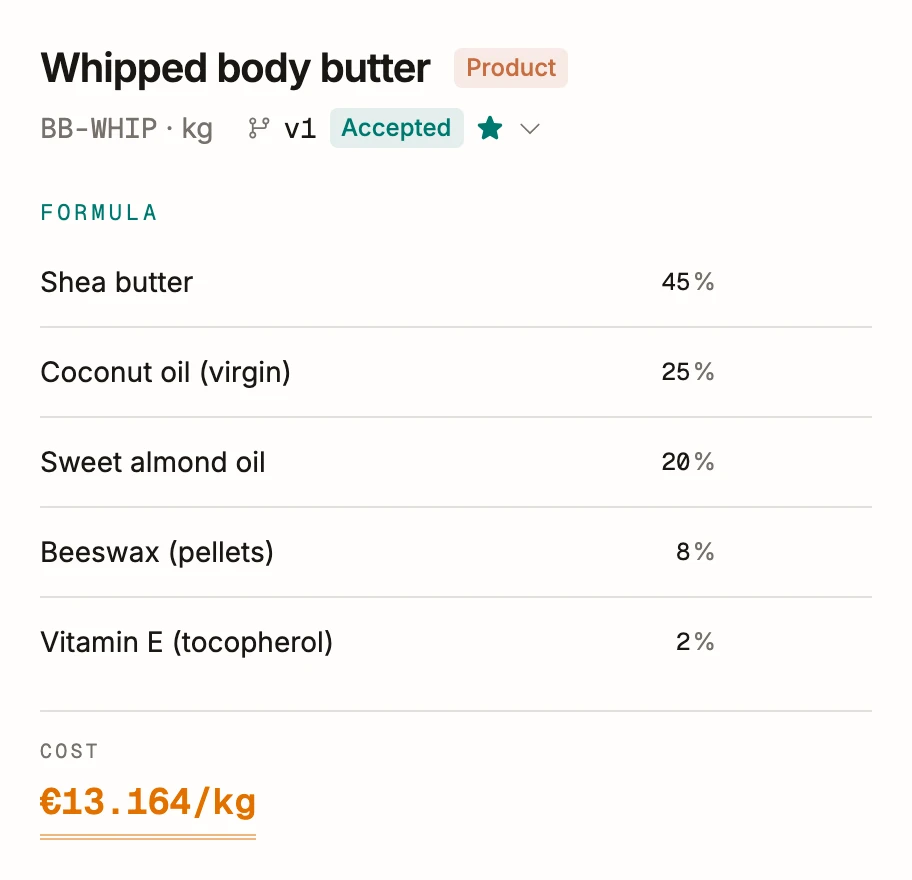
The formula is written the way a cosmetic is written: phases, percentages to the second decimal, every ingredient carrying its own INCI name. The panel keeps the shares adding to 100 while you type and prices the batch off your own deliveries, so a 0.2% preservative is 0.2% at every size and the cost per kilogram moves the day a butter does.
- Phases are real: the heated one, the cool-down, the one that only takes the preservative.
- A base you reuse across the range exists once, as a sub-formula, with its cost flowing through.
- Every trial keeps its own version, its notes and its score, so the emulsion that finally held is reproducible instead of legendary.
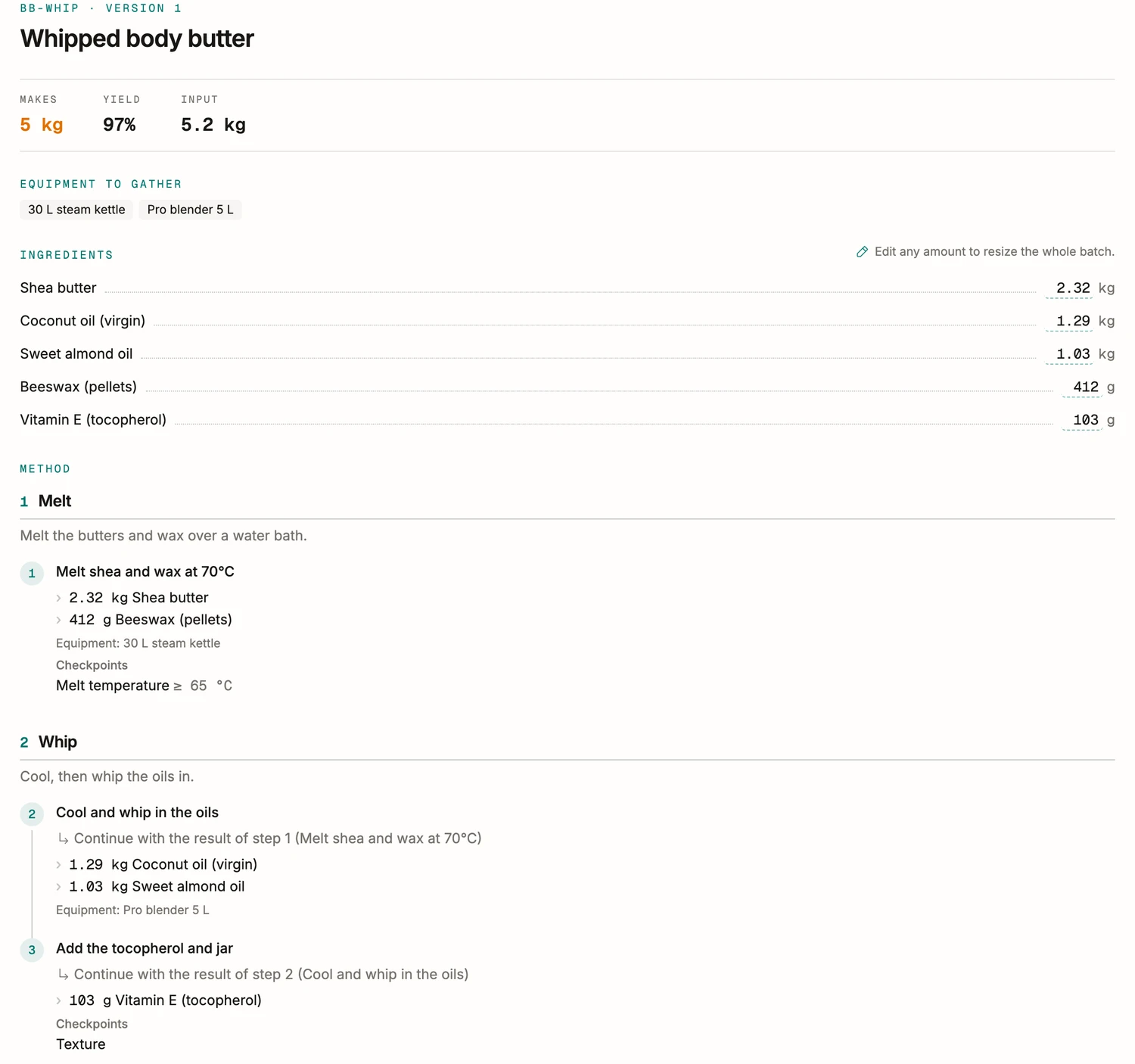
The same formula, printed for the bench
Ask for 5 kg and the sheet is 5 kg: 2.32 kg of shea, 412 g of wax, 103 g of tocopherol, rounded to what your scale can actually weigh. The equipment to gather is listed at the top, each phase carries the steps that belong to it, and the melt phase carries the temperature the butters have to reach before anything is whipped into them. Print it, or work off the screen.
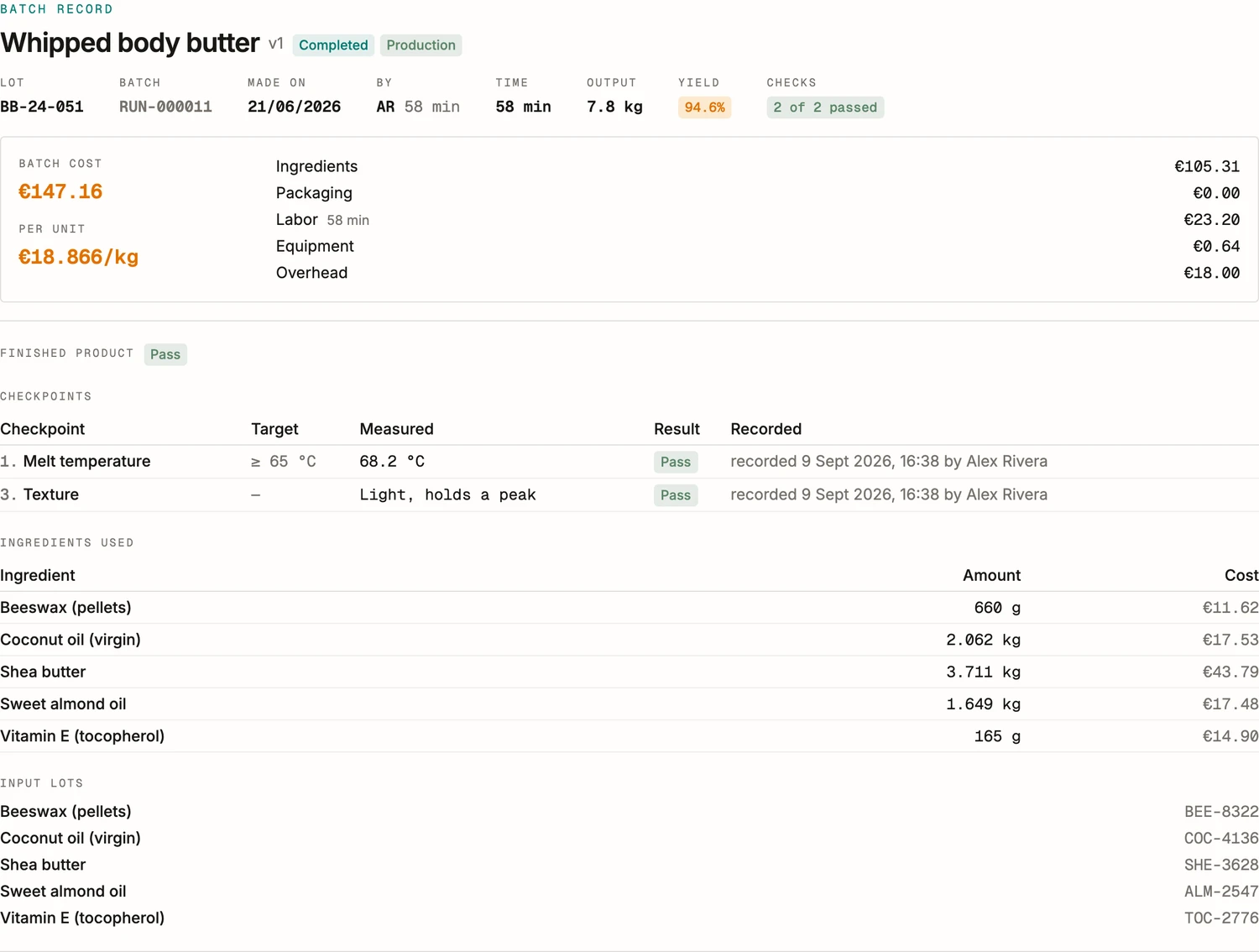
The batch record an assessor asks for
A finished batch seals itself: what it made and under which lot code, who ran it and for how long, the melt temperature that was measured and by whom, the exact quantities that went in with what each one cost, and the supplier lot behind every line. Edit the formula next month and none of it moves. This is the production file, kept as a side effect of producing rather than assembled the week before an inspection.
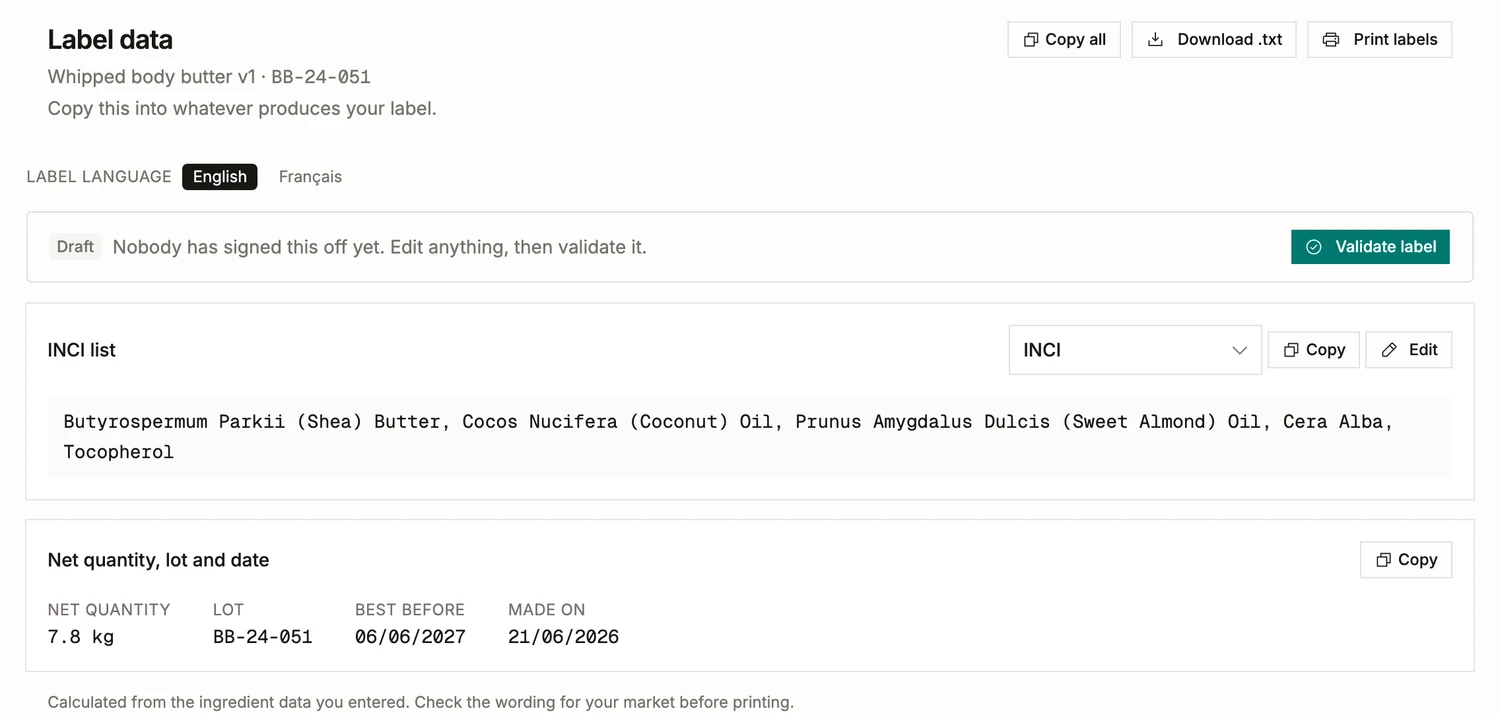
The INCI list writes itself
Switch the label to INCI and the declaration is already there, read off the batch’s own sealed composition: flat, descending by mass, every compound broken out, no percentages anywhere. The net quantity, the lot and the dates come from the same batch. It renders in each language your label ships in, and once you validate it, it is signed and stops following the calculation.
Every ingredient carries its own paperwork
A declaration is only as good as what sits behind it, so the data lives on the ingredient rather than in the label file:
- INCI name, CAS number, country of origin and the supplier’s own reference, each on the ingredient and each reused wherever it is needed.
- The INCI option stays switched off until every ingredient at or above 1% has a name, and it says which ones are missing. A list that quietly leaves an ingredient out is worse than no list.
- The suggestion button proposes the fields it can and marks them for review. You keep a value, correct it or untick it; nothing is saved without that pass.
What a jar costs, and what it earns
A batch prices itself from the deliveries you actually received, the minutes recorded on it, the jar and the pump as packaging, and the overhead your workshop carries. Divide by the format and you have a cost per jar rather than a cost per kilogram, next to the price you sell it at and the margin between them. When a butter goes up 8%, every product using it re-costs itself the same day.
Questions we hear before the first batch.
- Does it produce an INCI list?
- Yes. Each ingredient carries its INCI name, and the declaration is composed from the formula in descending order of quantity. Change the formula and it follows. You review it before it reaches a label.
- Can I use the records for a product information file?
- A finished batch record holds the formula version used, the quantities weighed, the lots that went in, the checks signed off and the date. That is the manufacturing half of a PIF. The safety assessment itself stays with your assessor.
- We make 3 kg at a time. Is this too much system?
- The smallest useful setup is a handful of ingredients with their prices and one formula. Everything else waits until you ask for it.
- Our formulas are in a spreadsheet. How do they get in?
- Ingredients and vendor prices import from CSV. A formula can be pasted in as text or photographed, and the AI reader drafts it for you to approve field by field.