'%3e%3cg%20transform='matrix(0.737731,0,0,0.737731,1584.657279,93.052323)'%3e%3cg%20transform='matrix(1,0,0,1,-73.197369,-28.78343)'%3e%3cg%20transform='matrix(2.327683,0,0,2.327683,-115.888888,-940.785017)'%3e%3cpath%20d='M610.12,610.782L535.09,610.782L535.09,570.757L618.413,570.757L610.12,610.782ZM628.935,570.757L697.713,570.757C709.523,570.757%20720.131,571.523%20729.536,573.054C738.94,574.585%20746.923,577.373%20753.485,581.42C760.046,585.466%20765.077,591.043%20768.576,598.151C772.076,605.26%20773.825,614.391%20773.825,625.545C773.825,632.107%20772.841,638.504%20770.873,644.737C768.904,650.971%20766.006,656.548%20762.179,661.469C758.351,666.39%20753.758,670.491%20748.4,673.772C743.041,677.052%20736.863,679.13%20729.864,680.005L729.864,680.661C741.018,683.723%20749.603,689.574%20755.617,698.213C761.632,706.852%20764.639,716.858%20764.639,728.231C764.639,740.917%20762.179,752.071%20757.258,761.695C752.337,771.318%20745.721,779.301%20737.409,785.644C729.098,791.987%20719.584,796.798%20708.867,800.079C698.15,803.36%20686.886,805%20675.076,805L580.368,805L581.484,799.615L609.457,665.57L687.543,665.57C696.947,665.57%20705.094,663%20711.984,657.86C718.873,652.72%20722.318,645.011%20722.318,634.731C722.318,625.545%20719.858,619.257%20714.937,615.867C710.015,612.477%20703.399,610.782%20695.088,610.782L620.636,610.782L628.935,570.757ZM638.101,764.975L672.779,764.975C684.59,764.975%20694.268,761.804%20701.814,755.461C709.359,749.119%20713.132,739.714%20713.132,727.247C713.132,721.123%20711.875,716.312%20709.359,712.812C706.844,709.313%20703.618,706.633%20699.681,704.774C695.744,702.915%20691.37,701.767%20686.558,701.33C681.747,700.892%20677.044,700.673%20672.451,700.673L651.88,700.673L638.101,764.975Z'%20style='fill:rgb(25,23,20);'/%3e%3c/g%3e%3cg%20transform='matrix(1,0,0,1,0,220.238764)'%3e%3cpath%20d='M1259.334,480.922L1129.63,480.922L1129.63,387.757L1278.681,388.212L1259.334,480.922Z'%20style='fill:rgb(0,120,111);'/%3e%3c/g%3e%3cg%20transform='matrix(1,0,0,1,0,452.077913)'%3e%3cpath%20d='M1210.953,480.922L1129.63,480.922L1129.63,387.757L1230.395,387.757L1210.953,480.922Z'%20style='fill:rgb(0,120,111);'/%3e%3c/g%3e%3cg%20transform='matrix(1,0,0,1,0,336.158338)'%3e%3cpath%20d='M1235.144,480.922L1129.63,480.922L1129.63,387.757L1254.586,387.757L1235.144,480.922Z'%20style='fill:rgb(0,120,111);'/%3e%3c/g%3e%3c/g%3e%3c/g%3e%3c/g%3e%3c/svg%3e)
Katana alternative for batch makers, with lot tracing built in.
Katana is cloud inventory and production software from Tallinn, used by more than 1,500 product businesses. Stock is its center: counted across channels and locations, reserved by sales orders, turned into manufacturing orders and bought back in, for job shops, batch producers and contract manufacturers alike. Its home page describes a system “built for product businesses selling across multiple channels and locations”.
BatchDash is centered on the batch instead. Recipes are kept in the shares a maker thinks in, each production run is weighed, costed and checked while it happens, and every lot keeps the record of where it came from and where it went. Lot tracing, several sites and label data come with it from the first day, at one price for the workspace.
Where the two meet, and where they part
The left column restates katanamrp.com. The right column is BatchDash, and the screens in the sections below show each line of it.
Who it serves
- Katana
- Product businesses selling across channels and locations, from ecommerce brands to manufacturers and wholesalers. Its industry pages run from food and cosmetics to apparel, electronics and industrial equipment.
- BatchDash
- Manufacturers whose products start as a recipe: sauces, preserves, bakes, drinks, creams and soaps, made in batches and sold under a lot number, from a one-person workshop to a production line.
Process or discrete
- Katana
- Both, on one platform: discrete and make-to-order jobs, job shops and contract manufacturing, and batch and process work with “recipe-based BOMs”.
- BatchDash
- Process work: batches weighed or measured, output read against what went in, and every filled jar tied to the lot it came from. Gift sets are assembled from finished jars and keep a trail of their own.
How a recipe is kept
- Katana
- Bills of materials with subassemblies. Its cosmetics page describes BOMs “specifying each ingredient”, so a team always knows “what quantities are required”.
- BatchDash
- The way the maker writes it: percentages of the batch, grams or baker’s percent against the flour, sub-recipes that have batches of their own, a line that keeps its weight however big the batch gets, and liters or pieces turned into the grams a scale reads.
Costing a production run
- Katana
- Manufacturing costs calculated “based on your BOMs, operations, and material usage”, planned against actual consumption. Added costs on purchase orders feed a landed cost.
- BatchDash
- Five parts, each read off what was actually spent: ingredients priced from the lots they came out of, packaging, every operator’s own hours, equipment for its share of use, and overhead as you allocate it. What the run lost in yield is carried into the price of each jar.
Tracing a lot
- Katana
- Batch, lot and serial numbers followed “from supplier to sale”, with expiry dates and returns. On the Core plan, traceability is an add-on at $249 a month.
- BatchDash
- Any lot code reads backward to the deliveries and forward to the customers, every quantity accounted for. Named lots show as certain and pooled stock as possible, and the recall summary lists who to call and which orders can still be held.
Label data and barcodes
- Katana
- Batch and internal barcodes generated for you, and printable PDF templates for every document Katana creates.
- BatchDash
- Ingredient list, allergens, nutrition and INCI list taken from the batch behind each jar and signed off by name, then laid out in a designer that prints UPC-A, EAN-13 or GS1-128 barcodes encoding the lot and a date, in English or French.
Several sites
- Katana
- Stock across inventory locations, partner locations included, with transfers between them. Core includes one location and charges for each one after it, and bins, pick and pack and mobile receiving are the Warehouse Management add-on, at $149 a month.
- BatchDash
- Named places, from the workshop and the walk-in fridge to a market van or a shelf in a farm shop, each with its own stock, value and counts. Deliveries land where you receive them, a batch draws from the place it runs in, and a finished lot moves whole, with its code and dates.
MRP, MRPII or ERP
- Katana
- It places itself “closest to the MRPII end” of the scale that runs from MRP to ERP, and connects accounting, ecommerce and shipping tools “rather than trying to replace them”.
- BatchDash
- Everything between the formula and the invoice: stock, buying, batches, costs, lots, labels and the sales orders that draw on them. The books stay in your accounting software, which gets the figures it needs.
Add-ons
- Katana
- Core from $299 a month with one location. Delivered sales orders and each extra location are billed by use, and Traceability ($249), Manufacturing Management for routings ($199) and Warehouse Management ($149) are monthly add-ons. An optional onboarding package costs $2,000.
- BatchDash
- The everyday work comes in one price for the workspace: lot tracing, several sites, label data, batch costing and planning, with nothing billed per order, per user or per place. Larger operations with needs of their own can ask for an arrangement that fits.
The first weeks
- Katana
- A Free plan up to 30 SKUs to try it, then Core through a conversation with sales, with the optional onboarding package. Its pages say you can be up and running in six weeks.
- BatchDash
- For now an account opens on request: tell us what you make. Your own recipes go in first, and on a bigger operation one of us runs the setup beside you.
Both keep stock, orders and production in one system. Katana stretches that system across every kind of product business and sells tracing, routings and warehouse tools as add-ons. BatchDash shapes each part around the batch, from the formula to the recall, with tracing, sites and label data in its price.
What to expect from batch manufacturing softwareHas Katana changed something since? Let us know and we will update this page.
From percentages to what the scale reads
Katana
Katana builds production on the bill of materials, subassemblies included, and offers process makers “recipe-based BOMs”. Its cosmetics page describes BOMs that specify each ingredient, so the team knows which raw materials make which product, and in what quantities.
BatchDash
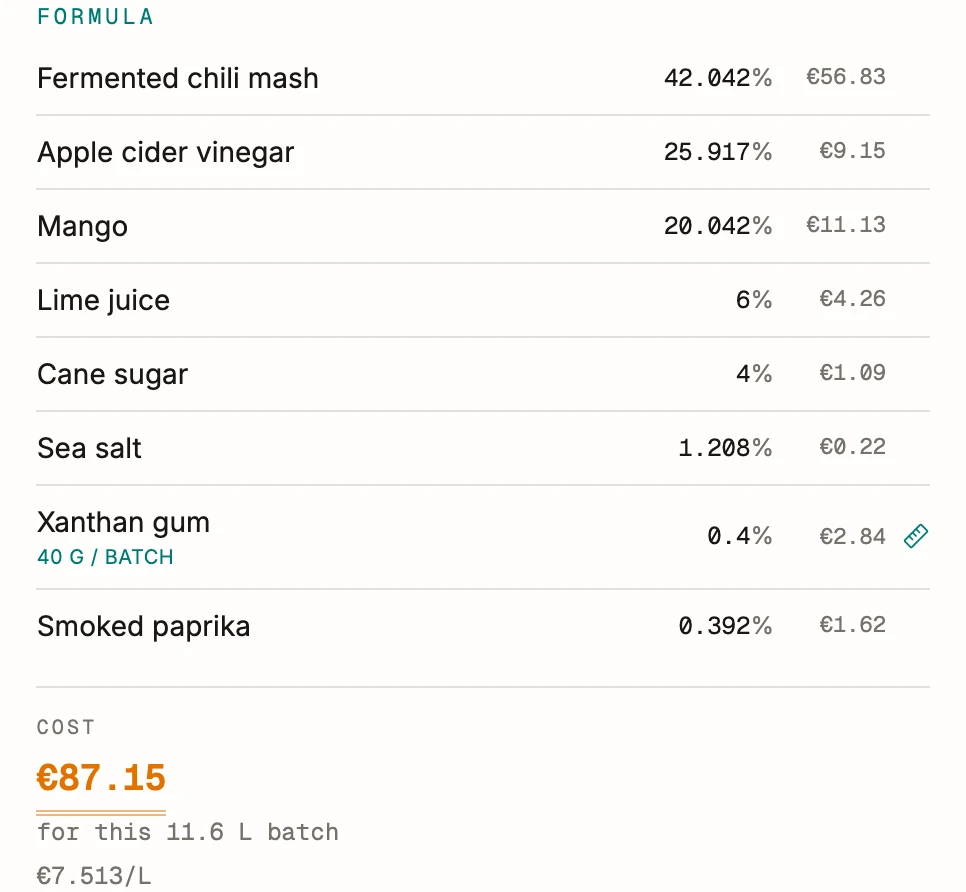
A bill of materials counts what goes into one unit. The formula on screen says what share of the batch each ingredient is: about a quarter cider vinegar, a fifth mango, and 42 % a fermented chili mash that is made in batches of its own, with 40 g of xanthan gum that stays put at any size. Ask for 11.6 liters and the panel prices it at €87.15, or €7.513 a liter.
- Shares are written the way the recipe was taught: a percentage of the whole, plain grams, or baker’s percent against the flour.
- Every line keeps its own scaling rule as the batch grows: in proportion, fixed per batch, per portion, or in whole steps.
- “2 liters of milk”, “6 eggs” and “the zest of 3 lemons” come out as the grams a scale weighs, through the milk’s density, what one egg weighs and the share of a lemon that is zest, each rounded to the step the scale can read.
- The chili mash is a recipe in its own right, made, stocked and traced in its own batches before the sauce draws on it.
A batch is measured, and its loss has a price
Katana
Katana calculates manufacturing costs “based on your BOMs, operations, and material usage” and compares planned against actual consumption for margin insight. Routings and manufacturing insights make up its Manufacturing Management add-on, at $199 a month on Core.
BatchDash
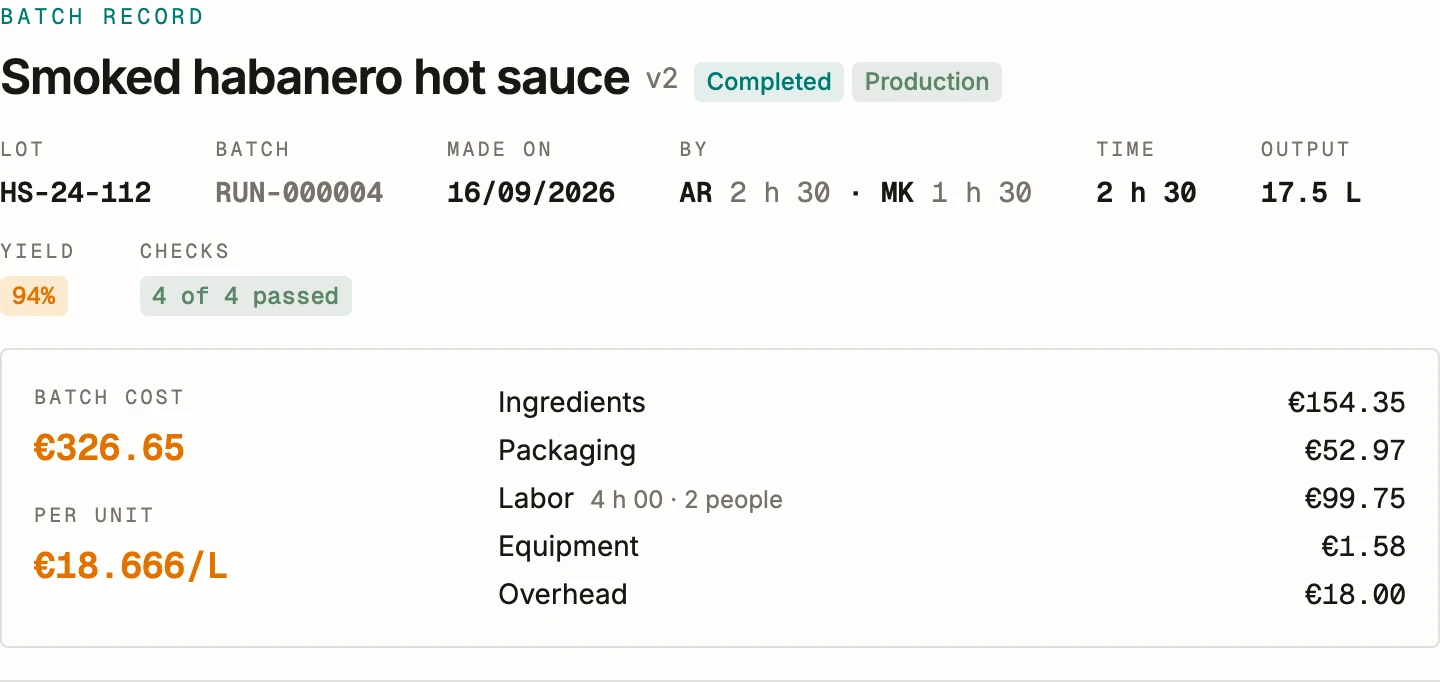
Batch RUN-000004 put 17.5 liters of sauce into jars, 94 % of what went into the kettle, with two people on it. Sealed, it cost €326.65, or €18.666 a liter, and the band beside it splits that total five ways, from €154.35 of ingredients drawn at their lots’ cost down to €1.58 for the equipment’s use.
- The 6 % lost between the kettle and the jars is spread over the price of each jar.
- The batch took 2 h 30 on the clock, and the payroll saw 4 hours: one person worked 2 h 30 and the other 1 h 30, each at their own rate.
- All four checks the recipe asks for were answered during the run and passed before the record was sealed.
A recall answered from the lot code up
Katana
Katana follows batch, lot and serial numbers “from supplier to sale”, with expiry dates, returns and audit-ready records. On the Core plan this is the Traceability add-on, at $249 a month.
BatchDash
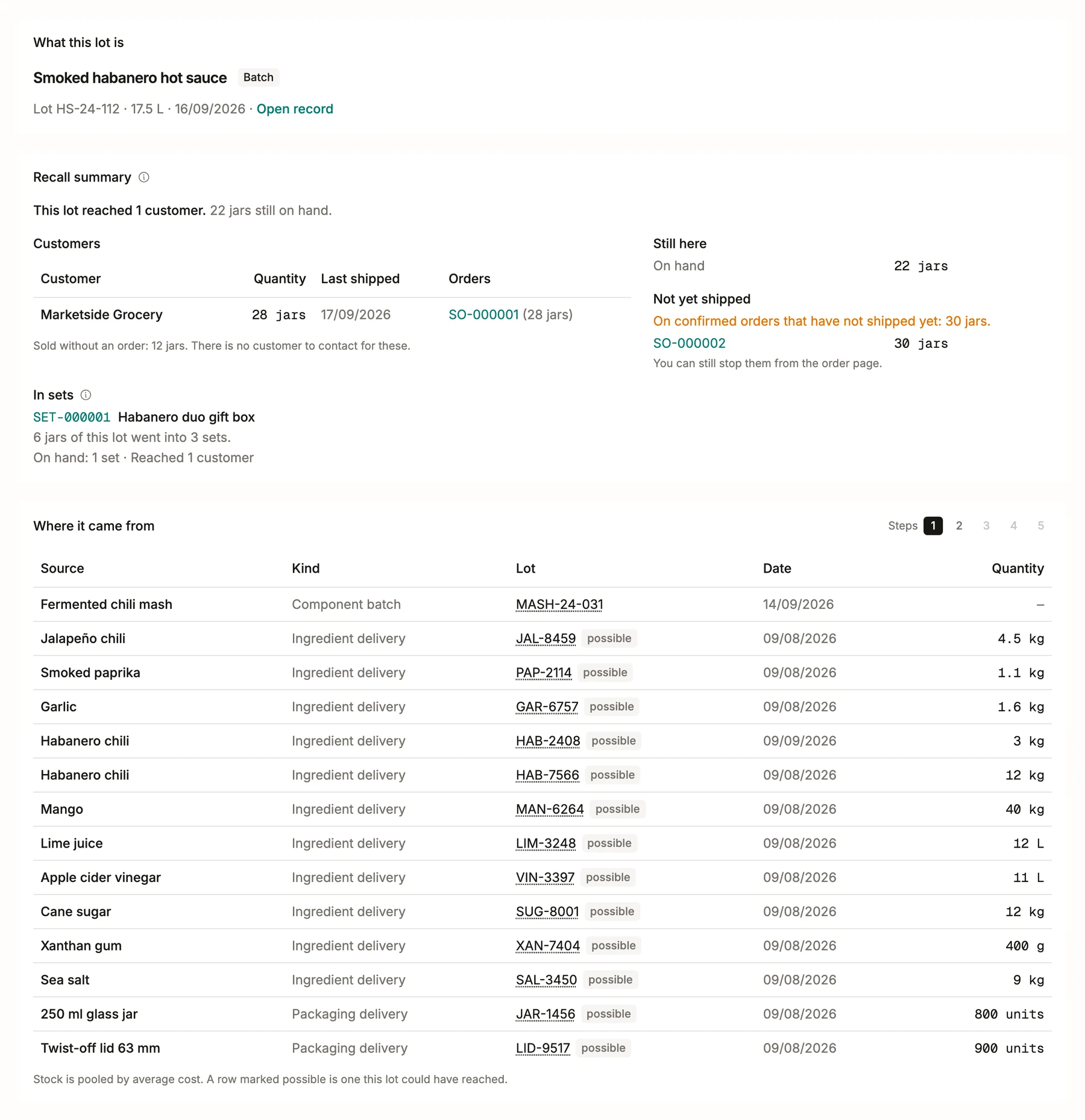
When a supplier calls about the chili in lot HS-24-112, one page answers what you need first: the customer who has it, 28 jars at Marketside Grocery on SO-000001; the order you can still hold, SO-000002 with 30 jars not yet shipped; and the 22 jars still on your shelves. Twelve jars sold without an order are counted too, marked as having nobody to call.
- Upstream, one source is certain: the chili mash batch MASH-24-031, drawn as a named lot. The deliveries of habanero, mango, vinegar and the rest read possible, since they sat in shared stock that could have reached this lot.
- Three Habanero duo gift boxes took six of its jars; the page follows them into the boxes and on to whoever bought one.
- The same page starts from a delivery’s lot code as well, and walks forward to every batch and customer it could have reached.
Every place you keep stock, down to the lot
Katana
Katana manages stock “in multiple sites, including partner locations”, with transfers between them. Core includes the first inventory location and charges for each one after it, by use, and storage bins, pick and pack and mobile receiving come with the Warehouse Management add-on, at $149 a month.
BatchDash
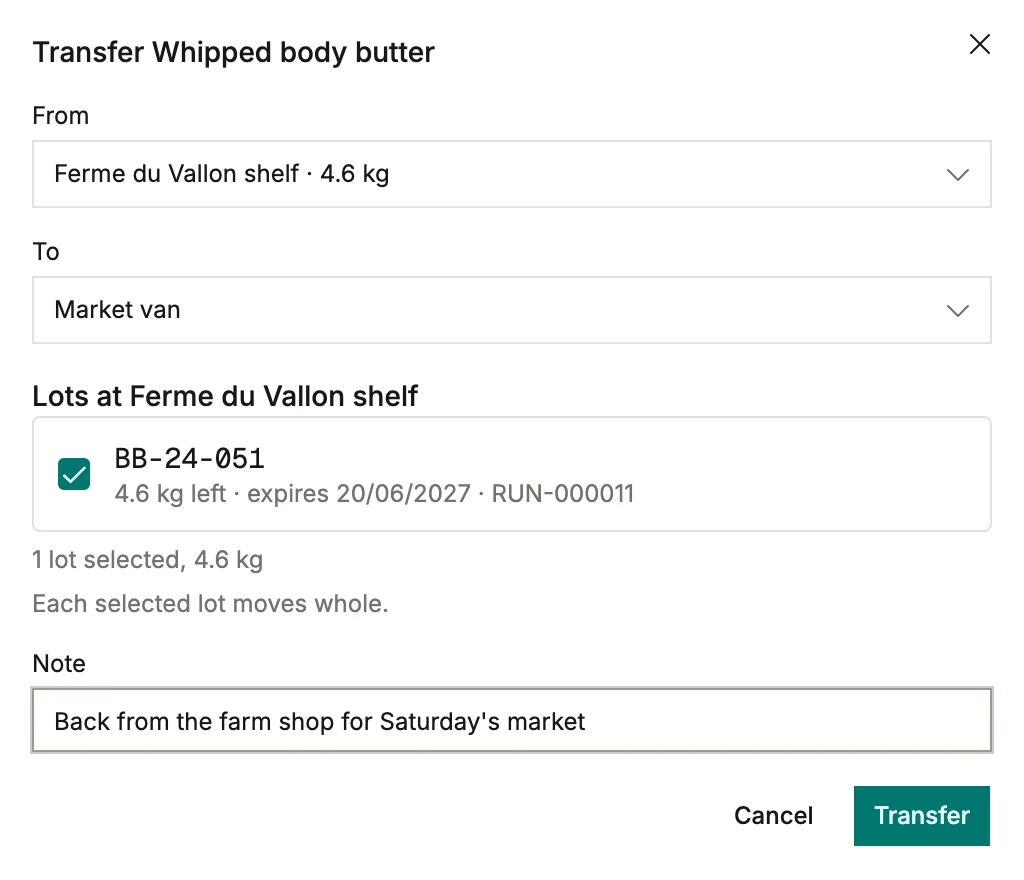
BatchDash keeps stock by place, however small the place. The demo workshop has four: the workshop itself, a walk-in fridge, the market van and a shelf at a farm shop holding whipped body butter on consignment. On screen, all 4.6 kg of lot BB-24-051 are leaving that shelf for the van: a finished lot moves whole, with its code, its date and the batch that made it, RUN-000011.
- Every ingredient and product page shows what sits in each place, and a count can cover one place at a time.
- A delivery lands in the place it is received into, and a batch draws from the place it runs in and books its lot there.
- When more leaves a shelf than was on it, the page says so and offers the two ways back: a transfer from another place, or a count.
Label data that comes out of the batch record
Katana
Katana generates batch and internal barcodes, and lets you customize printable PDF templates for all the documents it creates.
BatchDash
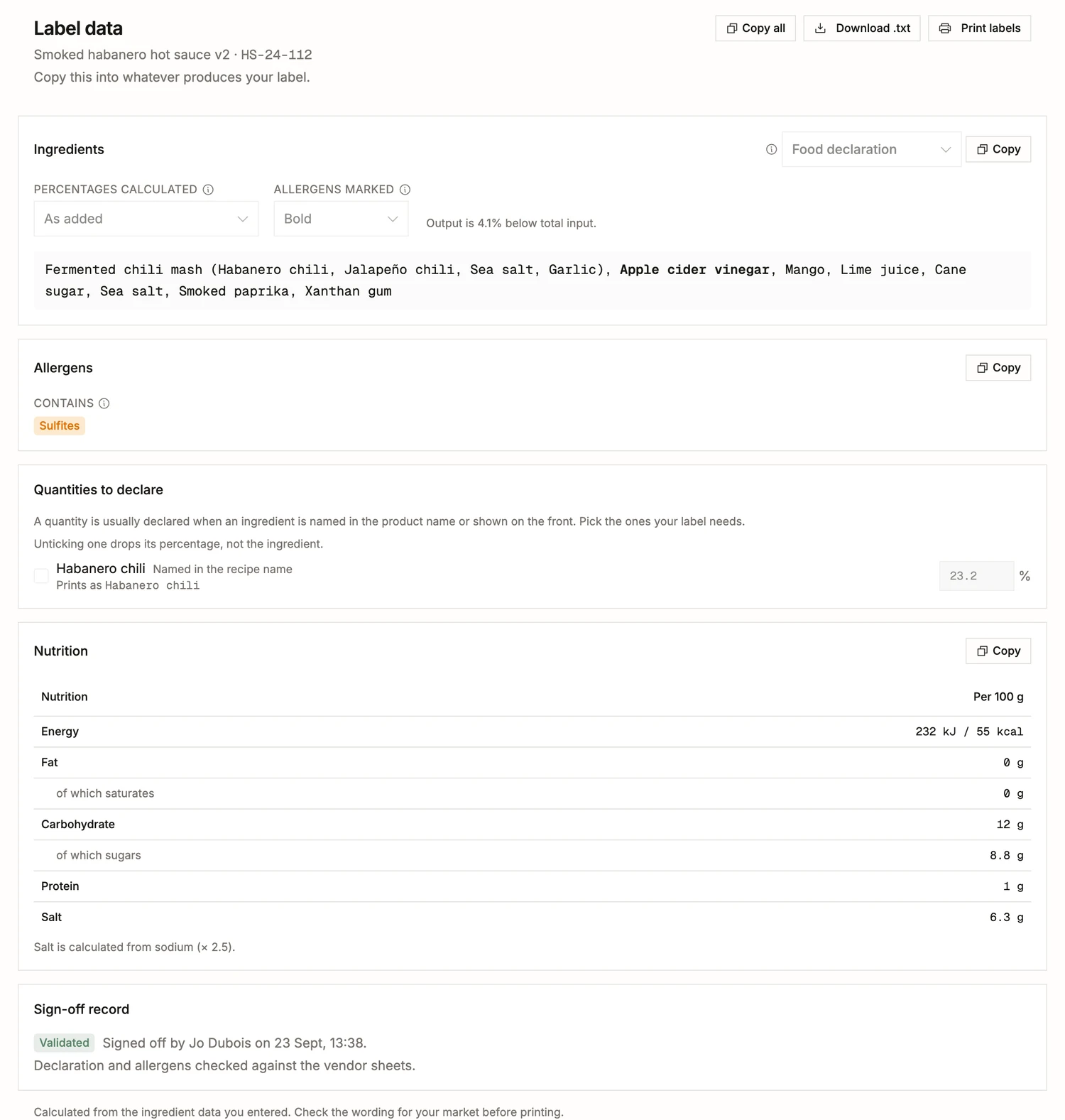
A jar called smoked habanero usually has to state how much habanero it holds. BatchDash works that out from the batch, chilis inside the fermented mash included: 23.2 % of the finished sauce. The rest of the label data comes from the same record, the ingredients in descending order, the cider vinegar in bold for its sulfites, which a Contains line repeats, and nutrition per 100 g, starting at 232 kJ and 55 kcal.
- Change the recipe tomorrow and this lot’s label stays put: what was signed off for HS-24-112 is what it keeps printing.
- Make a body butter instead and the batch hands you its INCI list, shea butter named once however many ingredients carry it, with the months it keeps once opened.
- Barcodes are chosen per label: UPC-A or EAN-13 for the shelf, and GS1-128 on the case with the lot and a date encoded in it.
What people weighing Katana ask us
- How is BatchDash different from Katana?
- Katana starts from inventory: stock on every channel and in every location, with production and purchasing around it, for makers of every kind. BatchDash starts from the batch: the formula, what each run drew and what it cost, for manufacturers who work from a recipe. It is the system batch manufacturers run on (recipes, costs, production, stock, and the records that prove each batch), and lot tracing, sites and label data come in its price.
- Who is better served by Katana?
- A business whose day is mostly moving stock through channels and warehouses: Shopify, Amazon and WooCommerce synced into one inventory, bins, pick and pack and a warehouse app, barcode scanning on the floor, forecasting, and an open API with a long list of integrations. Also a maker that assembles discrete products from parts, with routings and serial numbers. If your products start as a recipe, the sections above are where the two differ most.
- What does switching from Katana involve?
- Your ingredient list, suppliers and their prices, current stock with its lot codes, products and customers come in as spreadsheets, and each import shows every row before it writes anything. Recipes and bills of materials can be pasted in as text and checked line by line. Migration can also be taken on by our team; ask us about it. Moving off spreadsheets, step by step
- Is BatchDash an ERP?
- It covers what an ERP does for a batch maker, from the formula to the sales order: stock, buying, batches, costs, lots and labels. Like Katana, it leaves the books to your accounting software and keeps the figures they need ready. What it does not try to be is a general ERP for every kind of business, which is why it goes further on the batch.
- How do Katana’s add-ons compare with BatchDash’s price?
- Katana’s Core plan starts at $299 a month with one location. Delivered sales orders and each extra location are billed by use, traceability ($249), Manufacturing Management ($199) and Warehouse Management ($149) are monthly add-ons, and an optional onboarding package costs $2,000. BatchDash puts the everyday work in one price for the workspace, tracing, sites, label data and costing included, with nothing billed per order, per user or per place. For now an account opens on request: tell us what you make.
- Can BatchDash run several sites?
- Yes. Each place keeps its own stock, value and counts, from a second workshop to a fridge, a van or a consignment shelf in somebody else’s shop. Deliveries land where you receive them, batches draw from the place they run in, and a finished lot moves between places whole, with its code and dates.
- Does BatchDash work with Shopify?
- Yes. Orders are pulled from the shop on a schedule or on demand and arrive as confirmed sales orders that reserve their jars at once, with the buyer kept as a customer. BatchDash writes one figure back to the listings you map, what is available, and a batch waiting for its release check stays off sale until it is released. How the Shopify link works
- Can a manufacturer in the United States run on BatchDash?
- Yes. Open a workspace in dollars and it offers pounds, ounces and US gallons alongside metric units, costs every batch in dollars, and orders from each supplier in the currency they invoice, at a rate you book. Labels print UPC-A barcodes for US retail.