'%3e%3cg%20transform='matrix(0.737731,0,0,0.737731,1584.657279,93.052323)'%3e%3cg%20transform='matrix(1,0,0,1,-73.197369,-28.78343)'%3e%3cg%20transform='matrix(2.327683,0,0,2.327683,-115.888888,-940.785017)'%3e%3cpath%20d='M610.12,610.782L535.09,610.782L535.09,570.757L618.413,570.757L610.12,610.782ZM628.935,570.757L697.713,570.757C709.523,570.757%20720.131,571.523%20729.536,573.054C738.94,574.585%20746.923,577.373%20753.485,581.42C760.046,585.466%20765.077,591.043%20768.576,598.151C772.076,605.26%20773.825,614.391%20773.825,625.545C773.825,632.107%20772.841,638.504%20770.873,644.737C768.904,650.971%20766.006,656.548%20762.179,661.469C758.351,666.39%20753.758,670.491%20748.4,673.772C743.041,677.052%20736.863,679.13%20729.864,680.005L729.864,680.661C741.018,683.723%20749.603,689.574%20755.617,698.213C761.632,706.852%20764.639,716.858%20764.639,728.231C764.639,740.917%20762.179,752.071%20757.258,761.695C752.337,771.318%20745.721,779.301%20737.409,785.644C729.098,791.987%20719.584,796.798%20708.867,800.079C698.15,803.36%20686.886,805%20675.076,805L580.368,805L581.484,799.615L609.457,665.57L687.543,665.57C696.947,665.57%20705.094,663%20711.984,657.86C718.873,652.72%20722.318,645.011%20722.318,634.731C722.318,625.545%20719.858,619.257%20714.937,615.867C710.015,612.477%20703.399,610.782%20695.088,610.782L620.636,610.782L628.935,570.757ZM638.101,764.975L672.779,764.975C684.59,764.975%20694.268,761.804%20701.814,755.461C709.359,749.119%20713.132,739.714%20713.132,727.247C713.132,721.123%20711.875,716.312%20709.359,712.812C706.844,709.313%20703.618,706.633%20699.681,704.774C695.744,702.915%20691.37,701.767%20686.558,701.33C681.747,700.892%20677.044,700.673%20672.451,700.673L651.88,700.673L638.101,764.975Z'%20style='fill:rgb(25,23,20);'/%3e%3c/g%3e%3cg%20transform='matrix(1,0,0,1,0,220.238764)'%3e%3cpath%20d='M1259.334,480.922L1129.63,480.922L1129.63,387.757L1278.681,388.212L1259.334,480.922Z'%20style='fill:rgb(0,120,111);'/%3e%3c/g%3e%3cg%20transform='matrix(1,0,0,1,0,452.077913)'%3e%3cpath%20d='M1210.953,480.922L1129.63,480.922L1129.63,387.757L1230.395,387.757L1210.953,480.922Z'%20style='fill:rgb(0,120,111);'/%3e%3c/g%3e%3cg%20transform='matrix(1,0,0,1,0,336.158338)'%3e%3cpath%20d='M1235.144,480.922L1129.63,480.922L1129.63,387.757L1254.586,387.757L1235.144,480.922Z'%20style='fill:rgb(0,120,111);'/%3e%3c/g%3e%3c/g%3e%3c/g%3e%3c/g%3e%3c/svg%3e)
Know your margin before the batch, and prove it after.
Margins rarely die in one blow. A delivery lands 8% higher, the yield slips two points, a box of jars gets pricier, and the spreadsheet keeps quoting the plate at last spring’s numbers. The morning you finally recompute it, the money has been gone for months.
BatchDash computes every cost from the prices you actually paid, and recomputes the moment any of them moves. The figure on the recipe is the figure in your accounts, every day, without anyone opening a spreadsheet.
Built from receipts, defensible line by line
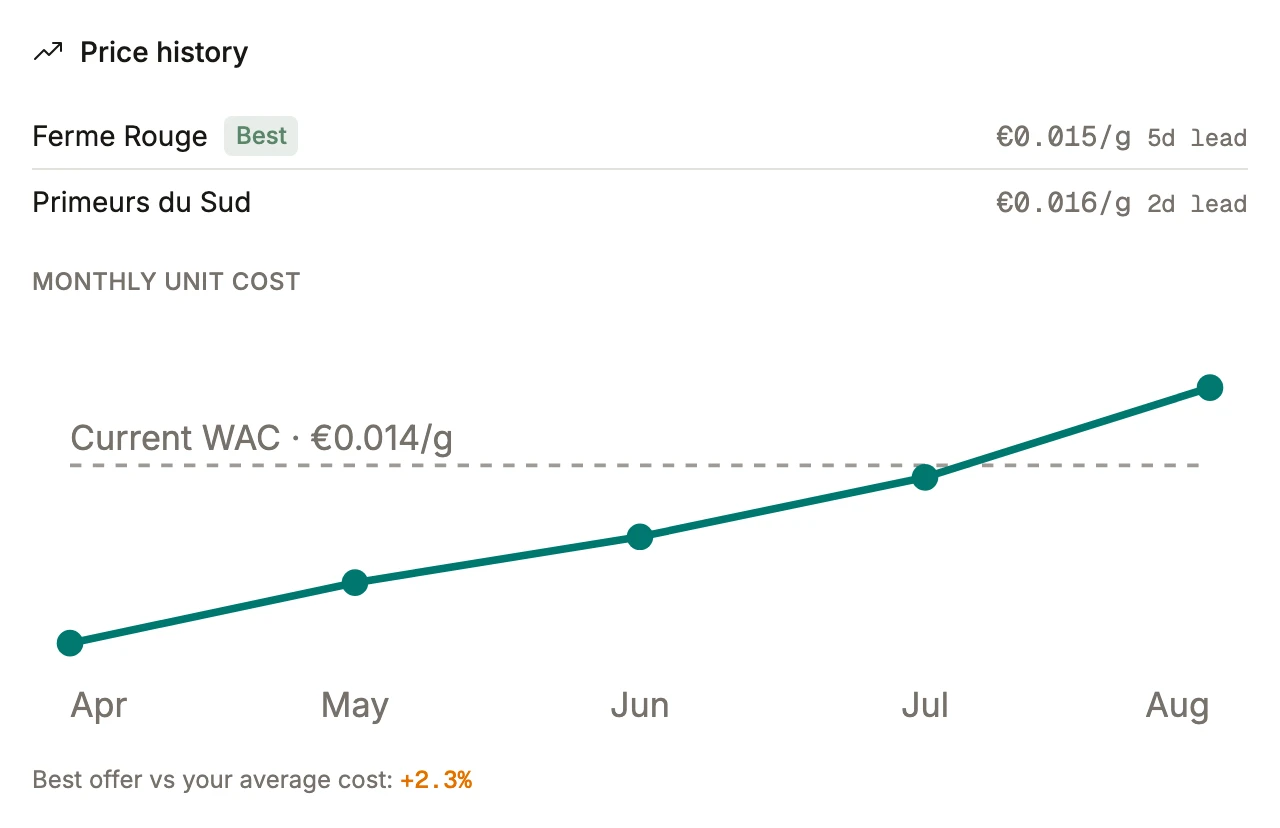
Every ingredient carries the weighted average of your real deliveries, with delivery and platform fees folded in, recomputed at every receipt. Under that figure sits the trail it came from: what each delivery cost, what each vendor quotes today and how long they take, and how far the best offer sits from what you are currently paying. Chilis at €0.014 a gram against a best offer of €0.015 means the next delivery will push the average up, and you can see it coming.
Every figure opens into the lines under it
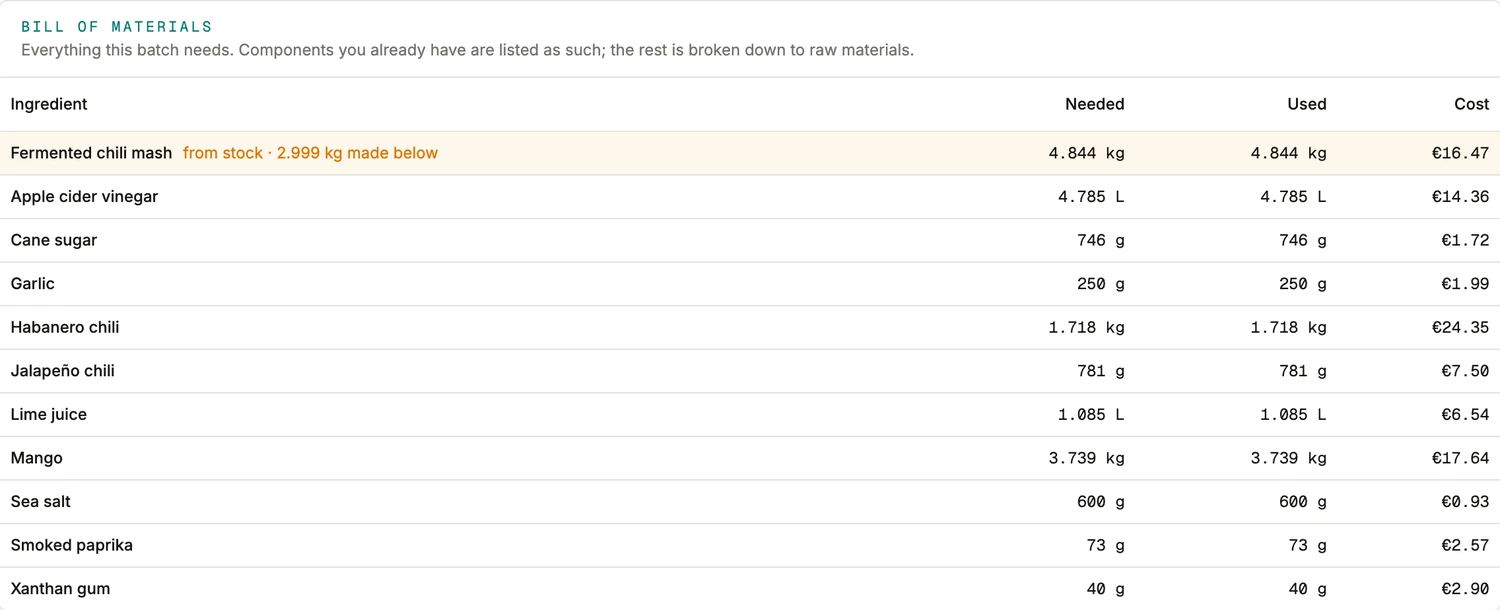
A recipe cost is the sum of what its lines truly cost, sub-formulas expanded, each priced from its own deliveries. A batch shows what it needed, what actually went in, and what that came to, ingredient by ingredient. A component you made last week is priced at what that batch cost, rather than re-derived from chilis bought at a different price six weeks ago. When your accountant, your bank or your co-founder asks where €4.67 a jar comes from, the answer is a click, and the answer holds.
In the unit you sell, with the whole truth in it
A cost is only useful in the unit you price in. BatchDash answers per plate, per jar, per liter or per 100 g, with the parts a quick estimate always forgets:
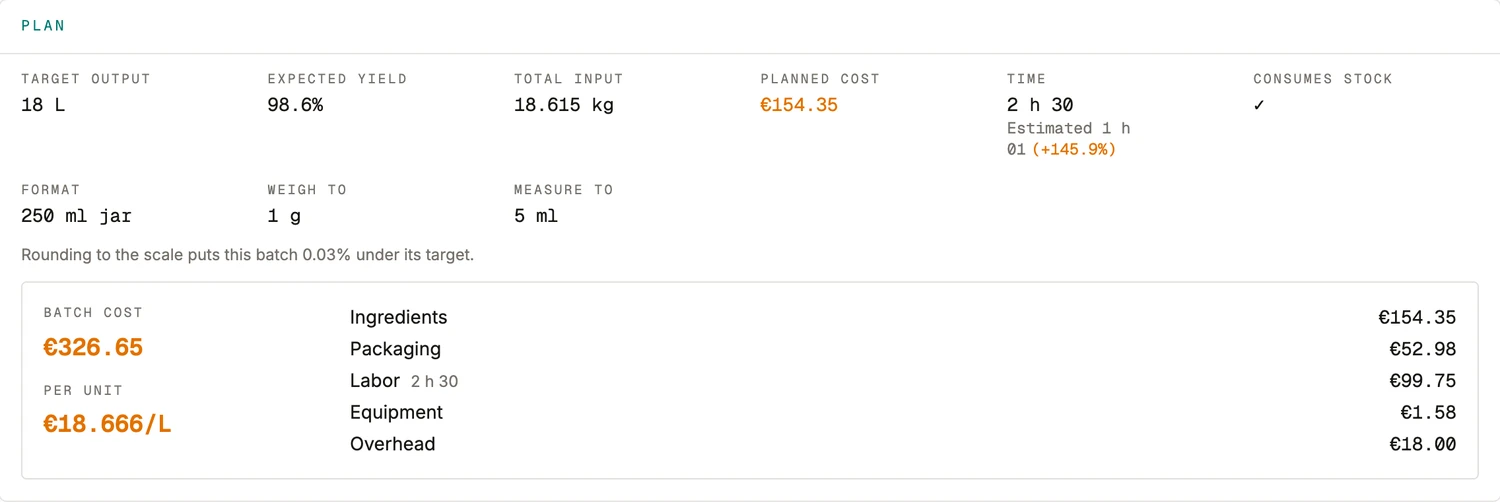
- The yield: a 92% batch means the jar carries the 8% that evaporated.
- The packaging set: jar, lid and printed label join the unit cost per piece.
- Labor at recorded minutes and each operator’s rate, when you switch the full model on. The batch above took 2 h 30 against an estimate of 1 h 01, and the cost says so.
- Equipment amortization and overhead, spread over the batches that actually used them.
You paid for the whole lemon
Plenty of what you buy never gets into the product, and a percentage column cannot see any of it. BatchDash costs an ingredient as bought and divides by what survives, so both losses land on the figure instead of on you at the end of the quarter.
- An ingredient with parts costs what the whole thing costs. Ask for 63 g of zest and you have paid for 18.5 lemons, and the jar carries all of them.
- A batch that has to round up to six whole eggs is costed at six, because that is what left the fridge.
- Yield sits in the divisor twice: once for what an ingredient loses on the board, once for what the batch loses on the heat.
Then set the price with the cost in front of you
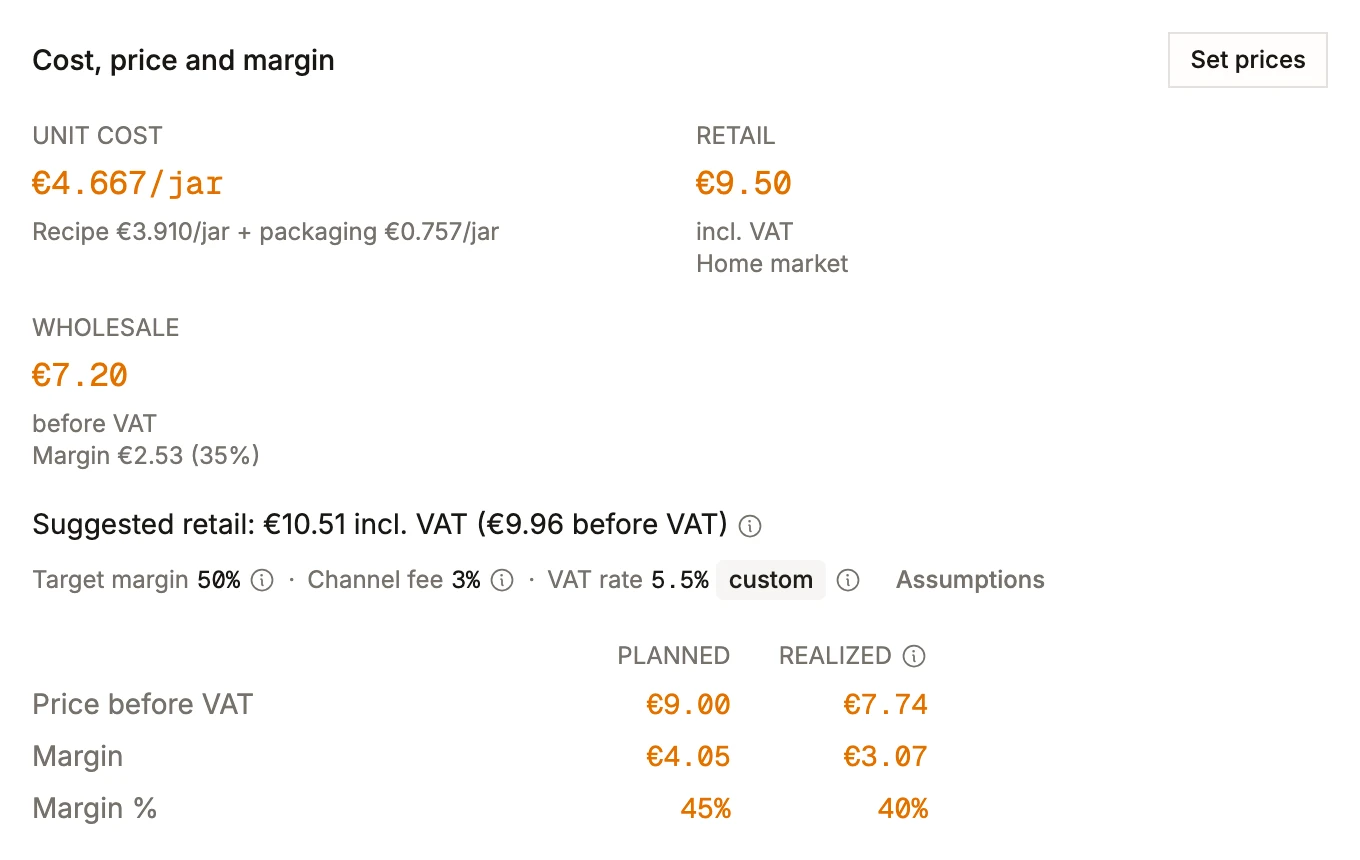
Each format carries a retail price, VAT included, and a wholesale price, before VAT. Under them, one sentence suggests a retail price from the true unit cost, your target margin, the fee your channel takes and your VAT rate. You still type the price; the card tells you what it should earn, and what recorded sales actually earned, both before VAT.
- A 3% marketplace fee is taken on what the customer pays, VAT included, so the suggestion counts it that way.
- Defaults live in your settings; any product overrides them, so jam at 5.5% VAT and soap at 20% share one workspace.
- Planned beside realized: a jar that should have earned 45% and earned 40% says so on the page you price from.
Buy in dollars, keep the books in euros
Your suppliers invoice in their currency and your accounts are in yours. Each vendor carries the currency it bills in, each order shows the rate it was booked at, and you can replace that rate with the amount your bank actually took: every line is then restated to the cent, with a row in the ledger saying what moved. Offers from three countries compare at today’s reference rate, fetched daily, so the cheapest one is the cheapest one. VAT works the same way. Say whether your business recovers it, type what the invoice printed, and the cost that reaches your average is the cost you actually bear.
One price moves, every affected recipe follows
Book a delivery at a new price and the weighted average shifts, the mash re-costs, the three sauces on it re-cost, and the jar’s margin updates, all before you have put the invoice down. At the end of the month the reports read off the same figures: what the units you sold cost to make, which batches came in over their plan, what the shelves are worth today. That is the difference between costing as a quarterly cleanup and costing as something the system keeps true.