'%3e%3cg%20transform='matrix(0.737731,0,0,0.737731,1584.657279,93.052323)'%3e%3cg%20transform='matrix(1,0,0,1,-73.197369,-28.78343)'%3e%3cg%20transform='matrix(2.327683,0,0,2.327683,-115.888888,-940.785017)'%3e%3cpath%20d='M610.12,610.782L535.09,610.782L535.09,570.757L618.413,570.757L610.12,610.782ZM628.935,570.757L697.713,570.757C709.523,570.757%20720.131,571.523%20729.536,573.054C738.94,574.585%20746.923,577.373%20753.485,581.42C760.046,585.466%20765.077,591.043%20768.576,598.151C772.076,605.26%20773.825,614.391%20773.825,625.545C773.825,632.107%20772.841,638.504%20770.873,644.737C768.904,650.971%20766.006,656.548%20762.179,661.469C758.351,666.39%20753.758,670.491%20748.4,673.772C743.041,677.052%20736.863,679.13%20729.864,680.005L729.864,680.661C741.018,683.723%20749.603,689.574%20755.617,698.213C761.632,706.852%20764.639,716.858%20764.639,728.231C764.639,740.917%20762.179,752.071%20757.258,761.695C752.337,771.318%20745.721,779.301%20737.409,785.644C729.098,791.987%20719.584,796.798%20708.867,800.079C698.15,803.36%20686.886,805%20675.076,805L580.368,805L581.484,799.615L609.457,665.57L687.543,665.57C696.947,665.57%20705.094,663%20711.984,657.86C718.873,652.72%20722.318,645.011%20722.318,634.731C722.318,625.545%20719.858,619.257%20714.937,615.867C710.015,612.477%20703.399,610.782%20695.088,610.782L620.636,610.782L628.935,570.757ZM638.101,764.975L672.779,764.975C684.59,764.975%20694.268,761.804%20701.814,755.461C709.359,749.119%20713.132,739.714%20713.132,727.247C713.132,721.123%20711.875,716.312%20709.359,712.812C706.844,709.313%20703.618,706.633%20699.681,704.774C695.744,702.915%20691.37,701.767%20686.558,701.33C681.747,700.892%20677.044,700.673%20672.451,700.673L651.88,700.673L638.101,764.975Z'%20style='fill:rgb(25,23,20);'/%3e%3c/g%3e%3cg%20transform='matrix(1,0,0,1,0,220.238764)'%3e%3cpath%20d='M1259.334,480.922L1129.63,480.922L1129.63,387.757L1278.681,388.212L1259.334,480.922Z'%20style='fill:rgb(0,120,111);'/%3e%3c/g%3e%3cg%20transform='matrix(1,0,0,1,0,452.077913)'%3e%3cpath%20d='M1210.953,480.922L1129.63,480.922L1129.63,387.757L1230.395,387.757L1210.953,480.922Z'%20style='fill:rgb(0,120,111);'/%3e%3c/g%3e%3cg%20transform='matrix(1,0,0,1,0,336.158338)'%3e%3cpath%20d='M1235.144,480.922L1129.63,480.922L1129.63,387.757L1254.586,387.757L1235.144,480.922Z'%20style='fill:rgb(0,120,111);'/%3e%3c/g%3e%3c/g%3e%3c/g%3e%3c/g%3e%3c/svg%3e)
Batch manufacturing software, from the formula to the lot trail.
One system for the work between a recipe and a shipped case: formulas, ingredients, purchasing, production batches, real costs and lot traceability. Written for food, drink and cosmetics manufacturers who make in batches.
Software built for assembly counts parts. This weighs ingredients, scales a recipe by ratio, records what the batch actually yielded, and holds the trail from the delivery that fed it to the customer who bought it. You cannot take a sauce apart, so the record has to hold.
Where the binder and the stock sheet run out
None of these is a reporting problem. Each one is a question about a single batch, asked by somebody already waiting on the phone.
A customer names a jar and a date, and nobody knows which delivery of fruit is inside it.
One code opens the trail both ways, and every row on it is a record.
The mango price has doubled since anyone last looked at what the jar sells for.
A delivery moves the weighted average, and every formula on it is recosted that day.
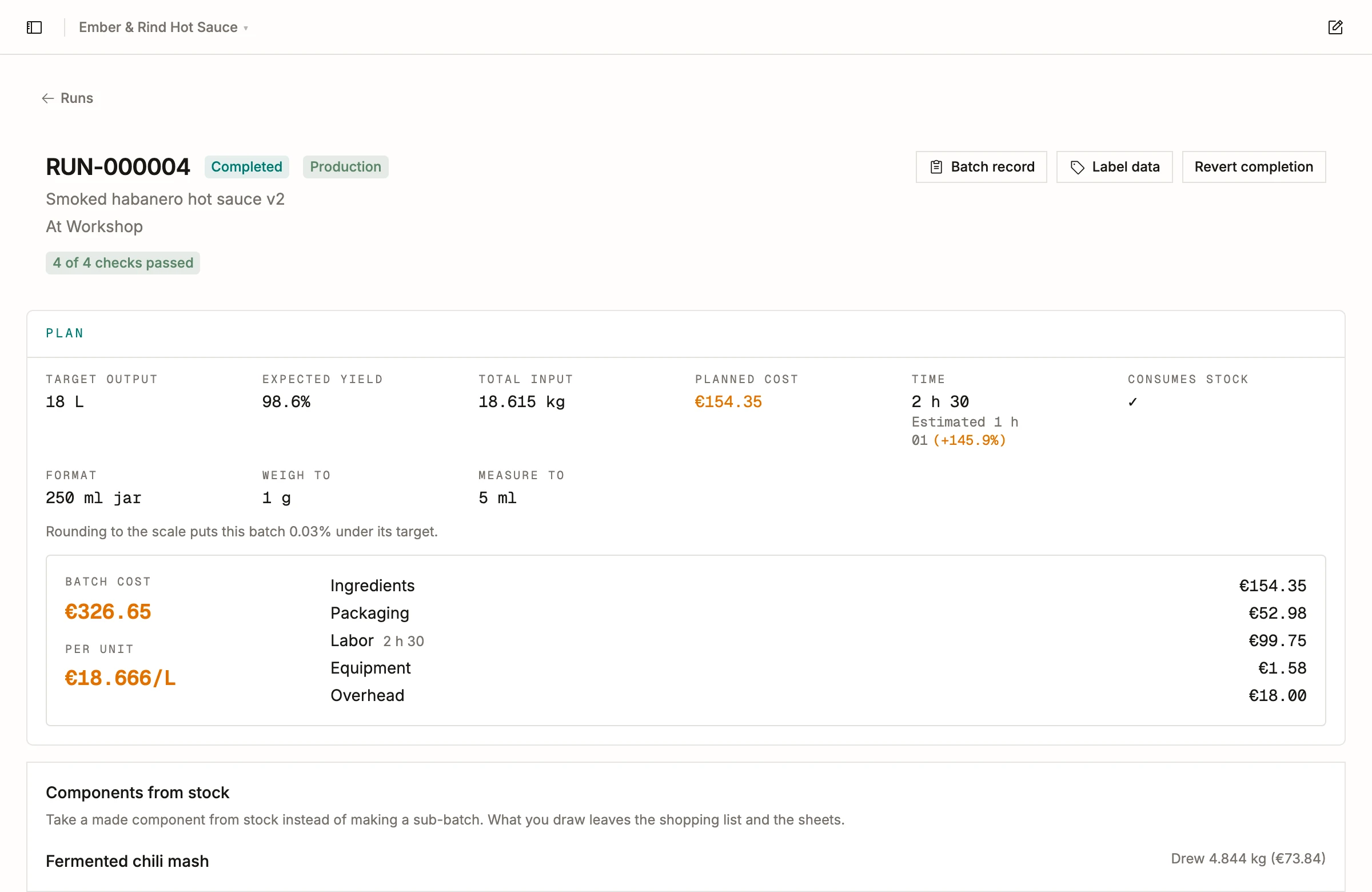
Production runs off a printed sheet, and what really happened is in handwriting on it.
The sheet is the record: quantities drawn, readings taken, and who took them.
An auditor asks for the file on one batch, and putting it together takes two days.
It sealed itself when the batch closed, version and lots and checks included.
Write the formula once, and cost it from what you paid
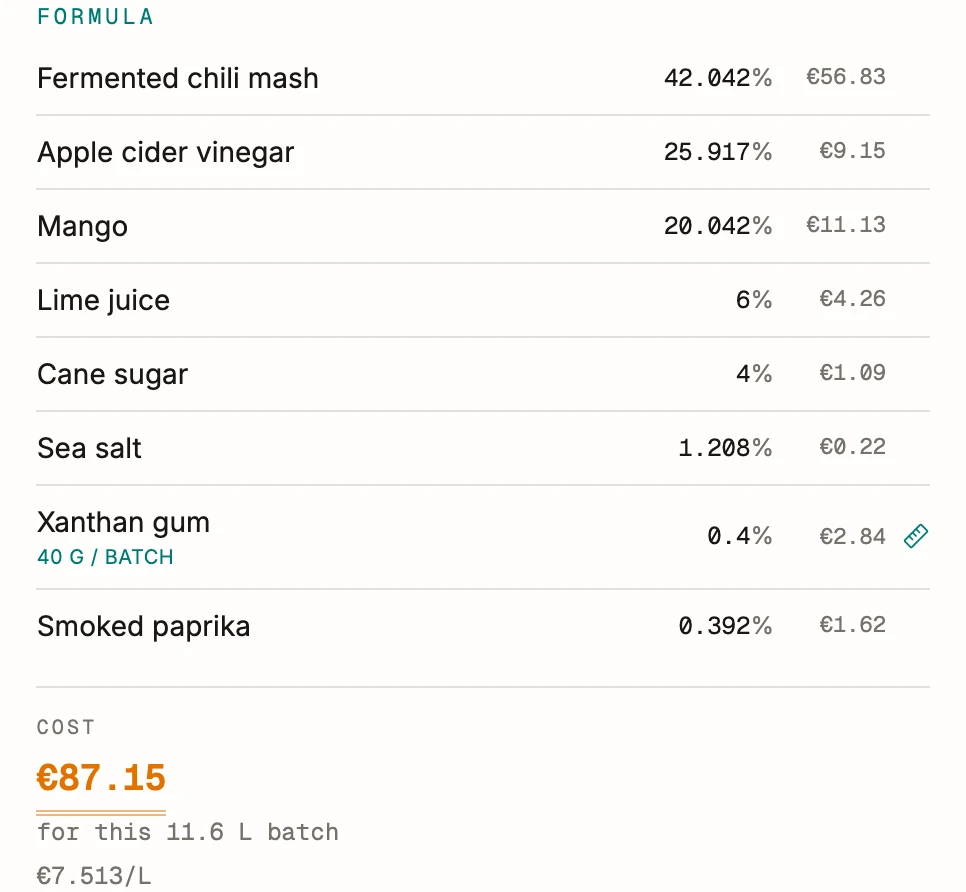
A formula is a set of proportions, so it scales by ratio instead of being retyped per size. Phases, steps and their parameters sit on it, and a version you have already produced against is frozen where it stands. The first line of this sauce is not an ingredient at all: it is 42 % of a fermented mash, a formula of its own with its own batches behind it.
- Every line carries what it costs at today's weighted average, freight and duty included. The panel totals €87.15 for the 11.6 liter batch on screen, which is €7.513 a liter.
- A price that moves recosts every formula drawing on it the same day, so the margin on screen is the one you are making.
- Not everything scales. The xanthan gum is 40 g a batch whatever the batch is, and it is costed that way. A cosmetic, already written in percentages, needs the same arithmetic.
Know what is short before the week starts
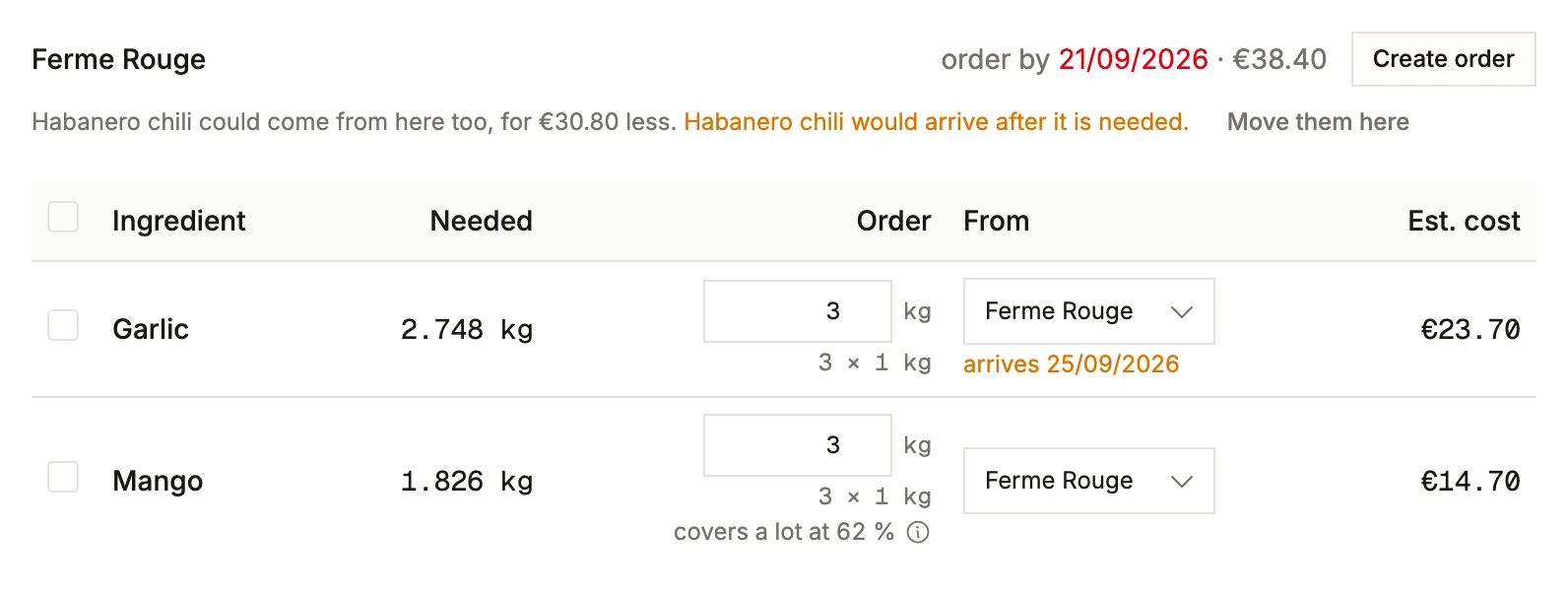
This is the calculation an MRP does, in recipe terms. Take the batches you have put on the week, break each one down to raw ingredients through as many sub-formulas as it takes, subtract what is on the shelf, and what is left is the order to place and the day it has to go out.
- The subtraction is against Available, so stock already held for another order is never offered twice.
- What is short arrives grouped by the vendor who has to be asked, rounded up to what they actually sell: 1.826 kg of mango becomes three one-kilo bags.
- Lead times are in the arithmetic. The card carries the last day the order can go out, and says so in amber when a line would land after the batch needs it.
Every batch leaves a signed record and a real cost
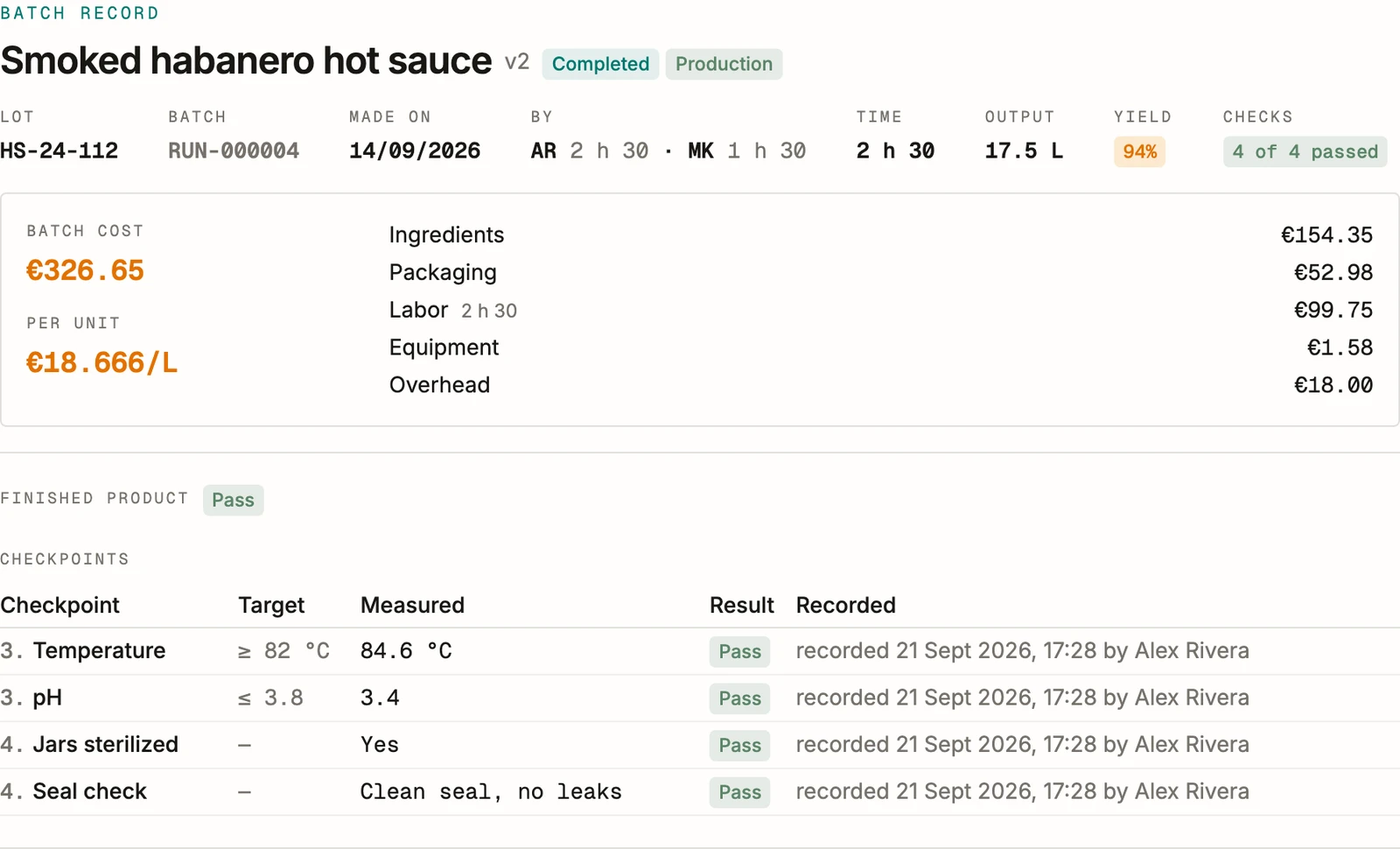
The run sheet is the recipe at this batch's size. Quantities drawn, readings taken, equipment used and the time two people spent are captured at the bench, and a checkpoint left unanswered keeps the batch open. Completing it books the output into stock under a lot code and seals the record.
- A batch planned at 18 liters that gives 17.5 is a 94 % yield, and that loss is priced into every jar rather than written off somewhere else.
- €326.65 in five parts: ingredients at the cost of the lots actually drawn, packaging, labor from the time recorded, equipment by the minutes it ran, overhead by your own rule.
- Every check carries its target, its reading, its result and the person who took it. A pH of 3.4 against a ceiling of 3.8, signed and timed, is what an auditor is asking to see.
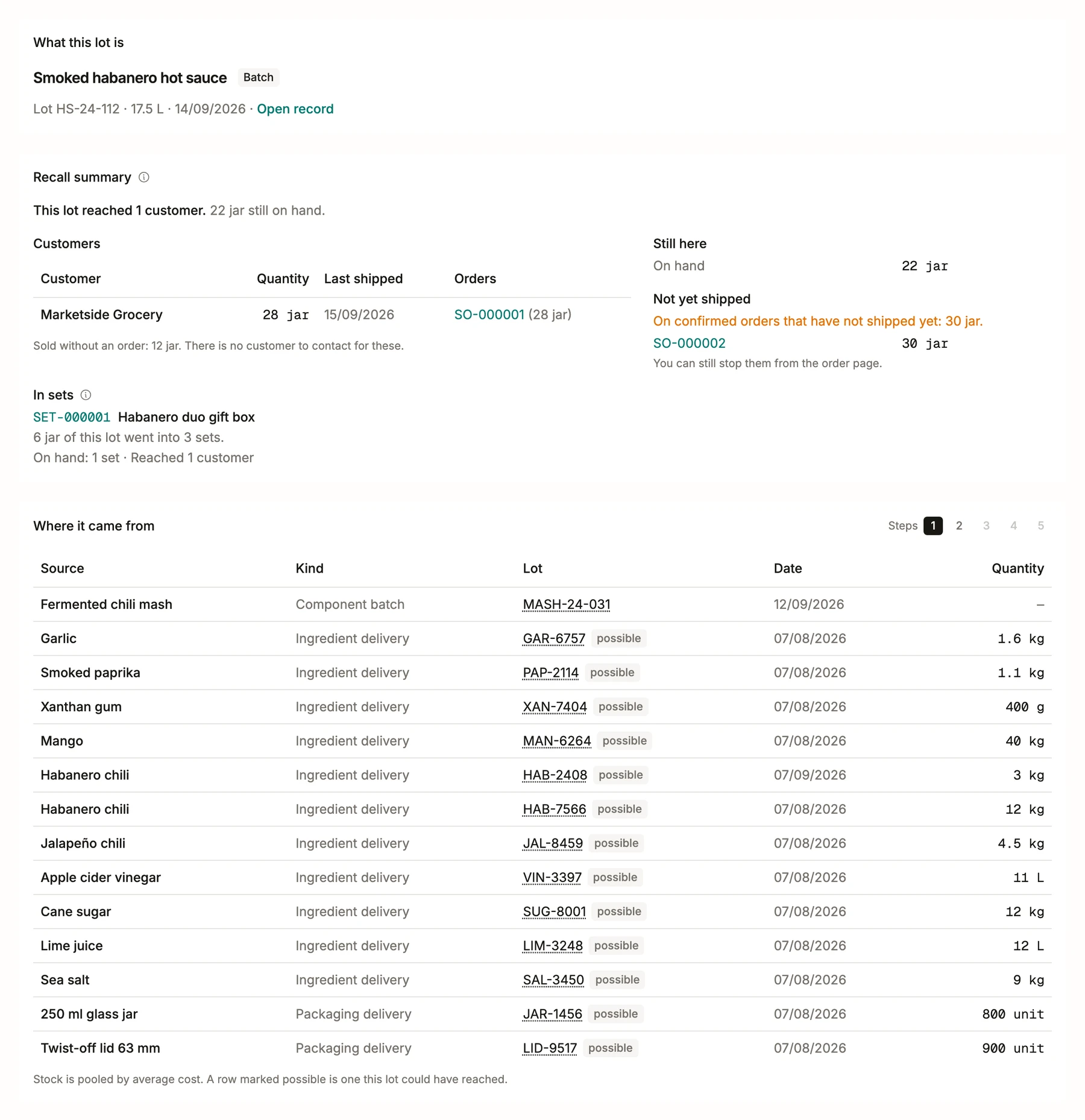
One code, and the trail opens both ways
A shop calls on a Tuesday about one jar. Type the lot code off its label and the batch names itself: smoked habanero hot sauce, 17.5 liters, its record one click away. Then the trail opens in both directions. A BRCGS traceability test allows four hours to get this far, mass balance included; here it takes as long as typing the code.
- Forward, nothing is in doubt. 28 jars went to one named shop on order SO-000001, 6 into three gift boxes traced as a lot of their own, 22 are still on your shelf.
- Then the two answers that are hardest to get in a hurry: 30 jars are on a confirmed order that has not shipped, and you can still stop them; 12 were sold without an order, so there is nobody to call, and the screen says so rather than letting you find out.
- Backward is the honest part. The fermented mash reads certain, because the batch drew it as a named lot. The thirteen pooled deliveries under it read possible, the mango among them. Record the lot you actually opened and a maybe becomes a proof.
- Every figure on that screen is a movement in the ledger rather than a count somebody made afterwards, which is why the quantities reconcile when an auditor asks for the mass balance beside the walk.
Who it is for
If you make from a recipe, in batches, and what comes out cannot be taken apart again, this is your work. It goes deepest where a label and a lot code are legal obligations, which is food, beverage and cosmetics.
Supplements, home care, candles, paint and pet food are the same job under a different label: a formula, a batch, a lot code, a declaration to print. What decides it is the shape of the work, never the aisle the product ends up in.
Compared with a spreadsheet and a general ERP
Those are the two things this gets weighed against. Here is what each of them does with a formula, a batch and a lot code.
A formula in percentages, with a recipe inside it
- A spreadsheet
- Cells and care. It holds until the batch size changes, or until one recipe has to go inside another.
- A general ERP
- Usually a bill of materials in fixed quantities. Several have a recipe or process module; how it handles percentages and a recipe inside a recipe varies by system.
- BatchDash
- The native shape: percentages, phases, parameters, a recipe inside a recipe, and a version frozen the moment you produce against it.
What a batch actually cost
- A spreadsheet
- A fixed price per ingredient, updated when somebody remembers.
- A general ERP
- Standard, average or actual costing, chosen at setup. A batch’s labor and overhead come in once work centers, routings and rates are configured.
- BatchDash
- The weighted average your own deliveries moved it to, landed cost inside the figure, recosted the day a price moves. The batch adds its packaging, the labor from the time recorded and overhead by your own rule.
Yield, and the loss that comes with it
- A spreadsheet
- A factor you multiply by, if anyone updates it.
- A general ERP
- Usually a planned scrap or yield percentage on the item or the recipe. The actual output is reported on the production order and surfaces as a variance.
- BatchDash
- Measured on the batch in front of you: 18 liters planned, 17.5 out, 94 %, and the loss priced into every jar.
A lot trail you can put in front of an auditor
- A spreadsheet
- A column of lot numbers, and a morning of filtering per question.
- A general ERP
- Lot tracking is native in many of them, sometimes in depth. How far a trace reaches follows the modules you license.
- BatchDash
- One screen from either end with a mass balance, saying certain where it can prove it and possible where it cannot.
Finding out whether it fits
- A spreadsheet
- You are already finding out, one surprise at a time.
- A general ERP
- Some can be tried on your own; most start with a demo, a discovery call and a quote. Your own recipes appear once it is set up for this work.
- BatchDash
- A free trial on the self-serve plans, on your own recipes and your own prices. For a larger setup, somebody from the team onboards you.
A spreadsheet knows nothing about this work. A general ERP knows manufacturing in general, and gets taught yours during an implementation. BatchDash was written for one kind of work: making from a formula, in batches, with the costs and the lot trail that come out of it. Everything on this page is there on the first afternoon.
Questions buyers ask
- What is batch manufacturing software?
- Software for making a fixed quantity of one product at a time from a recipe: 20 liters of sauce, 5 kilos of body butter, 200 jars of marmalade. It holds the formula, the ingredients and what they cost, the batch that consumed them, what that batch yielded, and the lot code tying the finished goods back to the deliveries behind them. The batch is the unit everything else attaches to, and that is what separates it from software written for assembly or for continuous production.
- Is this an ERP or an MRP?
- It does what an MRP does, for formulas instead of parts: it works out what to buy and when, from what you hold and what you are about to make. Then it follows the batch the whole way: developing the formula, buying the ingredients, running production with its checks, what the batch really cost, the label, the sales order and the lot trail. Finance, HR and payroll are what make something an ERP, and none of that is here.
- Does it do formula version control?
- Yes, and the rest of the system leans on it. Every version is kept and stays costed, branching from one is how a trial starts, and planning a batch freezes the version it will follow, so the finished record carries its own copy. Edit the recipe today and today’s batches follow the new version, while the sealed records stay exactly as they were signed.
- Can we run a traceability test or a mock recall from it?
- That is the exercise it is built around. From a lot code, or from a supplier’s own delivery code, one screen names what came in, the batches that drew on it, the batches those fed, and the sales that shipped, each row opening onto its record. The quantities reconcile because every one is a movement in the ledger, which is the mass balance an auditor asks for alongside the walk, cold and inside a few hours.
- Can it tell us what we actually make on a jar?
- That is the point of costing from deliveries rather than from a price list. A finished product carries the cost of the batch behind it, its packaging and its labor, and beside that the price you sell it at, retail and wholesale, with the margin on each. Move a vendor price and every one of those figures moves the same day, which is while there is still time to change what you charge.
- Does it replace our accounting?
- No, and it does not try to. This is the manufacturing subledger: what a batch cost, what a movement was worth, what a sale drew off the shelf. Connectors are how it meets the rest of what you run: a Shopify store connects, and the figures a bookkeeper needs come out as files, whether the books live in QuickBooks, in Xero or in a spreadsheet. What you get here that an accounting package cannot give you is the cost and the margin of one batch, one jar or one wholesale line, on the prices you actually paid.
- How do we start, and what does it cost?
- You can start on your own: sign up, load your own recipes and your own vendor prices, and nobody has to talk to you first. Plans that carry a trial say so on their card. For a larger setup, somebody from the team runs the onboarding with you.
- Does it handle cosmetics as well as food and drink?
- All three, in one system. An ingredient carries its INCI name, its CAS number and its allergens beside the food fields; a cosmetic formula is written in percentages, which is how this works anyway; and the declaration prints off the batch that filled the jar, in descending order, with a sub-formula broken out into what it is made of.