'%3e%3cg%20transform='matrix(0.737731,0,0,0.737731,1584.657279,93.052323)'%3e%3cg%20transform='matrix(1,0,0,1,-73.197369,-28.78343)'%3e%3cg%20transform='matrix(2.327683,0,0,2.327683,-115.888888,-940.785017)'%3e%3cpath%20d='M610.12,610.782L535.09,610.782L535.09,570.757L618.413,570.757L610.12,610.782ZM628.935,570.757L697.713,570.757C709.523,570.757%20720.131,571.523%20729.536,573.054C738.94,574.585%20746.923,577.373%20753.485,581.42C760.046,585.466%20765.077,591.043%20768.576,598.151C772.076,605.26%20773.825,614.391%20773.825,625.545C773.825,632.107%20772.841,638.504%20770.873,644.737C768.904,650.971%20766.006,656.548%20762.179,661.469C758.351,666.39%20753.758,670.491%20748.4,673.772C743.041,677.052%20736.863,679.13%20729.864,680.005L729.864,680.661C741.018,683.723%20749.603,689.574%20755.617,698.213C761.632,706.852%20764.639,716.858%20764.639,728.231C764.639,740.917%20762.179,752.071%20757.258,761.695C752.337,771.318%20745.721,779.301%20737.409,785.644C729.098,791.987%20719.584,796.798%20708.867,800.079C698.15,803.36%20686.886,805%20675.076,805L580.368,805L581.484,799.615L609.457,665.57L687.543,665.57C696.947,665.57%20705.094,663%20711.984,657.86C718.873,652.72%20722.318,645.011%20722.318,634.731C722.318,625.545%20719.858,619.257%20714.937,615.867C710.015,612.477%20703.399,610.782%20695.088,610.782L620.636,610.782L628.935,570.757ZM638.101,764.975L672.779,764.975C684.59,764.975%20694.268,761.804%20701.814,755.461C709.359,749.119%20713.132,739.714%20713.132,727.247C713.132,721.123%20711.875,716.312%20709.359,712.812C706.844,709.313%20703.618,706.633%20699.681,704.774C695.744,702.915%20691.37,701.767%20686.558,701.33C681.747,700.892%20677.044,700.673%20672.451,700.673L651.88,700.673L638.101,764.975Z'%20style='fill:rgb(25,23,20);'/%3e%3c/g%3e%3cg%20transform='matrix(1,0,0,1,0,220.238764)'%3e%3cpath%20d='M1259.334,480.922L1129.63,480.922L1129.63,387.757L1278.681,388.212L1259.334,480.922Z'%20style='fill:rgb(0,120,111);'/%3e%3c/g%3e%3cg%20transform='matrix(1,0,0,1,0,452.077913)'%3e%3cpath%20d='M1210.953,480.922L1129.63,480.922L1129.63,387.757L1230.395,387.757L1210.953,480.922Z'%20style='fill:rgb(0,120,111);'/%3e%3c/g%3e%3cg%20transform='matrix(1,0,0,1,0,336.158338)'%3e%3cpath%20d='M1235.144,480.922L1129.63,480.922L1129.63,387.757L1254.586,387.757L1235.144,480.922Z'%20style='fill:rgb(0,120,111);'/%3e%3c/g%3e%3c/g%3e%3c/g%3e%3c/g%3e%3c/svg%3e)
The whiteboard never told you Wednesday was impossible.
It knows who makes what on Thursday. It does not know the vinegar runs out Wednesday, that the jar pallet arrives Friday, or that Marta is off the day her batch is planned. Whiteboards are excellent at recording decisions and silent about whether they can happen.
The BatchDash planner is the same board, wired to the rest of the system: every production day is checked against your stock, your incoming orders and your people, and the board answers before the week starts.
Every batch arrives with a verdict
Covered by the shelf. Or genuinely short, in which case the card says Short and the board shows the last day to order the missing ingredient, per vendor, from their own lead times. A batch nobody has checked yet says Unverified rather than pretending. The day headers carry what is arriving and what still has to be ordered. The shortage that used to introduce itself on Thursday morning now introduces itself ten days early, on a screen, while it is still a purchasing errand instead of a crisis.
People and hours are part of the plan
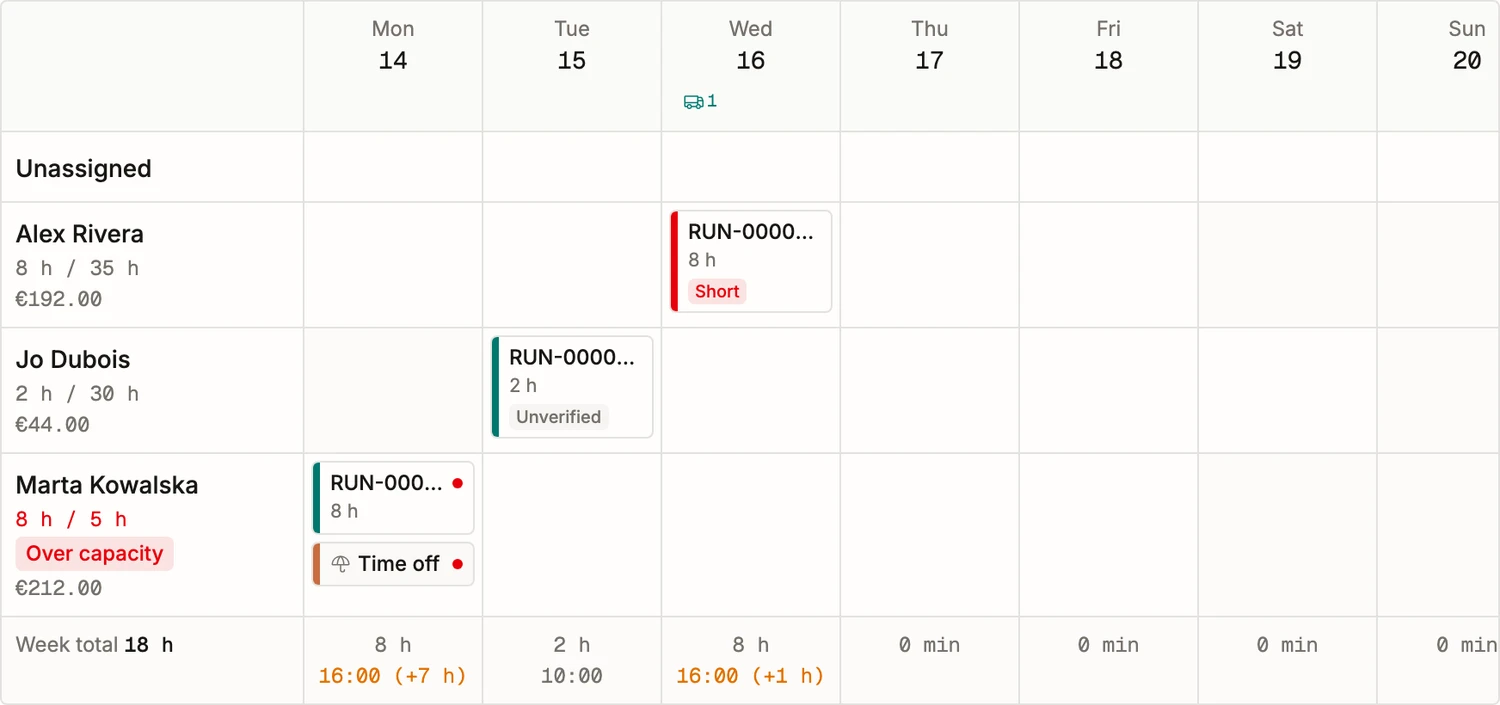
Batches, prep, packing and time off sit on the same board, assigned to operators with real working days and rates. Open a single day and it is an hour-by-hour timeline, with what that day costs in labor under each name.
- A batch planned on someone’s day off flags itself, before they find out at the coffee machine.
- A week over someone’s capacity says so in hours, next to what the day costs in labor.
- Each day carries the hour it will actually finish at, given everything already on it.
Nothing falls off by not having a day yet
A batch can exist before it has a date. It waits in a tray under the board with what it makes and how much, and you give it a day when you know one. Some of them put themselves there: a replenishment rule that watched a product drop under its level writes the batch and leaves it undated, because deciding that it needs making is arithmetic and deciding when is not.

Zoom out and the verdicts come with you
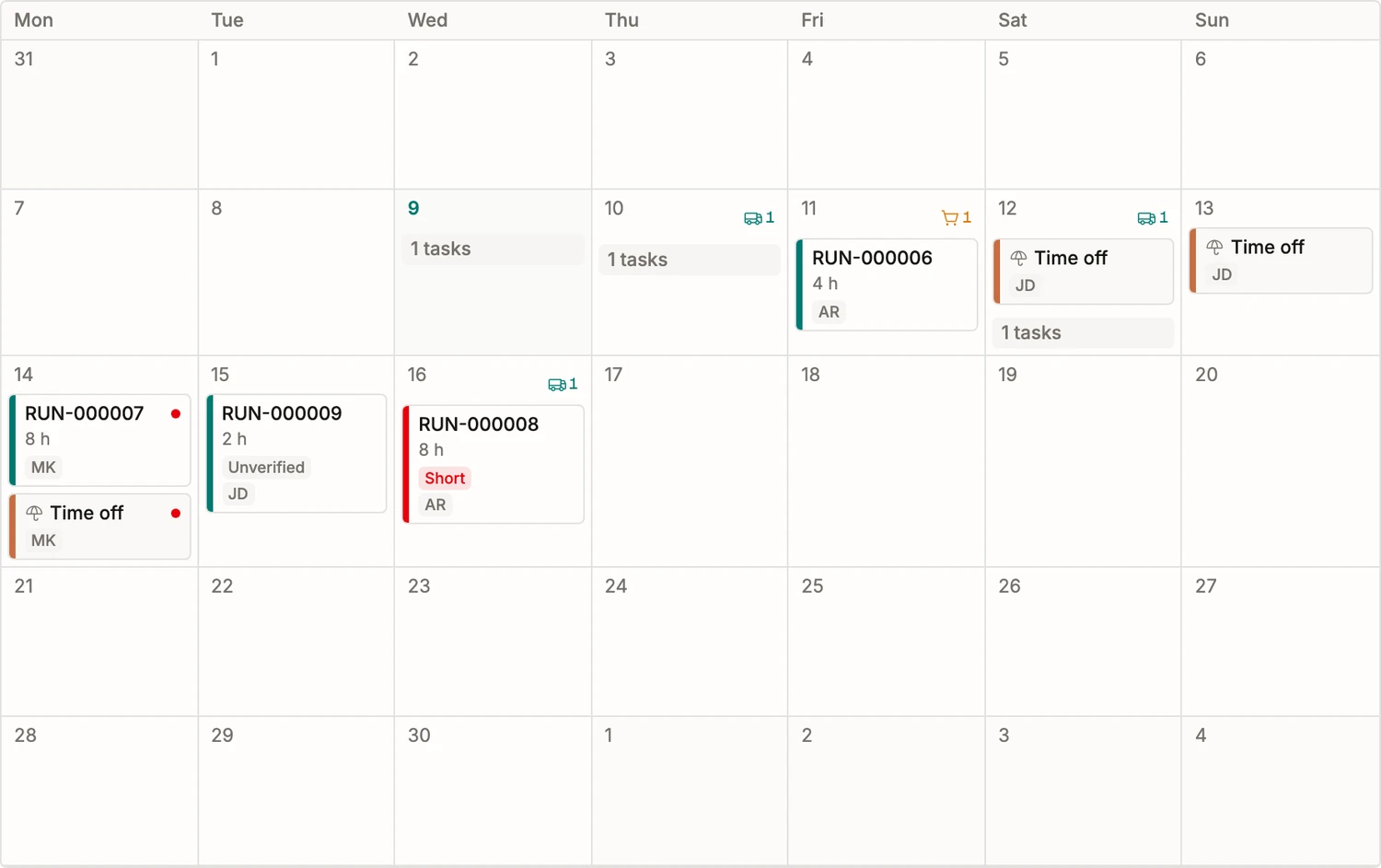
The same week reads as a month without losing what matters: the short batch is still short, the unverified one still unverified, time off and task counts sit on their days, and every entry carries the initials of whoever it is on. Narrow the board to production, to tasks, to time off, or to just your own, at any zoom.
A batch, a task, a day off: one board
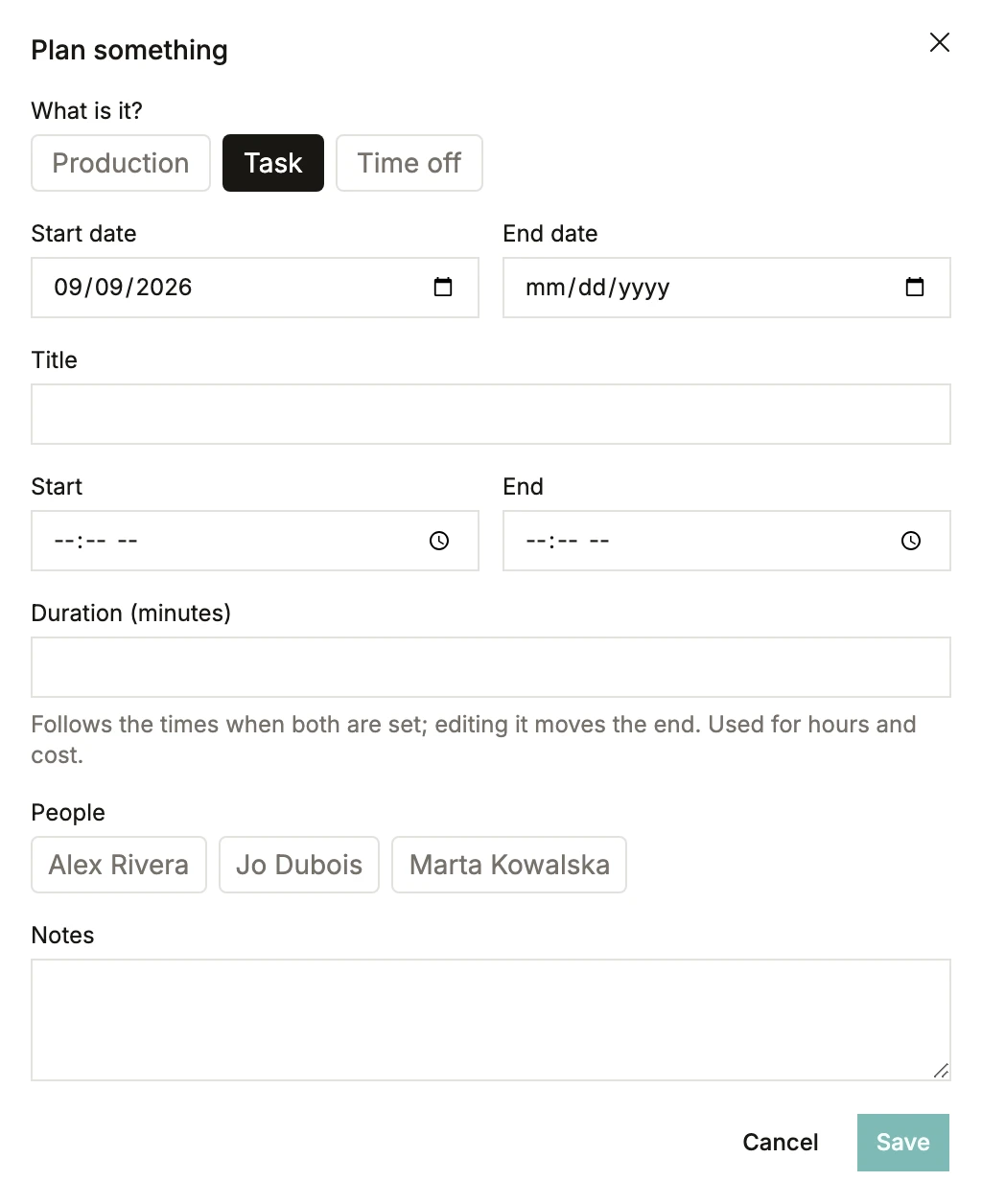
Everything that takes somebody’s time is an entry. A production batch, the packing session before the Saturday market, a week in July. Each takes people and a duration, and that duration is what feeds the hours and the cost, which is why the week total is a real figure rather than a guess.
Hand over the planning without opening the books
A planner role moves the week around without seeing costs, margins or supplier prices. The person who schedules does not have to be the person who knows the numbers.