'%3e%3cg%20transform='matrix(0.737731,0,0,0.737731,1584.657279,93.052323)'%3e%3cg%20transform='matrix(1,0,0,1,-73.197369,-28.78343)'%3e%3cg%20transform='matrix(2.327683,0,0,2.327683,-115.888888,-940.785017)'%3e%3cpath%20d='M610.12,610.782L535.09,610.782L535.09,570.757L618.413,570.757L610.12,610.782ZM628.935,570.757L697.713,570.757C709.523,570.757%20720.131,571.523%20729.536,573.054C738.94,574.585%20746.923,577.373%20753.485,581.42C760.046,585.466%20765.077,591.043%20768.576,598.151C772.076,605.26%20773.825,614.391%20773.825,625.545C773.825,632.107%20772.841,638.504%20770.873,644.737C768.904,650.971%20766.006,656.548%20762.179,661.469C758.351,666.39%20753.758,670.491%20748.4,673.772C743.041,677.052%20736.863,679.13%20729.864,680.005L729.864,680.661C741.018,683.723%20749.603,689.574%20755.617,698.213C761.632,706.852%20764.639,716.858%20764.639,728.231C764.639,740.917%20762.179,752.071%20757.258,761.695C752.337,771.318%20745.721,779.301%20737.409,785.644C729.098,791.987%20719.584,796.798%20708.867,800.079C698.15,803.36%20686.886,805%20675.076,805L580.368,805L581.484,799.615L609.457,665.57L687.543,665.57C696.947,665.57%20705.094,663%20711.984,657.86C718.873,652.72%20722.318,645.011%20722.318,634.731C722.318,625.545%20719.858,619.257%20714.937,615.867C710.015,612.477%20703.399,610.782%20695.088,610.782L620.636,610.782L628.935,570.757ZM638.101,764.975L672.779,764.975C684.59,764.975%20694.268,761.804%20701.814,755.461C709.359,749.119%20713.132,739.714%20713.132,727.247C713.132,721.123%20711.875,716.312%20709.359,712.812C706.844,709.313%20703.618,706.633%20699.681,704.774C695.744,702.915%20691.37,701.767%20686.558,701.33C681.747,700.892%20677.044,700.673%20672.451,700.673L651.88,700.673L638.101,764.975Z'%20style='fill:rgb(25,23,20);'/%3e%3c/g%3e%3cg%20transform='matrix(1,0,0,1,0,220.238764)'%3e%3cpath%20d='M1259.334,480.922L1129.63,480.922L1129.63,387.757L1278.681,388.212L1259.334,480.922Z'%20style='fill:rgb(0,120,111);'/%3e%3c/g%3e%3cg%20transform='matrix(1,0,0,1,0,452.077913)'%3e%3cpath%20d='M1210.953,480.922L1129.63,480.922L1129.63,387.757L1230.395,387.757L1210.953,480.922Z'%20style='fill:rgb(0,120,111);'/%3e%3c/g%3e%3cg%20transform='matrix(1,0,0,1,0,336.158338)'%3e%3cpath%20d='M1235.144,480.922L1129.63,480.922L1129.63,387.757L1254.586,387.757L1235.144,480.922Z'%20style='fill:rgb(0,120,111);'/%3e%3c/g%3e%3c/g%3e%3c/g%3e%3c/g%3e%3c/svg%3e)
One email about one jar. You have the answer before lunch.
A customer writes about a jar from March. Which batch? Which chili delivery? Which other jars? On binders and a text thread, that is an afternoon of archaeology with a deadline on it, and everyone in the workshop knows it.
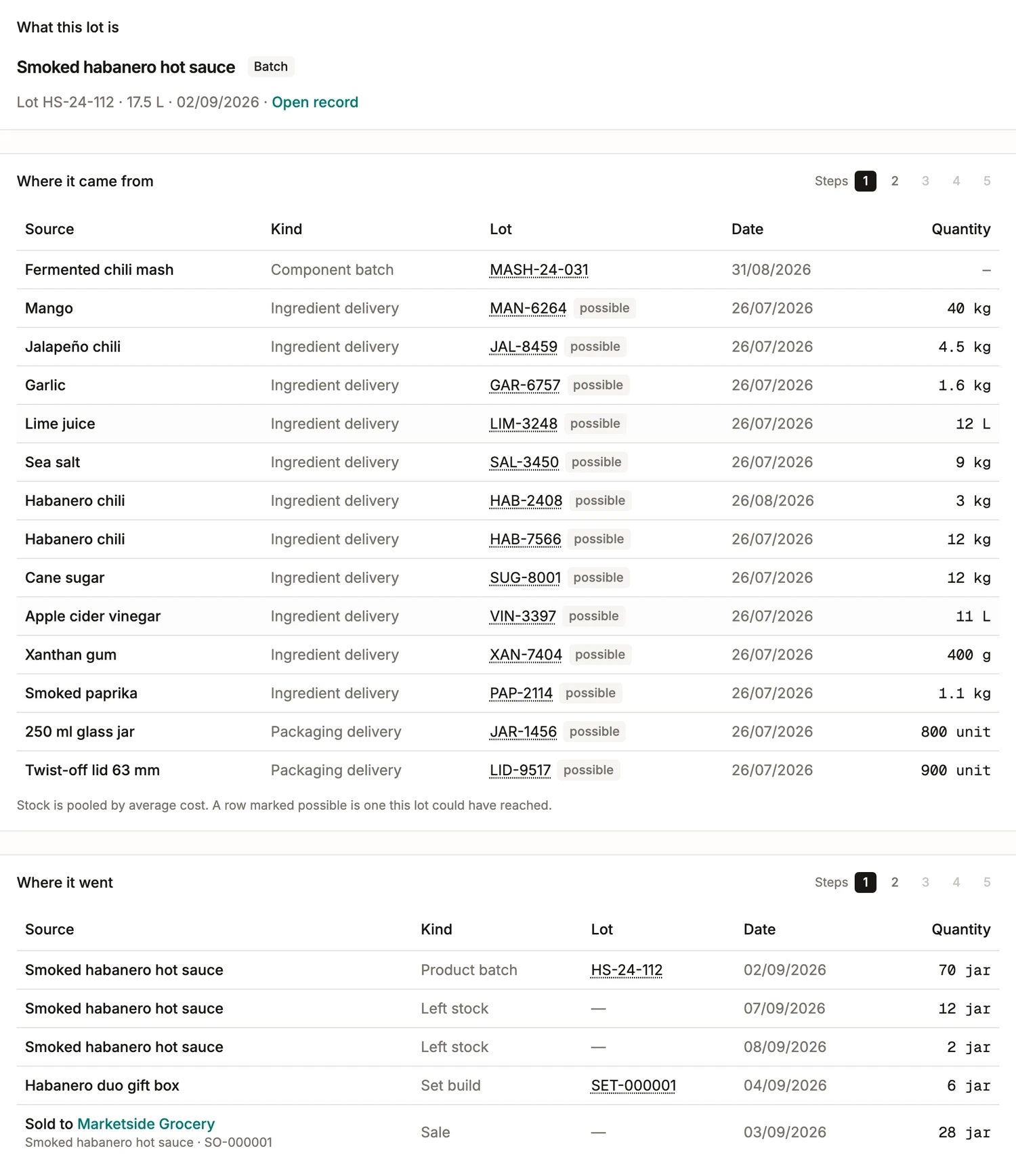
In BatchDash the answer already exists: every batch records the lots that went in and books its output under a lot code, as a side effect of just running production. Tracing is typing one code and reading.
One code, and the trail opens both ways
Type the lot off a label, a delivery note or a batch record. The screen names what the lot is, then opens in both directions at once: what it came from, and where it went. Every row is a real record you can open rather than a report line: the delivery, the purchase order, the batch, the movement, the sale. Push either side a step deeper when the question needs it.
Who has it, and what you can still stop
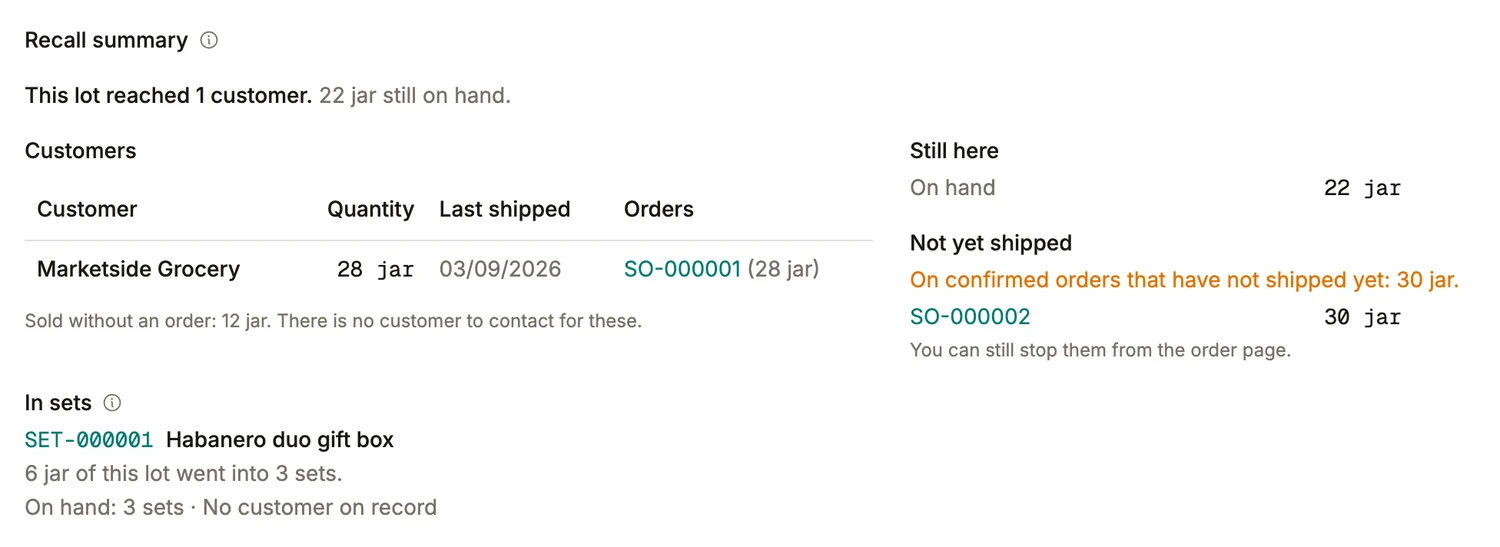
This is the half a spreadsheet never has. The lot reached one customer, who took 28 jars on an order you can open from the row. Twelve more were sold without an order, and the screen says plainly that there is nobody to contact for those. Twenty-two are still on your own shelf. And thirty are sitting on a confirmed order that has not shipped yet, which you can still stop from the order page. Six went into a gift box, and the set knows it.
When it is the vendor calling
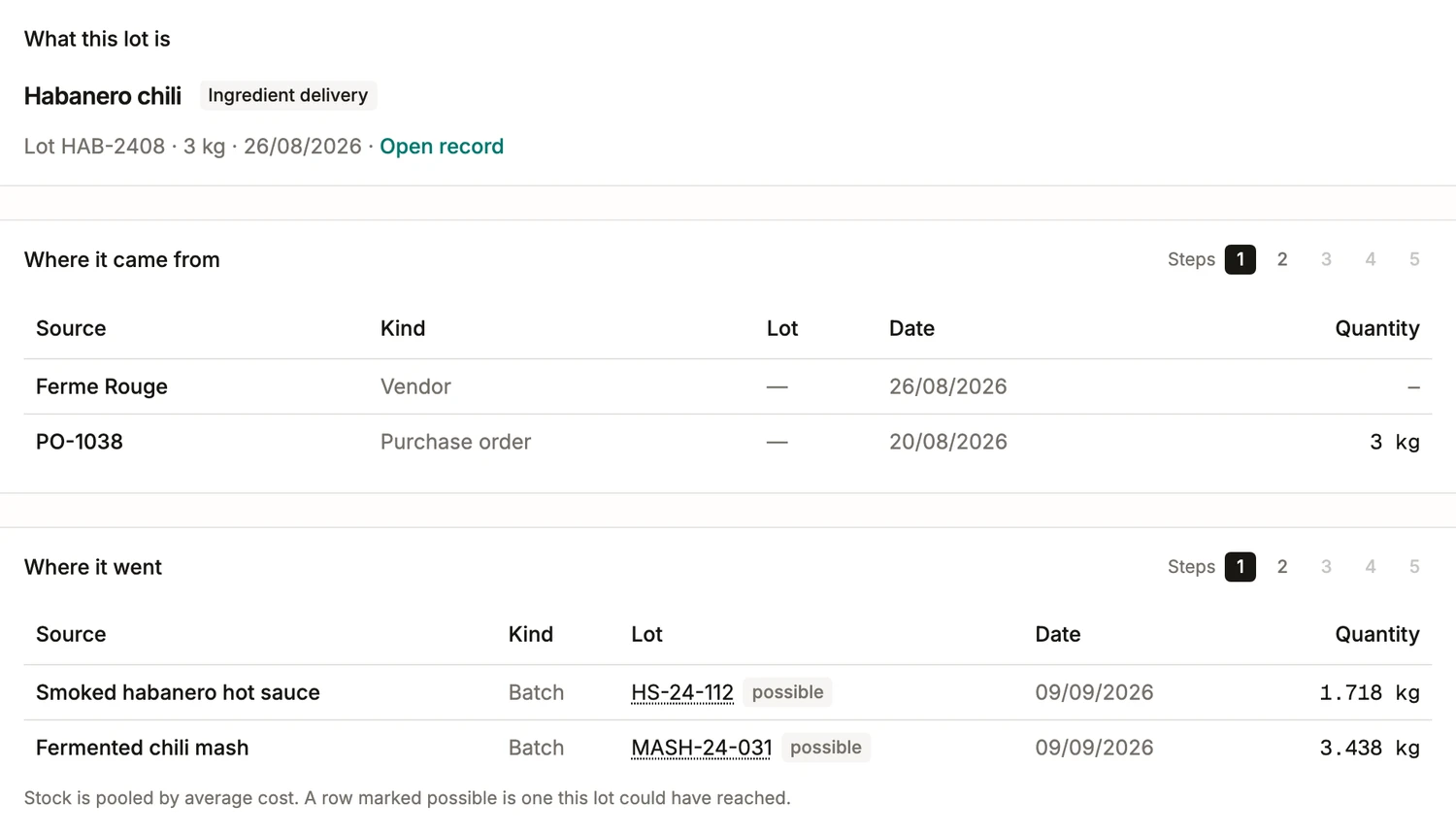
The other direction starts with a phone call about a delivery. Type the chili lot and the screen gives you the vendor and the purchase order behind it, then every batch it reached and how much each one took. From there, one click is the finished lot and one more is the recall summary above. The perimeter stops being a guess, and getting to it takes about a minute.
As deep as you ask, and honest where it cannot be sure
Both walks open one level at a time, up to five, so the screen answers the question you actually asked instead of burying it:
- A made component traces straight through: the jar knows its mash batch, and the mash knows its chilis.
- Ingredient stock is pooled at average cost, so a lot cannot always be pinned to one batch. A row it could have reached is marked possible instead of claimed.
- That marking is the point. A trace that overclaims is worse than no trace at all when somebody is deciding what to withdraw.
The code they quote is the code you search
The customer’s email quotes something printed on the jar. That something is the batch’s own lot, put on the label by the editor reading it off the record, which is why pasting it into the search finds the batch on the first try. No parallel numbering scheme, no lookup sheet taped inside a cupboard door.
And a file for whoever is asking
The whole walk exports as a file, with the order and the customer on every sale it names. An auditor, a customer’s QA department or your own insurer gets a document, and your afternoon stays yours.