'%3e%3cg%20transform='matrix(0.737731,0,0,0.737731,1584.657279,93.052323)'%3e%3cg%20transform='matrix(1,0,0,1,-73.197369,-28.78343)'%3e%3cg%20transform='matrix(2.327683,0,0,2.327683,-115.888888,-940.785017)'%3e%3cpath%20d='M610.12,610.782L535.09,610.782L535.09,570.757L618.413,570.757L610.12,610.782ZM628.935,570.757L697.713,570.757C709.523,570.757%20720.131,571.523%20729.536,573.054C738.94,574.585%20746.923,577.373%20753.485,581.42C760.046,585.466%20765.077,591.043%20768.576,598.151C772.076,605.26%20773.825,614.391%20773.825,625.545C773.825,632.107%20772.841,638.504%20770.873,644.737C768.904,650.971%20766.006,656.548%20762.179,661.469C758.351,666.39%20753.758,670.491%20748.4,673.772C743.041,677.052%20736.863,679.13%20729.864,680.005L729.864,680.661C741.018,683.723%20749.603,689.574%20755.617,698.213C761.632,706.852%20764.639,716.858%20764.639,728.231C764.639,740.917%20762.179,752.071%20757.258,761.695C752.337,771.318%20745.721,779.301%20737.409,785.644C729.098,791.987%20719.584,796.798%20708.867,800.079C698.15,803.36%20686.886,805%20675.076,805L580.368,805L581.484,799.615L609.457,665.57L687.543,665.57C696.947,665.57%20705.094,663%20711.984,657.86C718.873,652.72%20722.318,645.011%20722.318,634.731C722.318,625.545%20719.858,619.257%20714.937,615.867C710.015,612.477%20703.399,610.782%20695.088,610.782L620.636,610.782L628.935,570.757ZM638.101,764.975L672.779,764.975C684.59,764.975%20694.268,761.804%20701.814,755.461C709.359,749.119%20713.132,739.714%20713.132,727.247C713.132,721.123%20711.875,716.312%20709.359,712.812C706.844,709.313%20703.618,706.633%20699.681,704.774C695.744,702.915%20691.37,701.767%20686.558,701.33C681.747,700.892%20677.044,700.673%20672.451,700.673L651.88,700.673L638.101,764.975Z'%20style='fill:rgb(25,23,20);'/%3e%3c/g%3e%3cg%20transform='matrix(1,0,0,1,0,220.238764)'%3e%3cpath%20d='M1259.334,480.922L1129.63,480.922L1129.63,387.757L1278.681,388.212L1259.334,480.922Z'%20style='fill:rgb(0,120,111);'/%3e%3c/g%3e%3cg%20transform='matrix(1,0,0,1,0,452.077913)'%3e%3cpath%20d='M1210.953,480.922L1129.63,480.922L1129.63,387.757L1230.395,387.757L1210.953,480.922Z'%20style='fill:rgb(0,120,111);'/%3e%3c/g%3e%3cg%20transform='matrix(1,0,0,1,0,336.158338)'%3e%3cpath%20d='M1235.144,480.922L1129.63,480.922L1129.63,387.757L1254.586,387.757L1235.144,480.922Z'%20style='fill:rgb(0,120,111);'/%3e%3c/g%3e%3c/g%3e%3c/g%3e%3c/g%3e%3c/svg%3e)
Food manufacturing software where the batch writes the label.
A buyer asks for the allergen sheet on Thursday. The jar needs a best-before date, and that date has to come from somewhere. The mango price moved in March and the jam is still priced off last year. And the recipe that made last week’s batch has been saved over twice since.
BatchDash keeps one record from the recipe to the jar. The declaration, the allergens, the nutrition panel and the best-before are worked out from the batch that filled it, the cost is what your own deliveries came in at, and the lot code on the label walks back to the farm.
What food manufacturing software does
It holds the recipe, what each ingredient cost the day it landed, the batch that used them up, what came out of it, and what has to be printed on the pack. One record, so a question about one jar has one answer: which batch, which deliveries, what it cost, what the label said. The batch is the unit everything hangs off, which is what separates it from software written for assembly or for a continuous line.
- Drinks and liquids: a recipe in grams, an output in liters, and a density doing the conversion so the yield is measured rather than assumed.
- Sauces, preserves and pickles: ferments, reductions and rests are recipe steps, and a step can carry the check it needs.
- Snacks and bakery: a dough, a base mix or a praline is a recipe in its own right, made in its own batch and drawn by everything built on it.
- Ready meals and deli: components cooked ahead, each with its own lot and its own date, portioned into what you actually sell.
One recipe, and any batch size
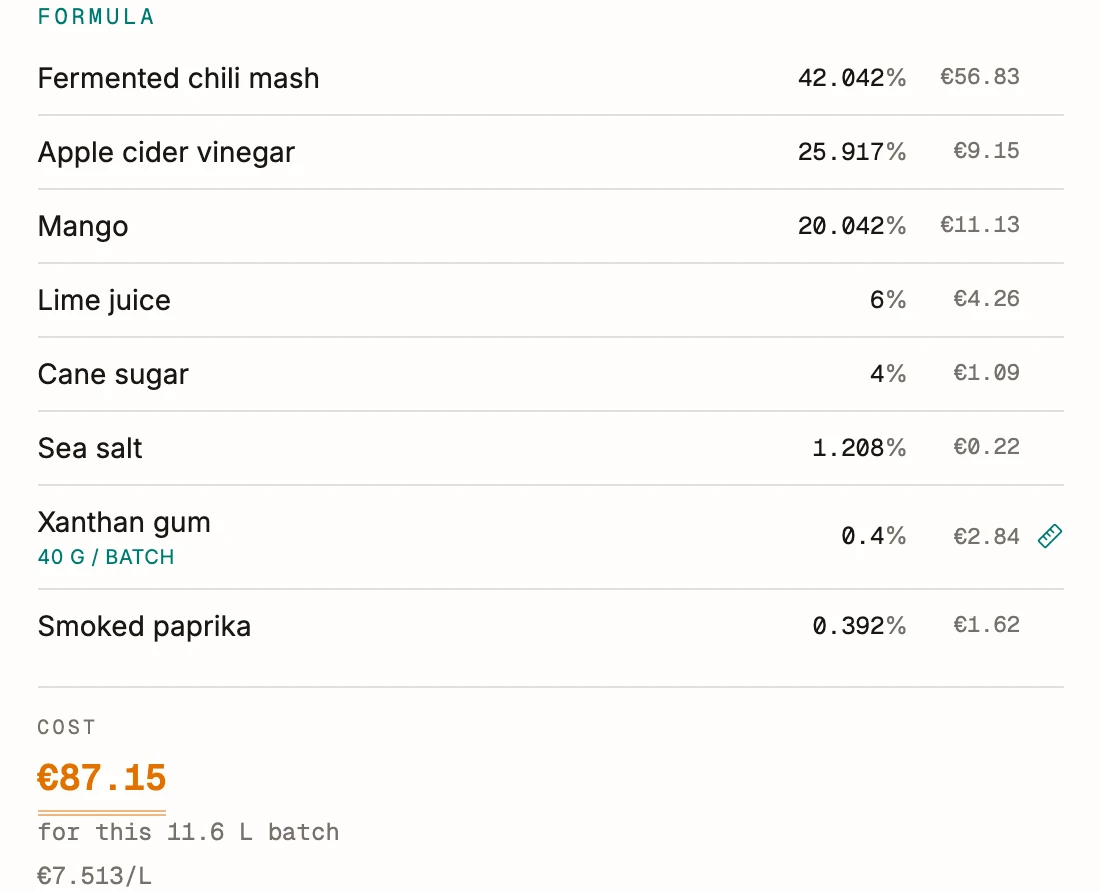
Write it once and ask for the batch you need. Shares can be percentages of the batch, baker’s percentages against the flour, or a dose you pin in grams. At 11.6 liters this sauce is 42.042 % fermented chili mash and costs €87.15, which is €7.513 a liter at the prices its deliveries actually came in at.
- A sub-recipe is a recipe: the fermented mash is made, lot-coded and costed on its own, and the sauce draws it like anything else.
- A line that should not scale says so. The xanthan gum is 40 g a batch whatever the batch is, and doubling the batch leaves it alone.
- Peeling and stoning are part of the arithmetic, so what you paid for the whole fruit lands in the jar even though only the flesh went in.
The batch, written down while it runs
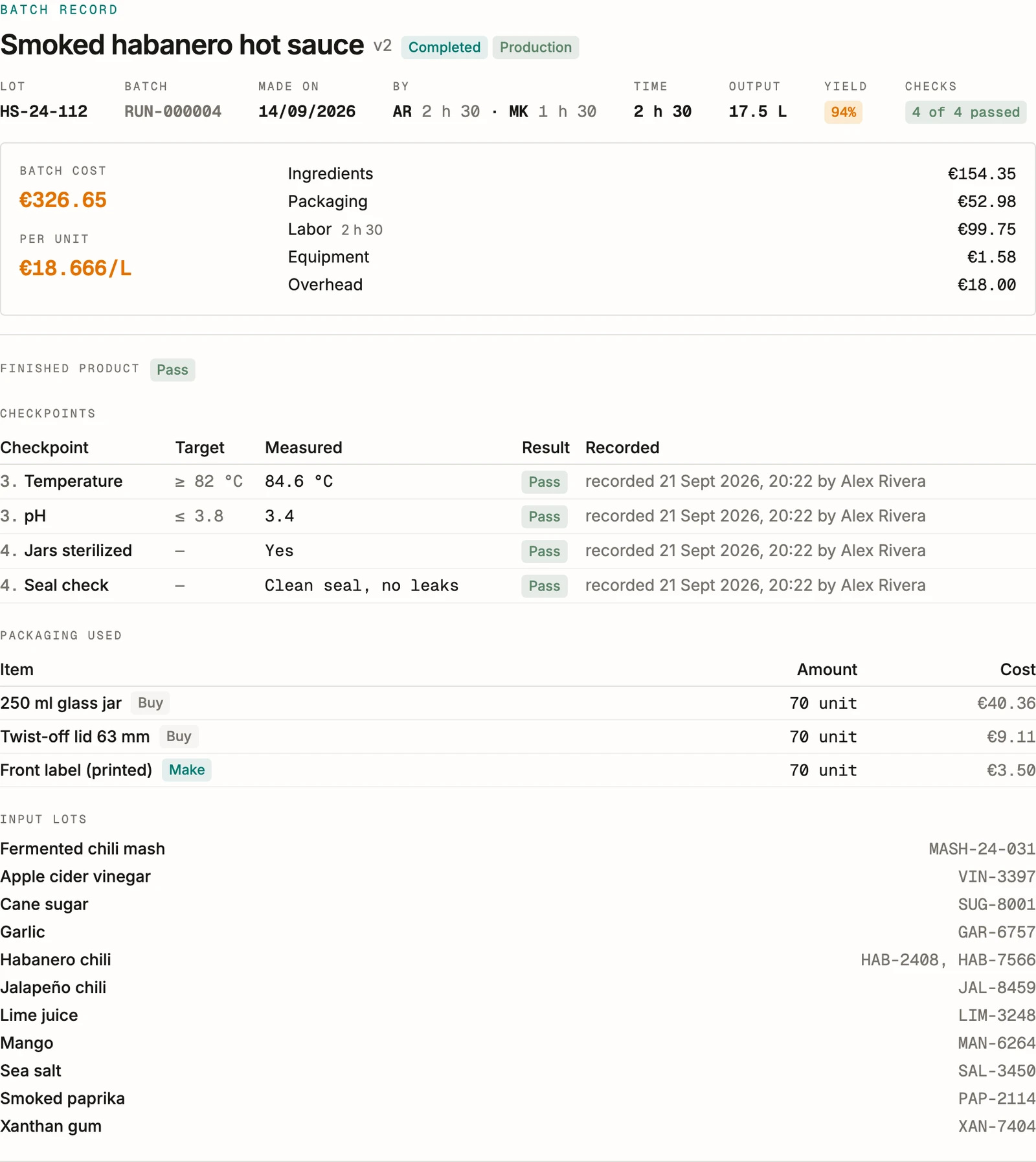
The sheet asks for what it needs at the bench: the readings, the people, their minutes, and the lot behind every ingredient. A check left unanswered keeps the batch open. This one came out at 17.5 liters against a plan of 18, which is a 94 % yield, and it cost €326.65 to make.
- Every check carries its target, its reading, its result and the person who took it: pH 3.4 against a ceiling of 3.8, 84.6 °C against a floor of 82, four of four passed, recorded by Alex Rivera.
- The cost is this batch’s own: €154.35 of ingredients, €52.98 of packaging, €99.75 of labor from the time recorded, €1.58 of equipment and €18.00 of overhead.
- Packaging is stock like anything else. Seventy jars, seventy twist-off lids and seventy printed front labels left the shelf with this batch, and the record keeps what each of them cost.
What the batch works out for the label
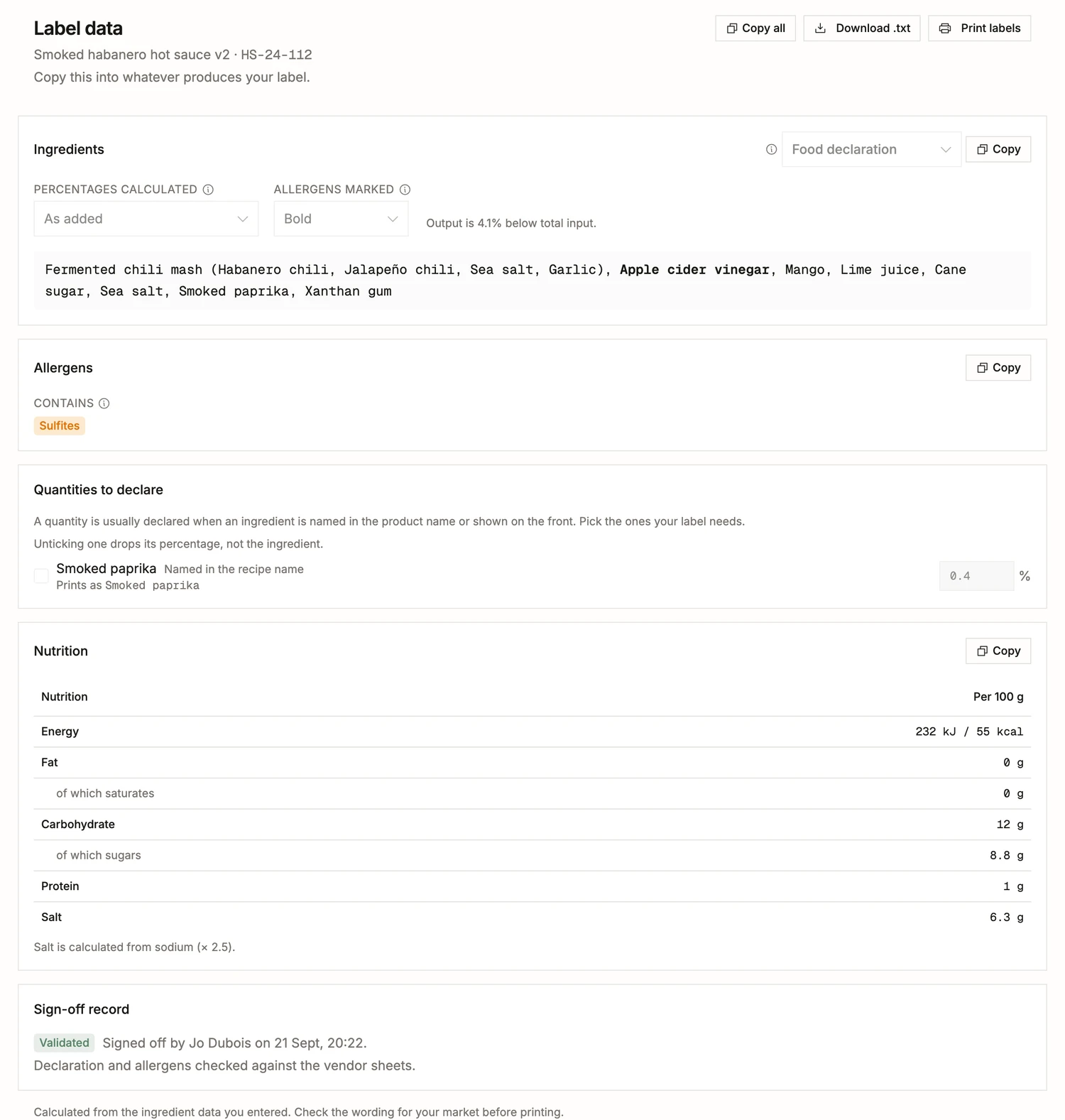
Point at a finished batch and the words are already there. The list is in descending order with the fermented mash opened up into its own chilis, salt and garlic, and the allergen marked bold and named again on a Contains line. This batch came out 4.1 % under what went into it, so the card says which basis its percentages are on.
- The order follows what the batch really drew, so the xanthan gum at its fixed 40 g sits below the smoked paprika on the jar, where the recipe has it a hair above.
- Nutrition is worked out per 100 g from the ingredient data you entered: 232 kJ, 55 kcal, 8.8 g of sugars, and a salt figure derived from sodium at × 2.5, which the panel says under its last row.
- A quantity to declare is offered where a label usually needs one. The smoked paprika is named in the recipe name, so its 0.4 % is worked out and waiting to print.
- And it gets signed off. Validated, with the name and the date on it, and a note saying the declaration was checked against the vendor sheets.
A label designer, at the size of the jar
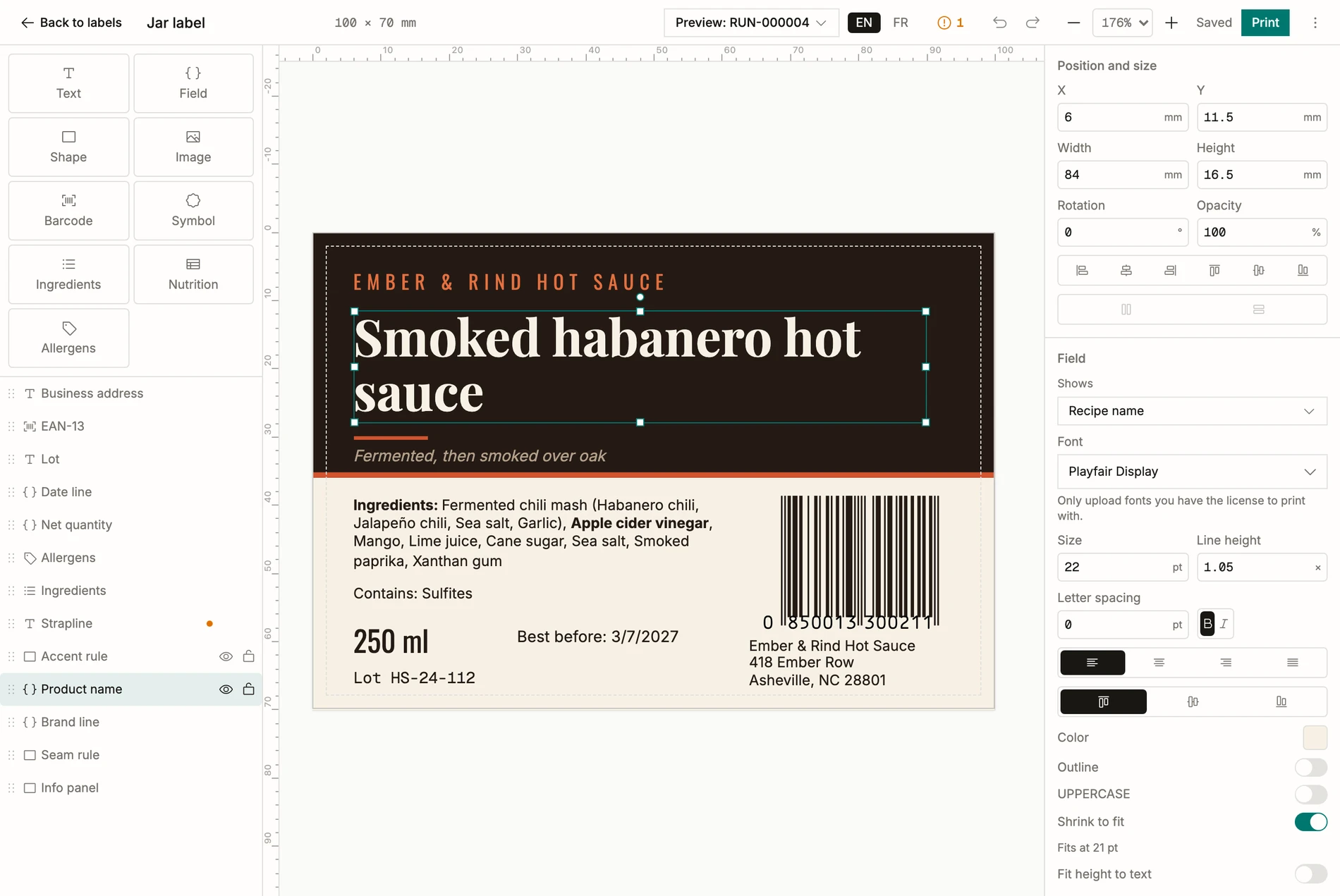
The blocks go into a label you lay out yourself, in millimeters, at the size the jar takes: this one is 100 × 70 mm. Drop in an Ingredients block, an Allergens line, a Nutrition table, a barcode, your own artwork. Point the preview at a batch and the design fills with that batch’s facts, which is how you find out the declaration overflows its box before anything is printed.
- A text element can be a field rather than typed words. This one shows the recipe name, at 22 pt, set to shrink to fit, and it says it fits at 21.
- The same design carries both languages, so a jar for a French shelf is the English one with the label language switched.
- Print a sheet on the printer in the room, or hand a print service a print-ready file with bleed. Either way the lot on the label is the lot in the ledger.
One shelf life, and every lot dated from it
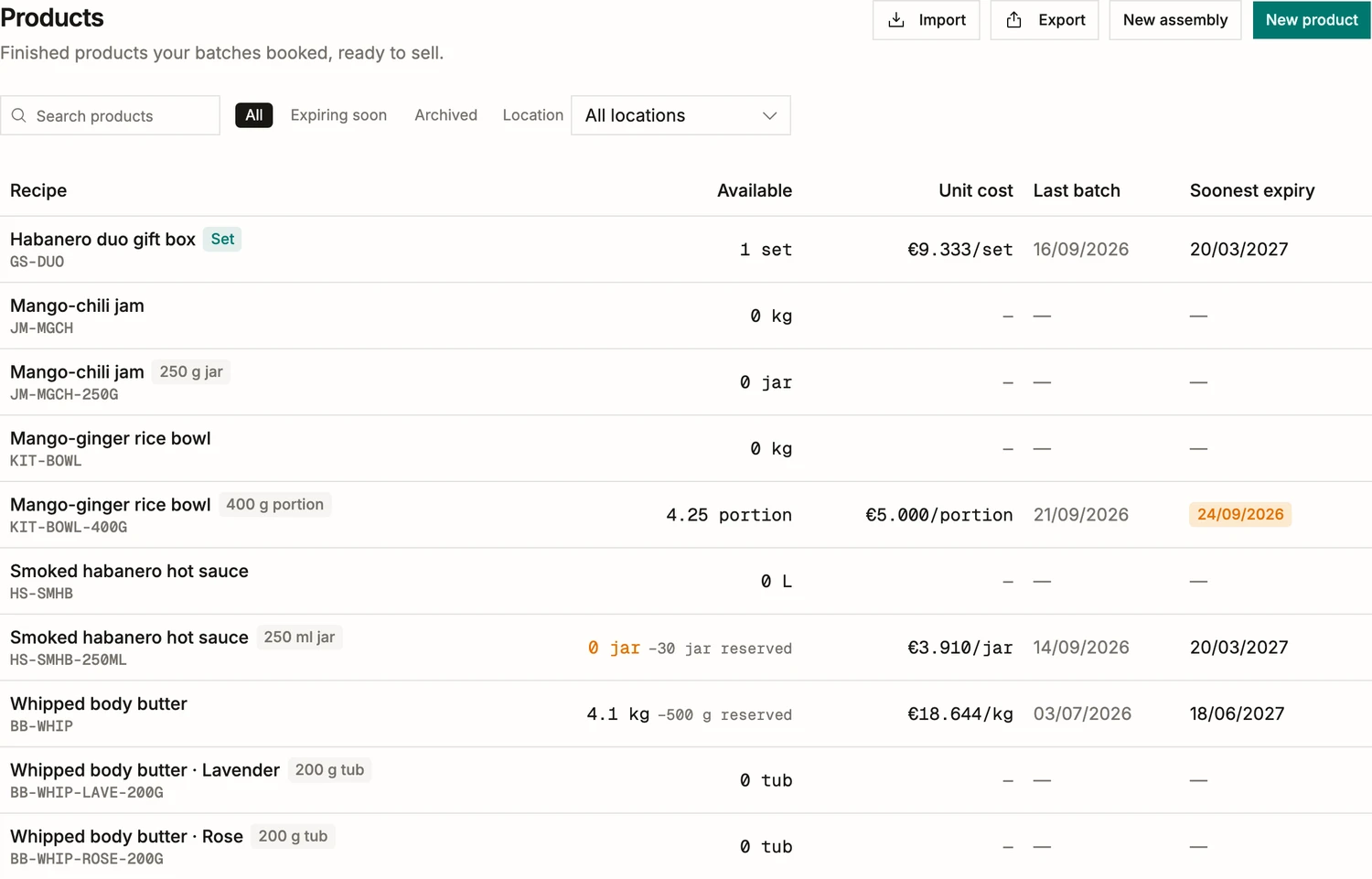
Put a shelf life on the recipe and each batch takes its best-before from the day it was made. These jars keep until 20/03/2027. The rice bowl portions made on 21/09/2026 are good until the 24th, which is why the shelf reads them in amber, and why the list has a filter for nothing but those.
- The date on the label and the date on the shelf are the same date, because both are read off the batch.
- Available is what you can still promise. The jars are on the shelf and 30 of them are reserved against an order, so the column reads zero.
- Ingredients carry a shelf life of their own, so a delivery lands with a date on it and the oldest lot is the one the next batch draws.
What a jar costs, and what it leaves you
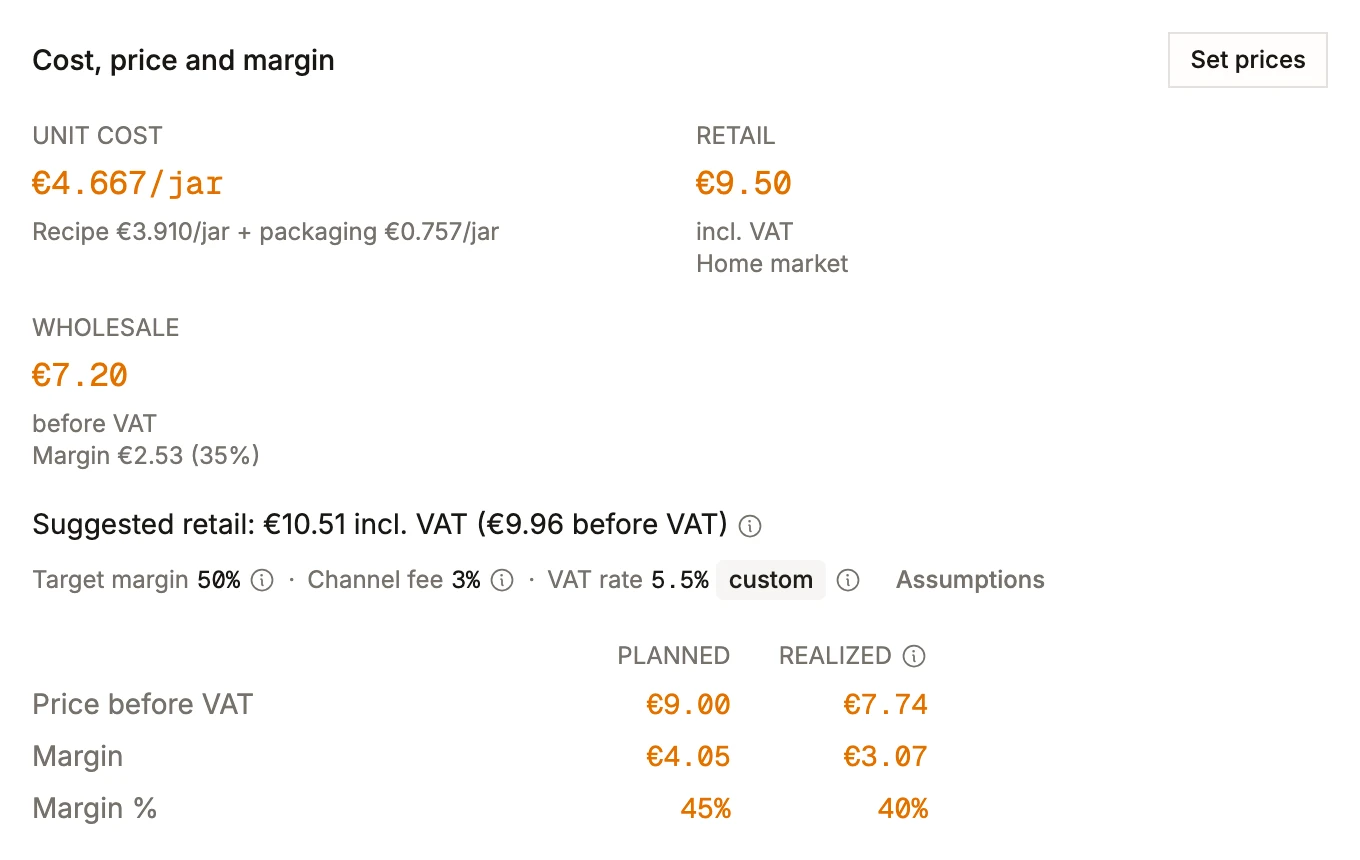
The unit cost is built rather than typed: €3.910 of recipe and €0.757 of packaging make €4.667 a jar. Beside it sits what you charge for it, and the two are never more than a screen apart.
- Retail €9.50 including VAT, wholesale €7.20 before it. The wholesale jar leaves €2.53, a 35 % margin.
- Planned and realized stay apart, so a season of discounts reads as the 40 % it came to rather than the 45 % you meant.
- A target margin, a channel fee and your own VAT rate turn the cost into a suggested shelf price: €10.51 including VAT on this one.
Tracing a lot, in both directions
This is the exercise a food standard sets you: take a finished lot, name everything that went into it, name everywhere it went, and make the quantities reconcile. The record further up holds the first half already, down to the two habanero deliveries the batch drew and the mango behind them, so walking backward is a read rather than a search.
- It starts at either end: your own lot code, or the delivery code a supplier reads out over the phone.
- Forward, it names the batches, the movements and the sales the lot reached, each row opening on the record behind it.
- The quantities add up because the ledger is the only place they are written: a delivery in, a draw into a batch, a sale out.
Questions we hear before the first batch.
- What is food manufacturing software?
- Software built around the batch: a fixed quantity of one food, made from a recipe, with a lot code and a date on it. It works beside what you already run. An accounting package knows what you spent and a till knows what you sold; this holds what happened in the room where the recipe became jars, and what has to be printed on them. If you make to a recipe and sell under a label, it is the system the rest of your paperwork comes out of.
- Does it handle allergens and the ingredient declaration?
- That is what the ingredient records are for. An allergen sits on the ingredient, so every recipe using it inherits the allergen, the declaration comes out in descending order of weight with a compound ingredient opened into its parts, and the allergen is marked in the list and named again on a Contains line. You choose the mark, bold, capitals or underline, and you can edit any wording before it prints. Check the result against your own market before you print it: the words are ours, the responsibility is yours.
- Can it work out the nutrition panel?
- Yes, per 100 g or 100 ml, from the figures on your ingredients: energy in both units, fat and saturates, carbohydrate and sugars, protein and salt, with salt derived from sodium when that is what you entered. The useful part is what it does with a gap. An ingredient carrying no nutrition data is listed as missing and the panel says it is incomplete, because a panel quietly computed over part of the recipe is worse than no panel at all.
- Does it handle use-by dates and a period after opening?
- Both. A recipe carries its shelf life in days and says whether the date is a best-before or a use-by, and it can carry a period after opening beside it, the way a jar tells you to finish it within a number of days. It also keeps the reason the shelf life is what it is, which is the part an auditor asks about. When a lot passes its date the shelf marks it expired, and throwing it away is a recorded loss against that batch, with expiry as the reason.
- Does it work for drinks as well as solids?
- It does, and the reason is that the arithmetic is done in mass. A recipe scales in grams whatever its ingredients were bought in, and the output is declared in liters through the density you recorded, so a 17.5 liter batch is a measured figure rather than a conversion somebody did on a phone. Ingredients bought by volume behave the same way, and the label states the net quantity in the unit the pack is sold in.
- Is this a HACCP system?
- It keeps the evidence a HACCP plan asks for. A recipe step can carry a checkpoint with a target, be marked as a critical control point, and the batch asks for the reading while it runs. What you get back is the record: target, measurement, result, the person and the minute, kept with the batch and unchangeable once sealed. Writing and reviewing the plan itself stays with you or with your consultant.
- How do we start?
- On your own, with one recipe. Load it with the ingredients behind it and the prices you last paid, run a batch, print the label, and you will know inside an afternoon whether the declaration comes out the way your market needs it. Nobody has to talk to you first. For a larger setup, somebody from the team runs the onboarding with you.