'%3e%3cg%20transform='matrix(0.737731,0,0,0.737731,1584.657279,93.052323)'%3e%3cg%20transform='matrix(1,0,0,1,-73.197369,-28.78343)'%3e%3cg%20transform='matrix(2.327683,0,0,2.327683,-115.888888,-940.785017)'%3e%3cpath%20d='M610.12,610.782L535.09,610.782L535.09,570.757L618.413,570.757L610.12,610.782ZM628.935,570.757L697.713,570.757C709.523,570.757%20720.131,571.523%20729.536,573.054C738.94,574.585%20746.923,577.373%20753.485,581.42C760.046,585.466%20765.077,591.043%20768.576,598.151C772.076,605.26%20773.825,614.391%20773.825,625.545C773.825,632.107%20772.841,638.504%20770.873,644.737C768.904,650.971%20766.006,656.548%20762.179,661.469C758.351,666.39%20753.758,670.491%20748.4,673.772C743.041,677.052%20736.863,679.13%20729.864,680.005L729.864,680.661C741.018,683.723%20749.603,689.574%20755.617,698.213C761.632,706.852%20764.639,716.858%20764.639,728.231C764.639,740.917%20762.179,752.071%20757.258,761.695C752.337,771.318%20745.721,779.301%20737.409,785.644C729.098,791.987%20719.584,796.798%20708.867,800.079C698.15,803.36%20686.886,805%20675.076,805L580.368,805L581.484,799.615L609.457,665.57L687.543,665.57C696.947,665.57%20705.094,663%20711.984,657.86C718.873,652.72%20722.318,645.011%20722.318,634.731C722.318,625.545%20719.858,619.257%20714.937,615.867C710.015,612.477%20703.399,610.782%20695.088,610.782L620.636,610.782L628.935,570.757ZM638.101,764.975L672.779,764.975C684.59,764.975%20694.268,761.804%20701.814,755.461C709.359,749.119%20713.132,739.714%20713.132,727.247C713.132,721.123%20711.875,716.312%20709.359,712.812C706.844,709.313%20703.618,706.633%20699.681,704.774C695.744,702.915%20691.37,701.767%20686.558,701.33C681.747,700.892%20677.044,700.673%20672.451,700.673L651.88,700.673L638.101,764.975Z'%20style='fill:rgb(25,23,20);'/%3e%3c/g%3e%3cg%20transform='matrix(1,0,0,1,0,220.238764)'%3e%3cpath%20d='M1259.334,480.922L1129.63,480.922L1129.63,387.757L1278.681,388.212L1259.334,480.922Z'%20style='fill:rgb(0,120,111);'/%3e%3c/g%3e%3cg%20transform='matrix(1,0,0,1,0,452.077913)'%3e%3cpath%20d='M1210.953,480.922L1129.63,480.922L1129.63,387.757L1230.395,387.757L1210.953,480.922Z'%20style='fill:rgb(0,120,111);'/%3e%3c/g%3e%3cg%20transform='matrix(1,0,0,1,0,336.158338)'%3e%3cpath%20d='M1235.144,480.922L1129.63,480.922L1129.63,387.757L1254.586,387.757L1235.144,480.922Z'%20style='fill:rgb(0,120,111);'/%3e%3c/g%3e%3c/g%3e%3c/g%3e%3c/g%3e%3c/svg%3e)
Wherefour alternative, built around the formula and the batch.
Wherefour and BatchDash do much of the same work. Both keep your formulas, follow every lot from the delivery to the customer, cost what a batch used and work out what to buy. Wherefour is a manufacturing ERP and traceability system from California, sold to sixteen industries.
BatchDash was written for one kind of work, making from a formula in batches, and it goes further wherever that work is decided: a formula engine that does a batch’s real arithmetic, the true cost of every batch, a trail that says what it can prove, and a label the batch writes itself. It works in your currency and your units, in English or French, with EU label law built in.
Wherefour and BatchDash, row by row
Every Wherefour cell says what Wherefour’s own pages say. The BatchDash cells say what the screens further down this page show.
What it is built for
- Wherefour
- Sixteen industries on its home page, from bakery and pet food to apparel, electronics and oil and gas, in process and discrete manufacturing.
- BatchDash
- One kind of work, taken all the way: making from a formula, in batches, where what comes out cannot be taken apart again. Food, drink, cosmetics and every trade that makes the same way.
The formula engine
- Wherefour
- Formulas and recipes behind work orders, which reserve what a batch needs and record its actual yield. Its batch workflows scale a recipe up or down.
- BatchDash
- Built for the arithmetic a batch really needs: a share in percent, baker’s percent or grams, lines that stay fixed, follow the portions or step up, recipes inside recipes, liters and pieces through density and piece weight, and every quantity rounded to what your scale weighs.
Development and trials
- Wherefour
- Experiments are cloned formulas given working names such as “Product X – Expt #Y”, run as a normal production order, with the results written in the work order’s notes.
- BatchDash
- One formula with every version kept: branch from any of them, weigh the trial as made, score the tasting, note why a line moved, and read two versions side by side. A trial batch undone gives its stock back.
What a batch cost
- Wherefour
- COGS per work order, captured as production happens: ingredients, labor and overhead, with standard cost variances.
- BatchDash
- Ingredients at the weighted average your deliveries set, freight and duty inside, then packaging, each person’s time, equipment by use and overhead by your rule. The yield loss is priced into every unit, and each format carries its margin.
Planning and buying
- Wherefour
- MRP from open sales orders, stock, open purchase orders and lead times. Purchase orders are drafted for preferred suppliers, and a What If? check runs formulas with multipliers against stock.
- BatchDash
- Batches placed on a week, each with a verdict against stock. What is short is netted through every sub-formula, grouped by vendor, rounded to what they sell and dated by the last day to order. Replenishment rules write the batch when stock runs low.
Choosing suppliers
- Wherefour
- Purchase orders drafted for your preferred suppliers, with each supplier’s lead time tracked and reorder points set.
- BatchDash
- A sourcing project per search: candidates and their quotes read into your own unit, samples tested in real batches, the paperwork each one sent, compared against what you pay today. The rule you set once picks the winner, which becomes a vendor offer in one step.
Lots and recalls
- Wherefour
- Lots followed from ingredient to customer delivery, custom lot codes, COAs attached to lots and bundled with shipments, mock recalls and FSMA 204 records.
- BatchDash
- One code opens the trail both ways, with a mass balance. It says certain where a lot was named and possible where stock was pooled, then who to call and what can still be stopped.
Labels
- Wherefour
- Barcode labels for products, packages and pallets (GS1-128, Code 128, Code 93), with nutritional analysis and label generation among its listed features.
- BatchDash
- A label designer bound to the batch: the declaration written from what it drew, allergens in bold, nutrition, lot and dates, or an INCI list with the period after opening. Barcodes from UPC-A and EAN-13 to a GS1-128 carrying the lot and its date, EU label law built in, and every label in English or French.
Languages, currencies, hosting
- Wherefour
- Offices in Petaluma, California and in Toronto. Its website is in English.
- BatchDash
- Any currency and the units you buy in (a dollar workspace starts with pounds and ounces beside grams), vendors paid in their own currency at a rate you book, English or French for each person, and your records hosted in the EU.
Getting started, and the price
- Wherefour
- A demo booked through a form, then a quote: “We don’t publish a price list because every operation is different.” Onboarding and data migration are included, with no long-term contract.
- BatchDash
- Access opens by request for now: ask, and say what you make. Once you are in, you start on your own recipes, and for a larger setup somebody from the team runs the onboarding with you.
Wherefour spreads one system across sixteen industries. BatchDash takes one kind of work all the way: the formula engine, the cost of each batch read off what you paid, a trail that says what it can prove, and the label the batch writes itself. If what you make starts from a formula, that depth is the difference you feel every day.
What batch manufacturing software coversSomething here out of date? Tell us and we will correct it.
A formula engine built for the arithmetic of a batch
Wherefour
Wherefour runs production from the work order, which it defines as “an instruction to produce a specific quantity of a product using a defined formula or recipe.” The work order reserves what the batch needs and records its actual yield, and its batch workflows scale a recipe up or down.
BatchDash
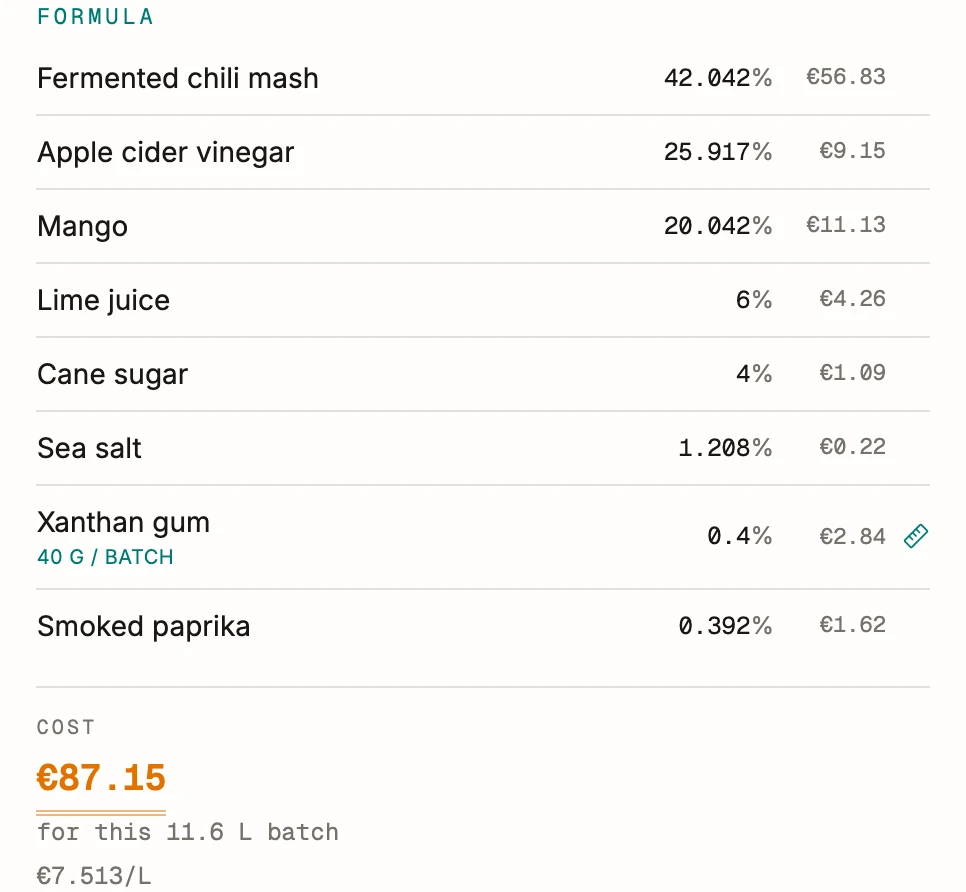
BatchDash starts earlier, while the formula is still being argued over, and its engine does the arithmetic a batch actually needs. The sauce on screen is written in percentages of what the batch makes. Its first line is a formula of its own, 42 % of a fermented chili mash with its own batches behind it, and the xanthan gum is pinned at 40 g whatever the batch size. The panel costs every line as you type: €87.15 for this 11.6 liter batch, €7.513 a liter.
- A share is stated the way the work thinks: percent of the batch, baker’s percent on the flour, or grams pinned per batch. A line can follow the batch, the number of portions or whole steps, like one crust for every 900 g of filling.
- Units follow the ingredient: a liquid through its density, an egg through what one weighs, a lemon through the share that is zest. The sheet prints what goes into the bowl and what leaves the shelf, and rounds each quantity to the step your scale weighs.
- Every version is kept. Branch from any of them for a trial, score the tasting, note why a line moved, and a batch keeps the version it was made from.
- A recipe you already have is not retyped. Paste it as written, photograph the page or drop in the PDF, and it arrives as a formula you check line by line, with one click to take the whole import back out.
What one batch really cost, in five parts
Wherefour
Wherefour captures each ingredient drawn, each labor entry and each overhead cost as production happens, and tracks COGS at the work order level with standard cost variances.
BatchDash
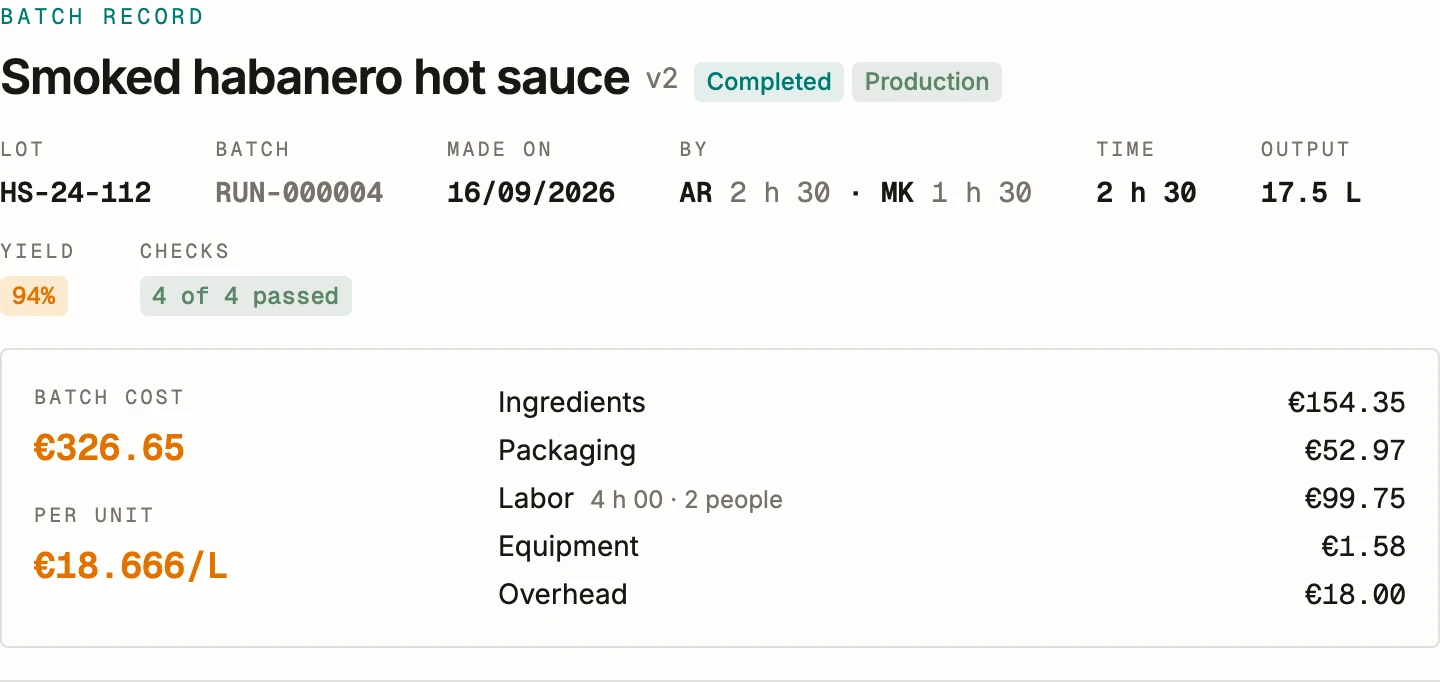
BatchDash costs a batch from what you actually paid. Run RUN-000004 of the sauce came to €326.65, or €18.666 a liter: €154.35 of ingredients at the cost of the lots it drew, €52.97 of packaging, €99.75 of labor, €1.58 of equipment and €18.00 of overhead.
- Its 17.5 liters are a 94 % yield on what went in, and the loss is priced into every jar that came out.
- Labor is each person’s own time at their own rate: two people for 2 h 30 and 1 h 30 are 4 hours of paid work. Equipment is its price spread over its use, and overhead follows the rule you set.
- A delivery that moves a price recosts every formula that uses it the same day, and each format you sell shows its margin at retail and at wholesale.
What is short, vendor by vendor
Wherefour
Wherefour’s MRP reads open sales orders, stock on hand, open purchase orders and supplier lead times to build a replenishment plan, and can draft purchase orders for your preferred suppliers. Its What If? function checks a list of formulas, with multipliers, against what is on hand.
BatchDash
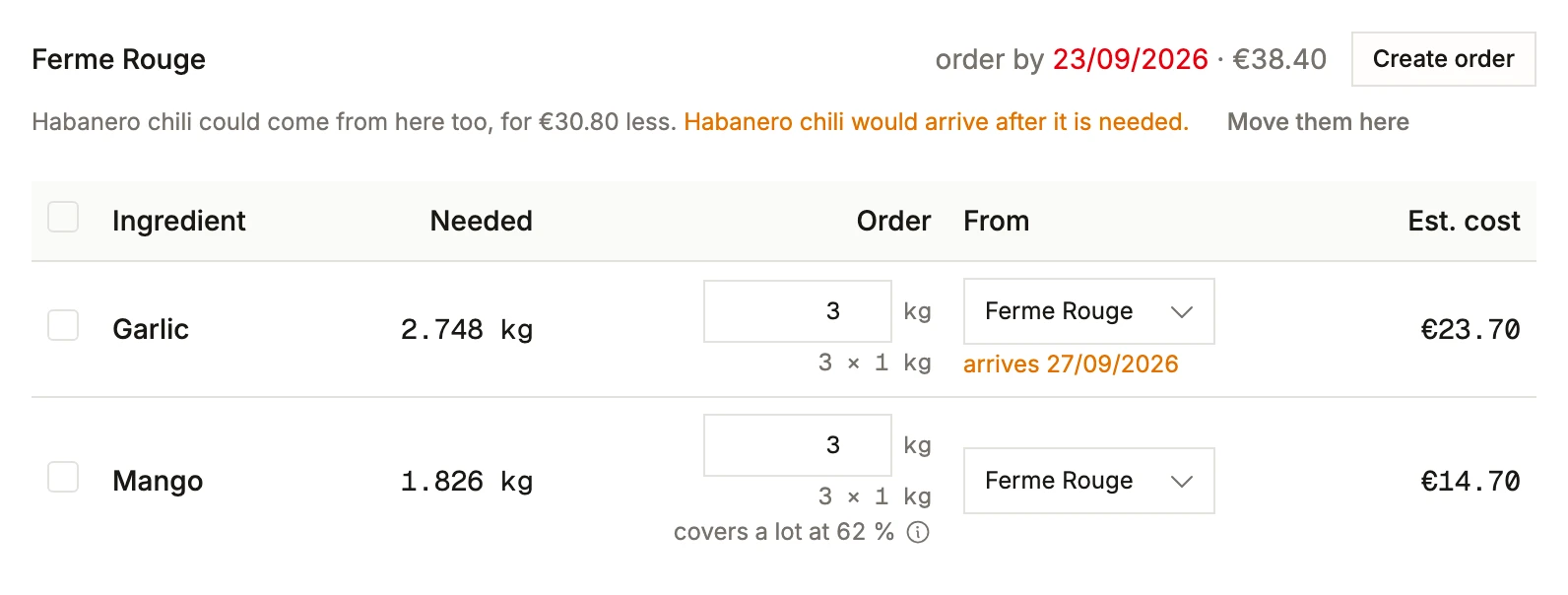
BatchDash nets the week’s batches through every sub-formula against what is available, and hands you the shortfall grouped by the vendor who has to be asked. On this card that is Ferme Rouge, €38.40 in all, with the last day to order in red. The 2.748 kg of garlic is rounded up to three one-kilo bags. The mango is bought to cover a lot at the low end of its yield, 62 %, so where the batches expect to use 1.826 kg there is still enough if the fruit turns out poor.
- Lead time is part of the sum, so a line that would arrive after its batch needs it turns amber before the order goes out.
- It looks for a cheaper source too: the habanero chili could come from this vendor for €30.80 less, and the card warns that it would arrive too late before you move it.
- A new ingredient gets a sourcing project: candidates and their quotes read into your own unit, samples tested in real batches, the paperwork each one sent, compared against what you pay today. The rule you set once, in time and at a fresh price first and then the cheapest, picks the same way here and in buying.
- Replenishment rules watch a product and write the batch when its stock drops under the level you set, leaving it undated until you give it a day.
One code, both ways, and honest about pooled stock
Wherefour
Wherefour follows a lot “from raw ingredient to finished product to customer delivery”, attaches COAs to lots and bundles them with shipments, runs mock recalls in minutes, and records the key data elements FSMA 204 asks for.
BatchDash
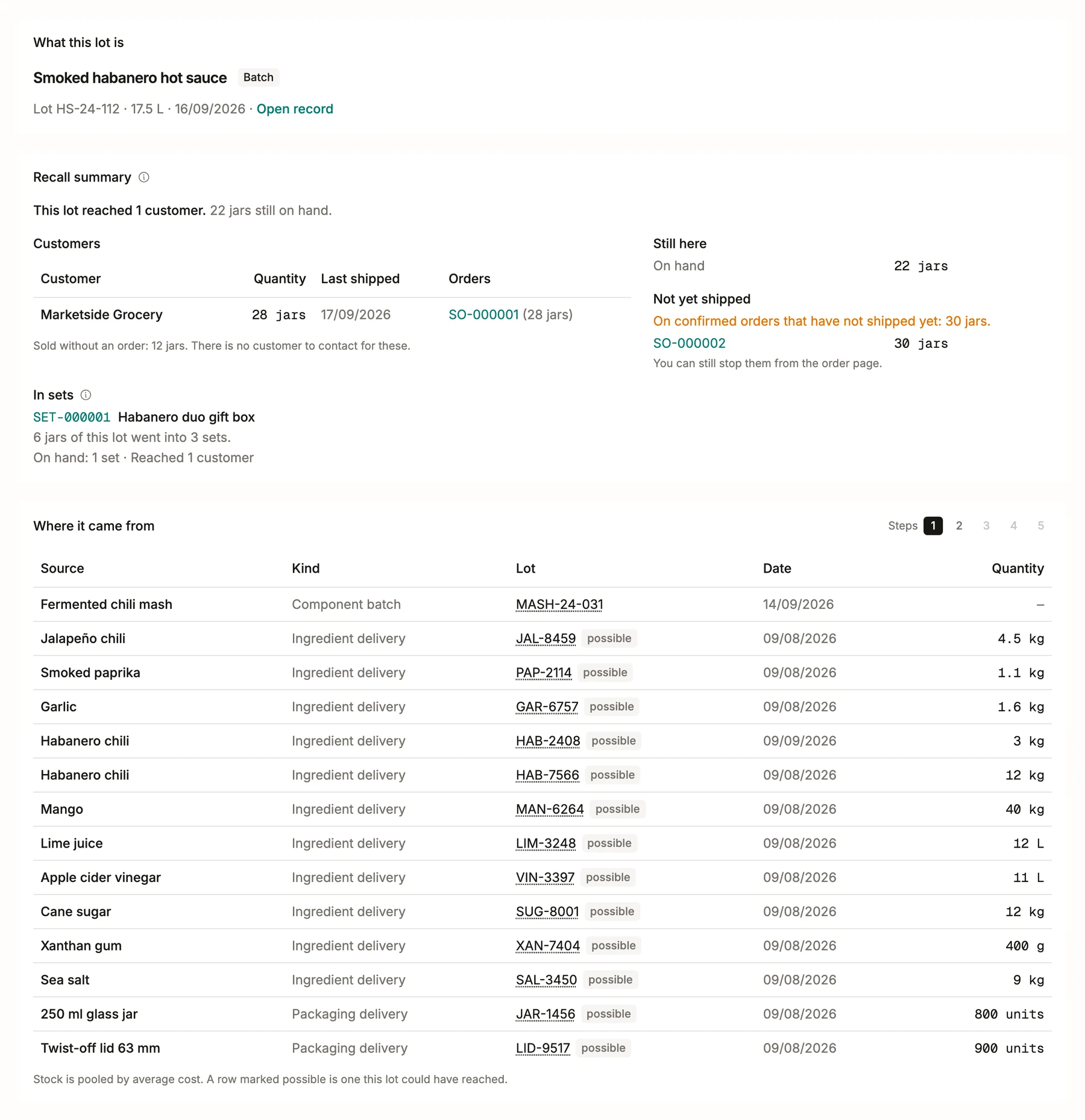
Type lot HS-24-112 and BatchDash answers the questions a recall opens with. It reached one customer, Marketside Grocery, with 28 jars on order SO-000001. Another 30 are on a confirmed order that has not shipped, and you can still stop them. A further 12 were sold without an order, so there is nobody to call, and the screen says so.
- Backward, the fermented chili mash traces to the batch it came from, MASH-24-031. The ingredient deliveries are marked possible, because stock pooled at average cost could have reached this lot without proof that it did.
- The gift boxes are traced as lots of their own: 6 jars went into 3 Habanero duo gift boxes, and the screen follows those as well.
- Each quantity is a movement in the stock ledger, which is why the figures add up when an auditor asks for a mass balance.
The label, written by the batch that filled the jar
Wherefour
Wherefour prints barcode labels for products, packages and pallets (GS1-128, Code 128, Code 93), and lists nutritional analysis and label generation among its features.
BatchDash
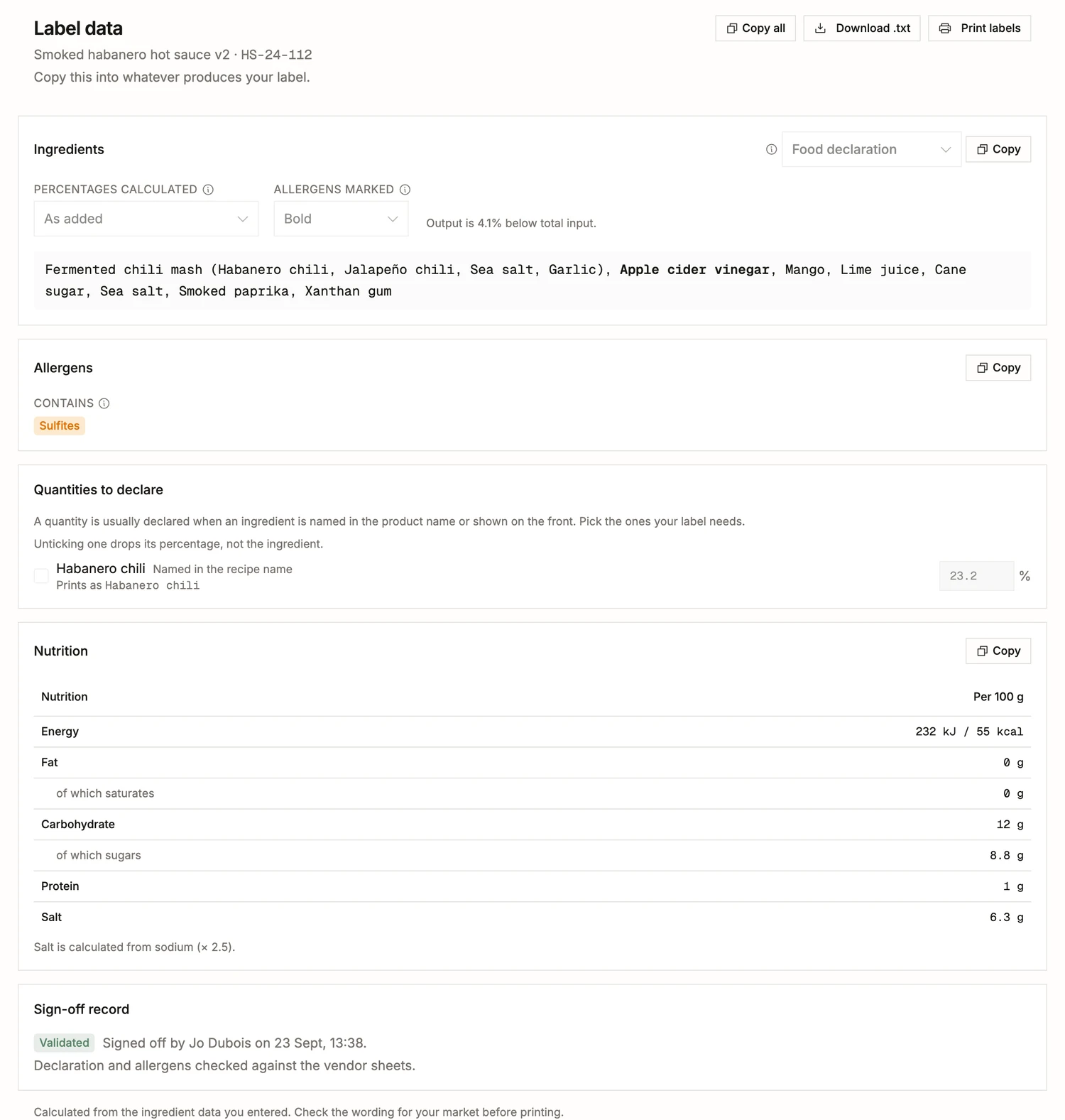
BatchDash writes the label data from what the batch actually drew. For lot HS-24-112 that is the ingredient list in descending order, with the fermented chili mash opened into its own chilis, salt and garlic, and the allergen in bold and named again on a Contains line. Nutrition comes per 100 g: 232 kJ, 55 kcal, 8.8 g of sugars and 6.3 g of salt, worked out from sodium.
- Somebody signs it off, with their name and the time on it, and a sealed batch prints the declaration that was signed whatever the recipe does next.
- EU label law is built in: the descending order, the allergens emphasized and repeated, the quantities to declare, nutrition per 100 g. A cosmetic batch writes its INCI list instead, each substance once, with the period after opening beside its date.
- The designer lays the label out on a millimeter canvas with the barcode a buyer asks for: UPC-A, EAN-13, Code 128, QR, DataMatrix, or a GS1-128 that carries the GTIN, the lot and its use-by or best-before date. The same design prints in English or French, filled with the batch’s lot and dates.
Questions from people comparing the two
- What is the difference between Wherefour and BatchDash?
- Both run production from formulas and follow every lot to the customer. Wherefour is a manufacturing ERP and traceability system that serves sixteen industries. BatchDash is the system batch manufacturers run on (recipes, costs, production, stock, and the records that prove each batch), built only for making from a formula, and it goes further at every step of that work: the formula engine, development, the cost of each batch, sourcing, the trail and the label.
- When is Wherefour the better choice?
- When much of the work is discrete manufacturing, products assembled from parts as in electronics or automotive, which Wherefour’s site covers beside process manufacturing. The same goes when a buyer’s questionnaire asks for FSMA 204 records or a SOC 2 report. For everything made from a formula, in batches, BatchDash goes further at every step this page shows.
- How do we move from Wherefour to BatchDash?
- Take your lists out as spreadsheets and bring them in through the imports: ingredients, vendor offers, deliveries with their lot codes, products, customers and past sales. Each file is read in your browser and shown to you row by row before anything is created. Recipes can be pasted as written, photographed or dropped in as a PDF, and each reading arrives as a formula you check line by line. A move handled by our team is also possible: tell us what you have and we will say how. What the move looks like
- Does BatchDash work with QuickBooks, Xero or Sage?
- Your accounting stays where it is. BatchDash keeps the manufacturing side of the books beside it: what each batch cost, what each stock movement was worth, what each sale drew off the shelf. Those figures are ready for QuickBooks, Xero, Sage or whatever keeps your books, and a Shopify store’s orders arrive as sales orders on their own.
- How do the prices compare?
- Wherefour does not publish a price list: its pricing page offers a 20-minute conversation, and the quote follows. BatchDash opens access by request for now: ask, say what you make, and once you are in you start on your own recipes. For a larger setup, somebody from the team runs the onboarding with you.
- Does BatchDash work for a company in the United States?
- Yes. A dollar workspace starts with pounds, ounces and US gallons beside grams and liters, vendors are paid in their own currency at the rate you book, and every batch is costed in dollars. A company that needs its records hosted in a particular place can have its own instance.
- Where is our data kept, and in which language do we work?
- In the European Union, on machines we operate ourselves, unless a company needs its own instance somewhere in particular, which can be arranged. Each person works in English or French, whatever currency and units the workspace runs in. Where your records live
- Does it work for cosmetics as well as food?
- Yes, on the same formula engine. An ingredient carries its INCI name and CAS number beside its food fields, a cosmetic is written in percentages, and the batch writes its INCI list in descending order, each substance once, with the period after opening beside its date. Cosmetics manufacturing software
- Is BatchDash big enough for a growing manufacturer?
- There is no size it stops at. Stock can sit in several locations, and each person’s role decides what they see and change, costs and supplier prices included. Every change lands in an audit trail, and a company with its own requirements can have its own instance.