'%3e%3cg%20transform='matrix(0.737731,0,0,0.737731,1584.657279,93.052323)'%3e%3cg%20transform='matrix(1,0,0,1,-73.197369,-28.78343)'%3e%3cg%20transform='matrix(2.327683,0,0,2.327683,-115.888888,-940.785017)'%3e%3cpath%20d='M610.12,610.782L535.09,610.782L535.09,570.757L618.413,570.757L610.12,610.782ZM628.935,570.757L697.713,570.757C709.523,570.757%20720.131,571.523%20729.536,573.054C738.94,574.585%20746.923,577.373%20753.485,581.42C760.046,585.466%20765.077,591.043%20768.576,598.151C772.076,605.26%20773.825,614.391%20773.825,625.545C773.825,632.107%20772.841,638.504%20770.873,644.737C768.904,650.971%20766.006,656.548%20762.179,661.469C758.351,666.39%20753.758,670.491%20748.4,673.772C743.041,677.052%20736.863,679.13%20729.864,680.005L729.864,680.661C741.018,683.723%20749.603,689.574%20755.617,698.213C761.632,706.852%20764.639,716.858%20764.639,728.231C764.639,740.917%20762.179,752.071%20757.258,761.695C752.337,771.318%20745.721,779.301%20737.409,785.644C729.098,791.987%20719.584,796.798%20708.867,800.079C698.15,803.36%20686.886,805%20675.076,805L580.368,805L581.484,799.615L609.457,665.57L687.543,665.57C696.947,665.57%20705.094,663%20711.984,657.86C718.873,652.72%20722.318,645.011%20722.318,634.731C722.318,625.545%20719.858,619.257%20714.937,615.867C710.015,612.477%20703.399,610.782%20695.088,610.782L620.636,610.782L628.935,570.757ZM638.101,764.975L672.779,764.975C684.59,764.975%20694.268,761.804%20701.814,755.461C709.359,749.119%20713.132,739.714%20713.132,727.247C713.132,721.123%20711.875,716.312%20709.359,712.812C706.844,709.313%20703.618,706.633%20699.681,704.774C695.744,702.915%20691.37,701.767%20686.558,701.33C681.747,700.892%20677.044,700.673%20672.451,700.673L651.88,700.673L638.101,764.975Z'%20style='fill:rgb(25,23,20);'/%3e%3c/g%3e%3cg%20transform='matrix(1,0,0,1,0,220.238764)'%3e%3cpath%20d='M1259.334,480.922L1129.63,480.922L1129.63,387.757L1278.681,388.212L1259.334,480.922Z'%20style='fill:rgb(0,120,111);'/%3e%3c/g%3e%3cg%20transform='matrix(1,0,0,1,0,452.077913)'%3e%3cpath%20d='M1210.953,480.922L1129.63,480.922L1129.63,387.757L1230.395,387.757L1210.953,480.922Z'%20style='fill:rgb(0,120,111);'/%3e%3c/g%3e%3cg%20transform='matrix(1,0,0,1,0,336.158338)'%3e%3cpath%20d='M1235.144,480.922L1129.63,480.922L1129.63,387.757L1254.586,387.757L1235.144,480.922Z'%20style='fill:rgb(0,120,111);'/%3e%3c/g%3e%3c/g%3e%3c/g%3e%3c/g%3e%3c/svg%3e)
The recipe that made last winter’s best batch still exists. Here.
You know the scene. The binder says 12 kg of mangoes, the costing sheet says 40%, and the batch everyone still talks about followed a correction scribbled on a printout that went through the wash. Every workshop runs on recipes. Very few could reprint the one that actually made them money.
A sauce, a serum, a spice blend: a BatchDash formula is one record holding the composition, the method, the parameters and the cost, from a 5-liter pilot to a 500-liter run. Change it and the old version keeps existing, still readable, still costed, still runnable.
Percentages or grams. The other side fills itself in.
Type 42% and the grams for this batch appear beside it. Weigh 5,045 g into the pot instead and the share appears. It is the same record either way, so the sheet you develop on and the sheet you produce from stop being two documents that disagree. Phases group the steps the way the work is really organized, and each step carries what belongs to it: the temperature, the hold, the pH window, the kettle it needs.
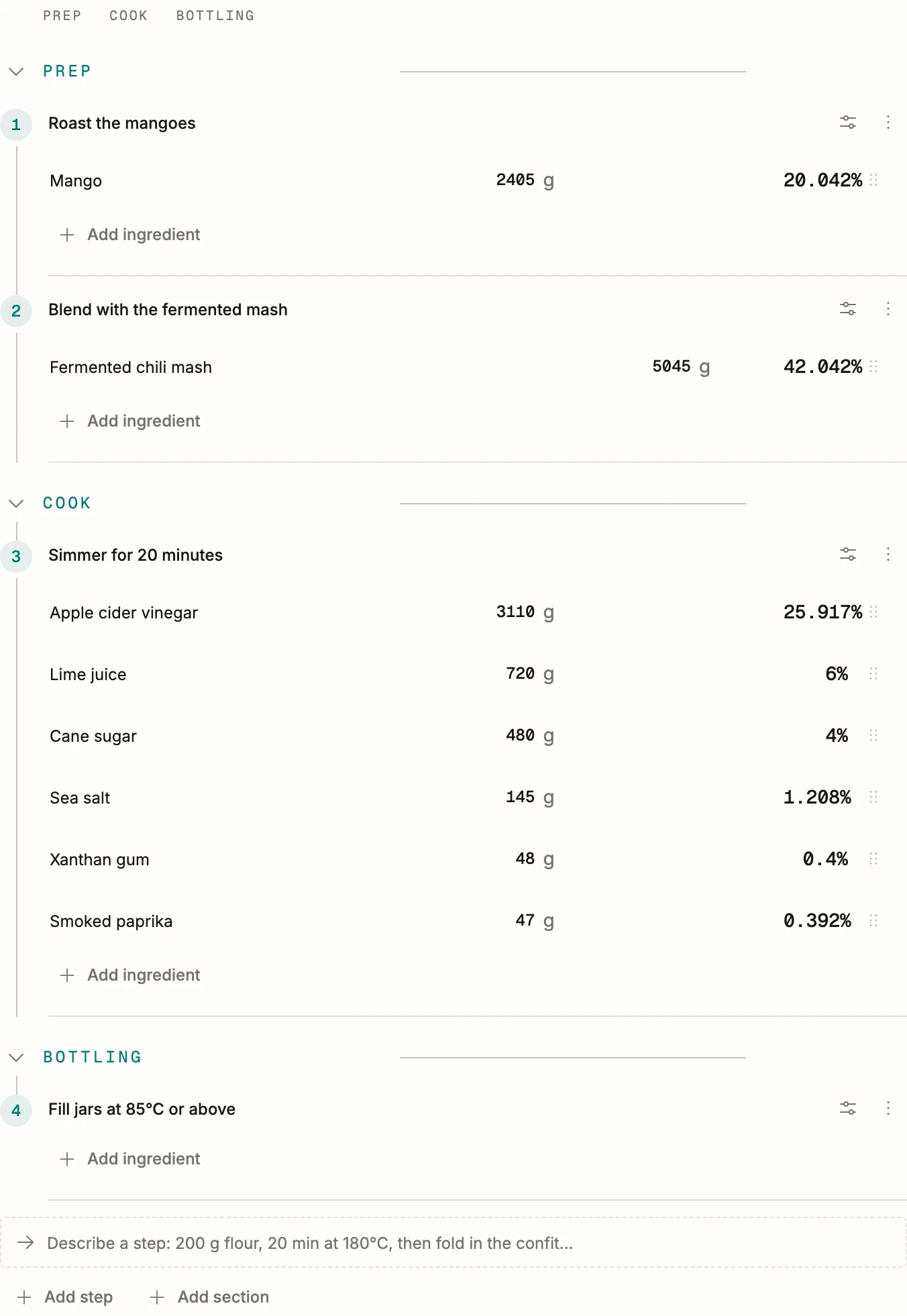
The formula adds itself up while you type
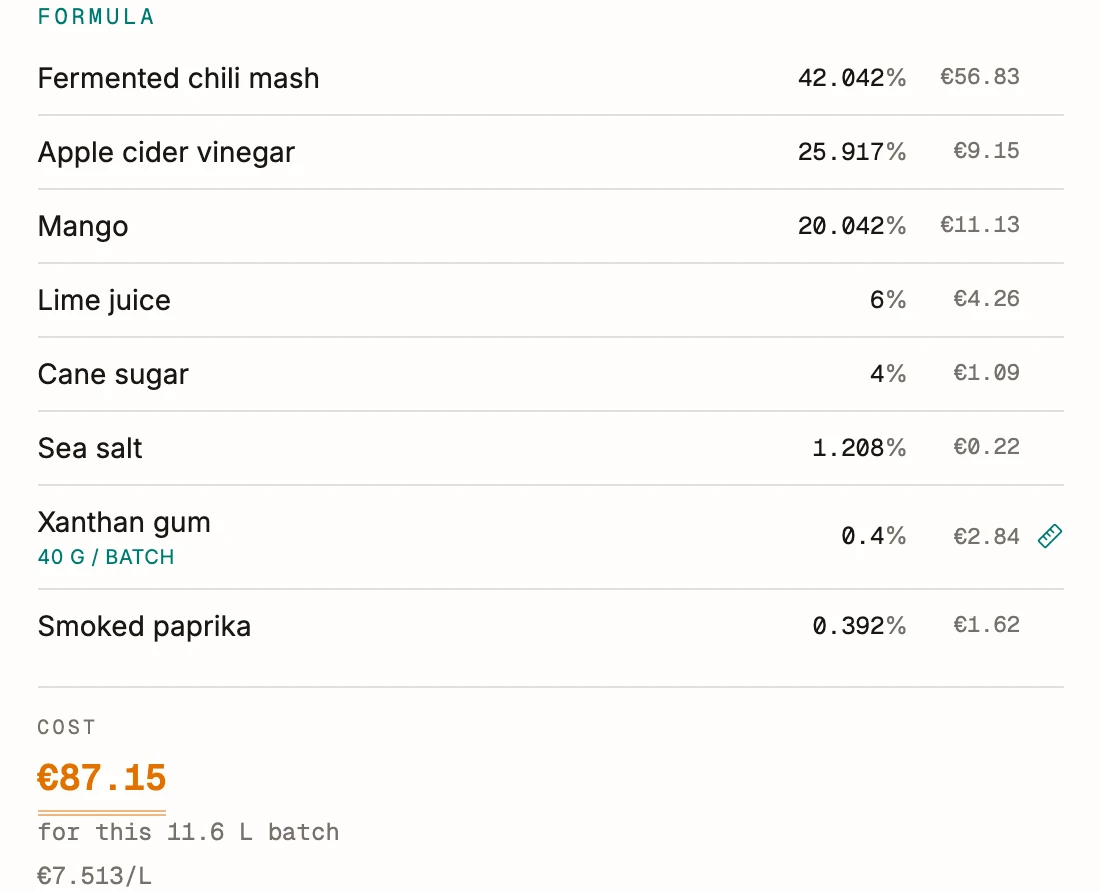
Beside the steps sits the recipe as a bill of materials: every ingredient once, folded together across the steps that use it, priced at the weighted average of what you actually paid. Sub-formulas open into their own lines. The batch total and the cost per liter, per kilo or per jar sit underneath, and they move the same second a delivery changes what an ingredient costs.
- Not every line follows the batch. A stabilizer dosed at 40 g per batch stays 40 g whether you make 10 liters or 200.
- A lid, a label or a garnish counts per portion, so it follows the number of jars rather than the mass.
- One crust per 900 g of filling rounds up for every started slice, and that line can set the batch size, so batches come in whole quiches.
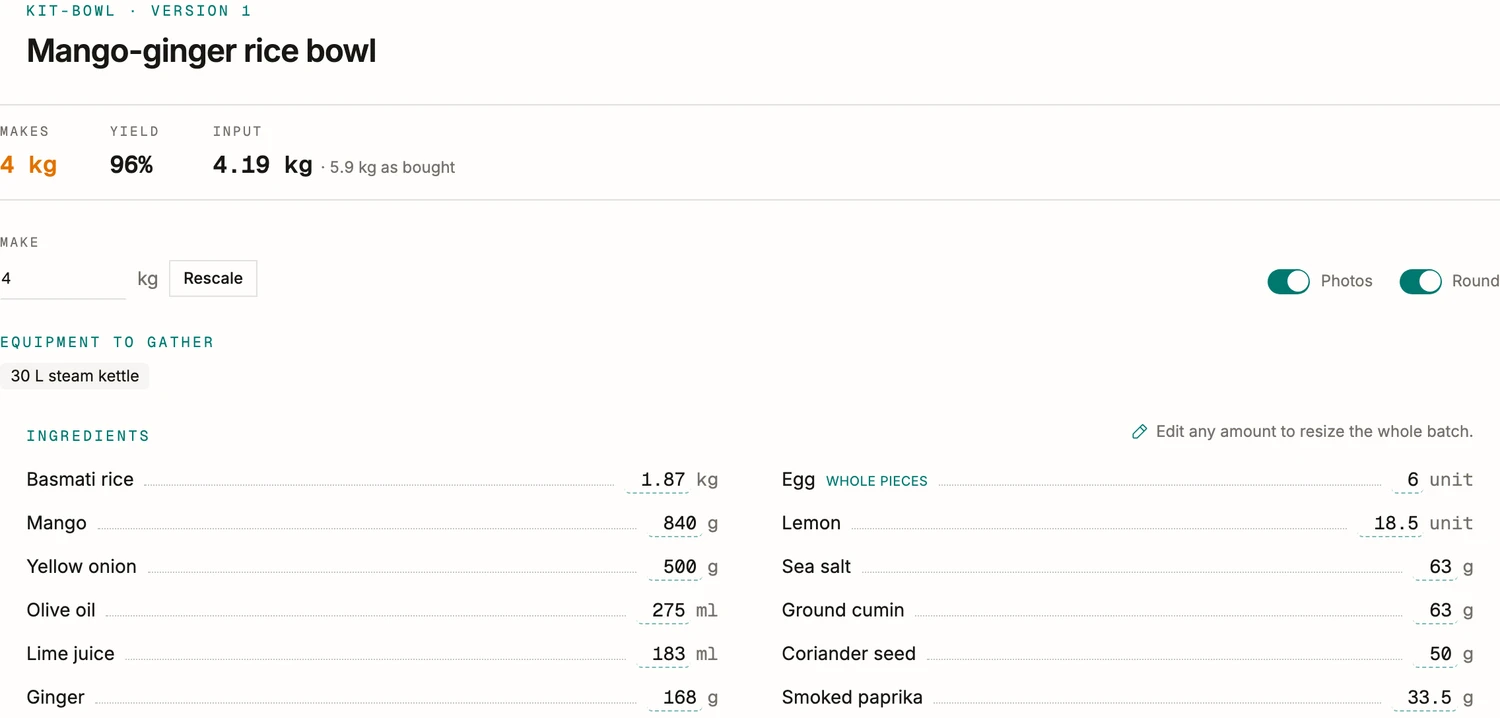
Eggs come whole. A lemon is mostly pith.
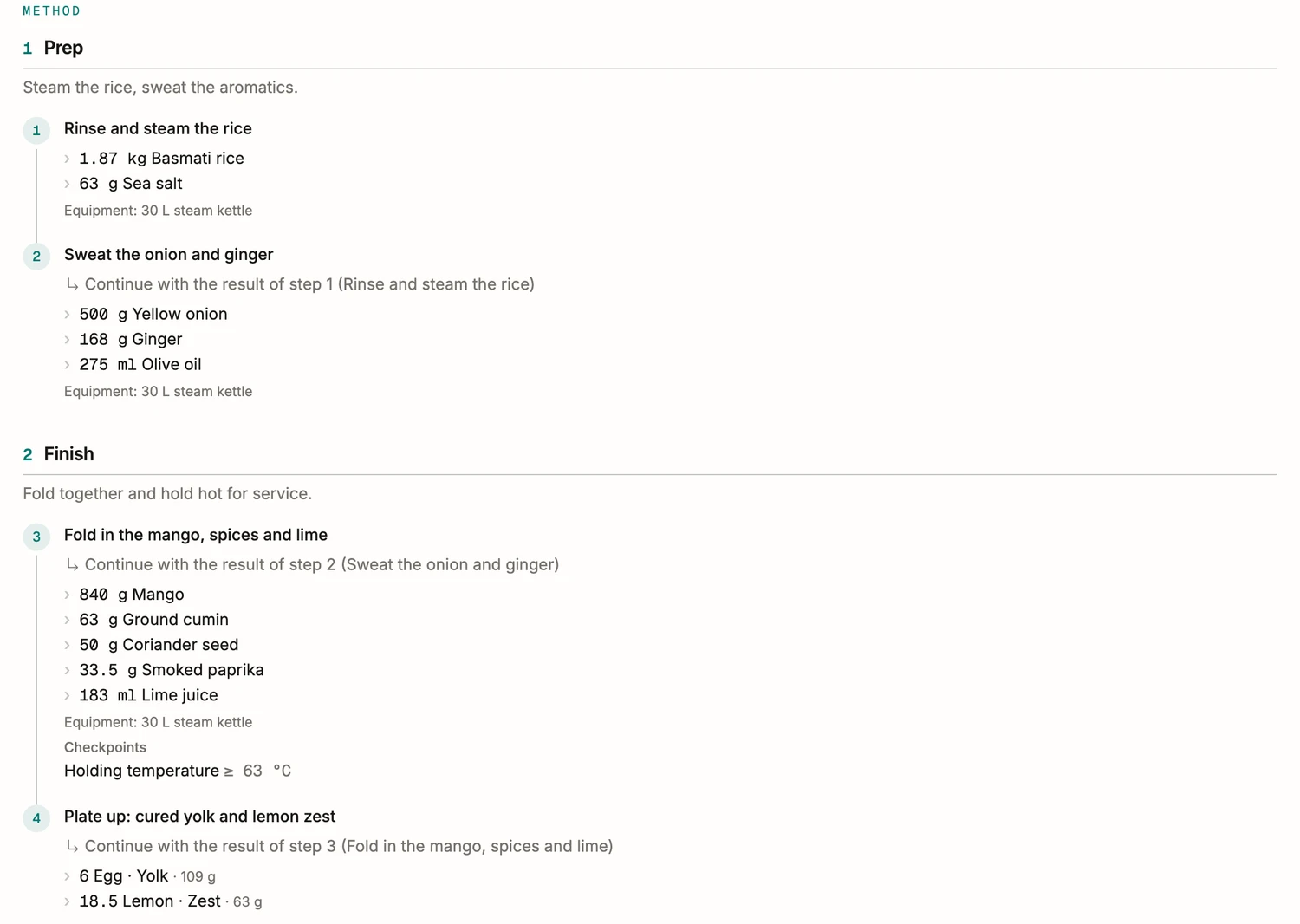
An ingredient counted in pieces carries what one piece weighs, so a recipe can ask for 2.5% egg and the sheet can ask for six of them. A piece that cannot be split says so and rounds up; a lemon that halves is allowed to be 18.5. An ingredient can also have parts, and this recipe wants the yolk and the zest. Getting them takes 6 eggs and 18.5 lemons, because a zest is 4% of a lemon. So the sheet prints the input twice: 4.19 kg goes into the bowl, 5.9 kg leaves the shelf. The second figure is the one you paid for, and a percentage column will only ever show you the first.
Recipes inside recipes
A mother sauce, a fermented mash, an emulsion base: real production nests one recipe inside another. In BatchDash the nested one is a sub-formula, one record used everywhere, and everything built on it stays true by construction.
- Cost flows through. The mash re-costs after a chili delivery, and every sauce that contains it re-costs the same second.
- A batch can draw the base from stock you already made, or make it fresh inline. The plan shows both and prices both.
- Circular references are refused at the picker, so “the sauce contains the sauce” can never be saved at 6 pm on a Friday.
Then it prints as something the bench can follow
Type the batch you are making and the whole sheet recomputes: quantities, equipment, the checks. Each step lists what goes in at that moment instead of making someone read the full ingredient list and work it out. An earlier step’s result flows into the next one by name, so a mash that becomes a sauce reads as one sequence. Checks sit where they are taken, with their target beside them. Print it, or leave it open on a phone next to the scale.
Every version still exists, and you can see what changed
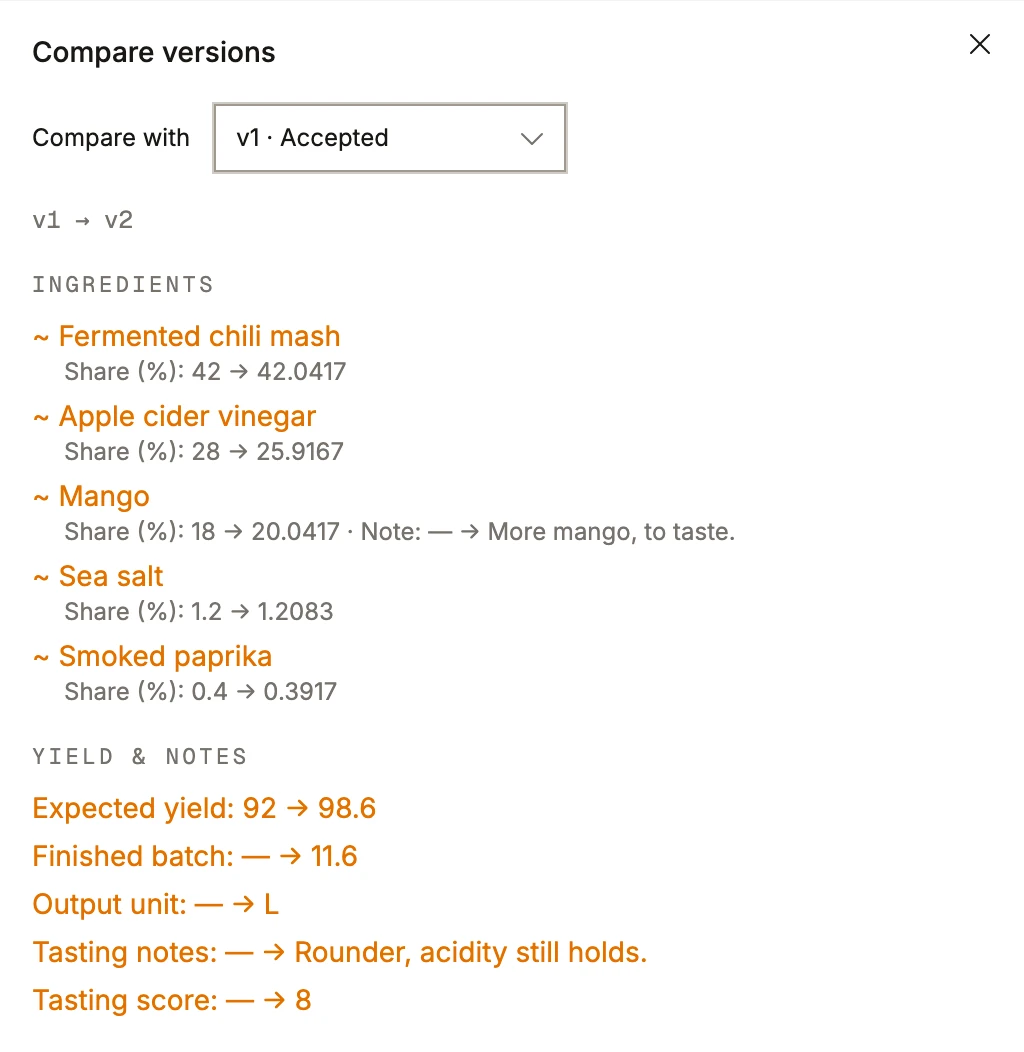
Editing a recipe writes a version instead of overwriting one. The old one stays readable, still costed, still runnable, and can be locked so nobody edits history. Branch from any version to try something on a Tuesday. Score the result, write down what you thought. The comparison between two versions then reads as the development log nobody had time to keep: the shares that moved, the note added to the mango line, the yield going from 92% to 98.6%.