
Completing a run
Complete closes the batch and moves stock. Until now the run was a working document; completion turns it into inventory and a sealed record.
The completion dialog
Section titled “The completion dialog”If the batch has checks that failed, or checks nobody recorded, the dialog says so first, with each failed check’s note next to it. A failure does not stop you closing the batch. A failure with no note does, and the message names the check. See executing a run.
Complete this batch asks for:
- Observed output: what the batch actually made, in the unit you choose.
- Lot code and Expiry: the identity the output carries into stock.
- Signed off by: who is closing the batch, prefilled with your own operator when you have one. The signer need not have worked the batch; a supervisor can close what two other people made, and signing adds nothing to the labor cost.
- Finished-product check: pass or fail, with an optional note.
- Packaging to consume, for packaged formats. A format set to “fill some, keep the rest as bulk” asks how many jars you filled; the remainder books as bulk component stock.
Who worked the batch, and how long it took, are not questions for this dialog: you record them on the run page while the batch is running (see executing a run). Whatever was captured there is sealed into the record at completion, and it is what the labor cost reads when your organization counts labor in a unit cost.
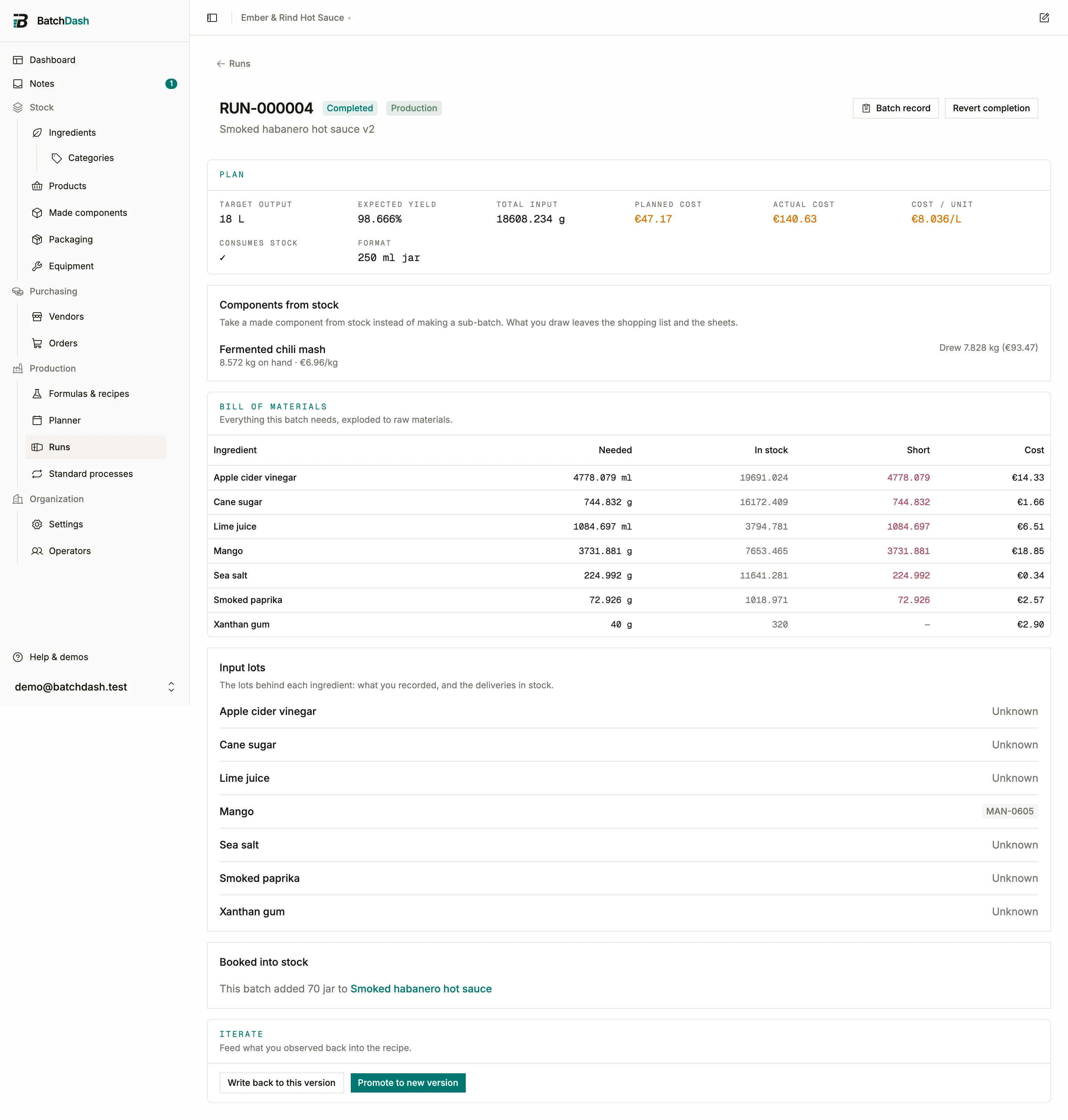
What completion does
Section titled “What completion does”- Ingredients are consumed from stock at their weighted average cost, at the amounts you recorded in What went in (a line you never recorded consumes its planned amount). The batch cost reflects what you actually paid for what actually went in, and the completed run’s ingredient list shows both figures, needed and used. A test run consumes stock only if you ticked Consume stock when completed when planning it.
- The output is booked. A component recipe books into made-component stock at the batch’s real cost; a product recipe books sellable units into the chosen format (see sellable products).
- The batch record shows the yield: observed output against expected input.
- Depending on your release setting, the output is on hand right away, or held until its finished-product check passes.
When component stock runs short
Section titled “When component stock runs short”If the batch needs more of a made component than you have on hand, your organization’s Short component stock setting decides what happens: Warn, allow override (complete anyway and let stock go negative), Block, or Take what’s there. Configure it in organization settings.
Reverting and abandoning
Section titled “Reverting and abandoning”- Revert completion reopens a completed run so you can adjust it. Stock it consumed returns to inventory and its booked output comes back out. Handy when a batch was closed with a typo in the output.
- Abandon closes a run without output, at any point before completion. If it had consumed stock, that stock is returned.