
Your first run
A run is one real batch of a formula: planned, executed, then completed with what actually came out. Your first one should be a test run. Test runs are for trials: consuming stock is optional, and you can revert them afterwards.
1. Plan the run
Section titled “1. Plan the run”On your formula’s page, press Run this recipe (or open Runs and press New run). In the Plan a run dialog, pick the recipe and version, set the Kind to Test, and enter a Target output such as 20 L. Leave Consume stock when completed off for a dry rehearsal, or on if you want the trial to draw down inventory for real.
2. Read the bill of materials
Section titled “2. Read the bill of materials”The run freezes the recipe as it stands and explodes it into a Bill of materials: every raw ingredient the batch needs, sub-recipes included, with four columns that matter: Needed, On hand, Short and Cost. A shortfall shows in its own column instead of surprising you mid-batch, and the Shopping list turns what’s missing into clean amounts and vendor packs; from there you can create a draft purchase order in one click.
The planned cost sits at the top: each line priced at the ingredient’s average cost, summed for the batch and per unit.
3. Run it
Section titled “3. Run it”Press Start run when you begin. While you work, the run captures reality: actual quantities per line, the checks each step calls for (pH 3.8, 82 °C at bottling, jars sterilized), input lot codes, who operated. The printable recipe sheet carries the scaled quantities and the method. Executing a run covers this stage in detail.
4. Complete it
Section titled “4. Complete it”Press Complete and fill in Complete this batch: the observed output (19.2 L, say), a lot code, an expiry if relevant. The run closes with its actual cost and yield.
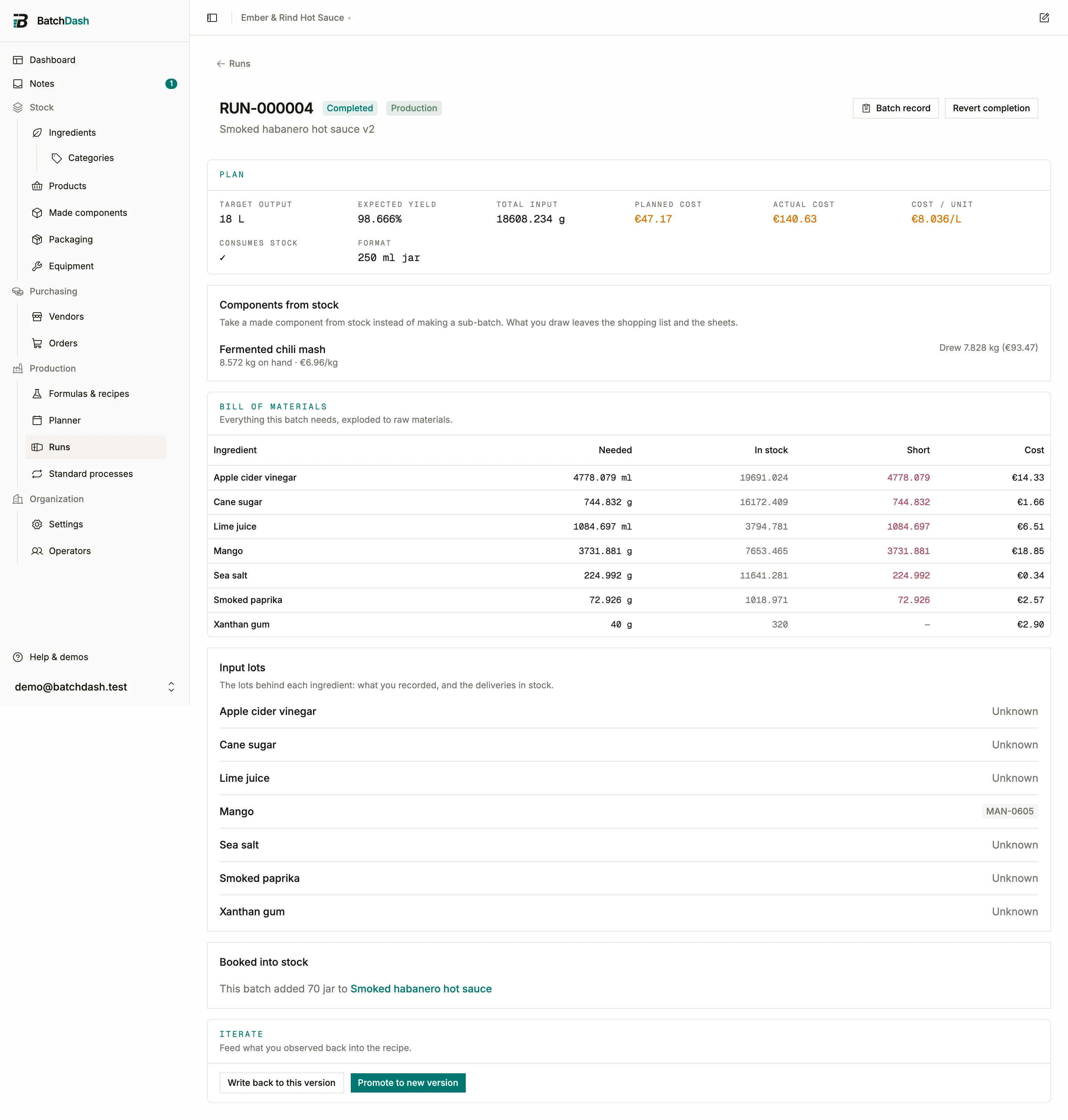
Made a mistake, or just rehearsing? Revert completion reopens the run and returns any stock it consumed. That safety net is what test runs are for.
What’s next
Section titled “What’s next”If the batch was good, feed it back: promote the run’s observations into a new formula version (iterating and promoting). For the bigger picture of test versus production runs, read the runs overview, and see yield for what that 19.2 L out of 20 L means for your cost.