
One ingredient, several variants
Cherries and pitted cherries are one fruit and two things on the shelf: two stocks, two prices, two lines a recipe might name. Mango comes fresh in season and frozen the rest of the year. Shea butter comes from two suppliers, and a batch should not stop because one of them is late. Ingredient variants keep those under one name without pretending they are one thing. They are part of your plan’s production tools, so everything on this page appears once your plan includes them.
What a variant is
Section titled “What a variant is”An ingredient is a name, “Cherries”, and the variants under it are what you hold: Cherries and Cherries · Pitted. Each variant is a complete ingredient of its own, with its own unit, stock, offers, cost, allergens and history. The name is what they share.
The first one keeps the name. Adding a second variant changes nothing about it: every recipe that named Cherries still names Cherries, every figure stays, and “Cherries” reads the same in the list, the pickers and the bills of materials. Give it a label of its own later (“Fresh”) if that reads better.
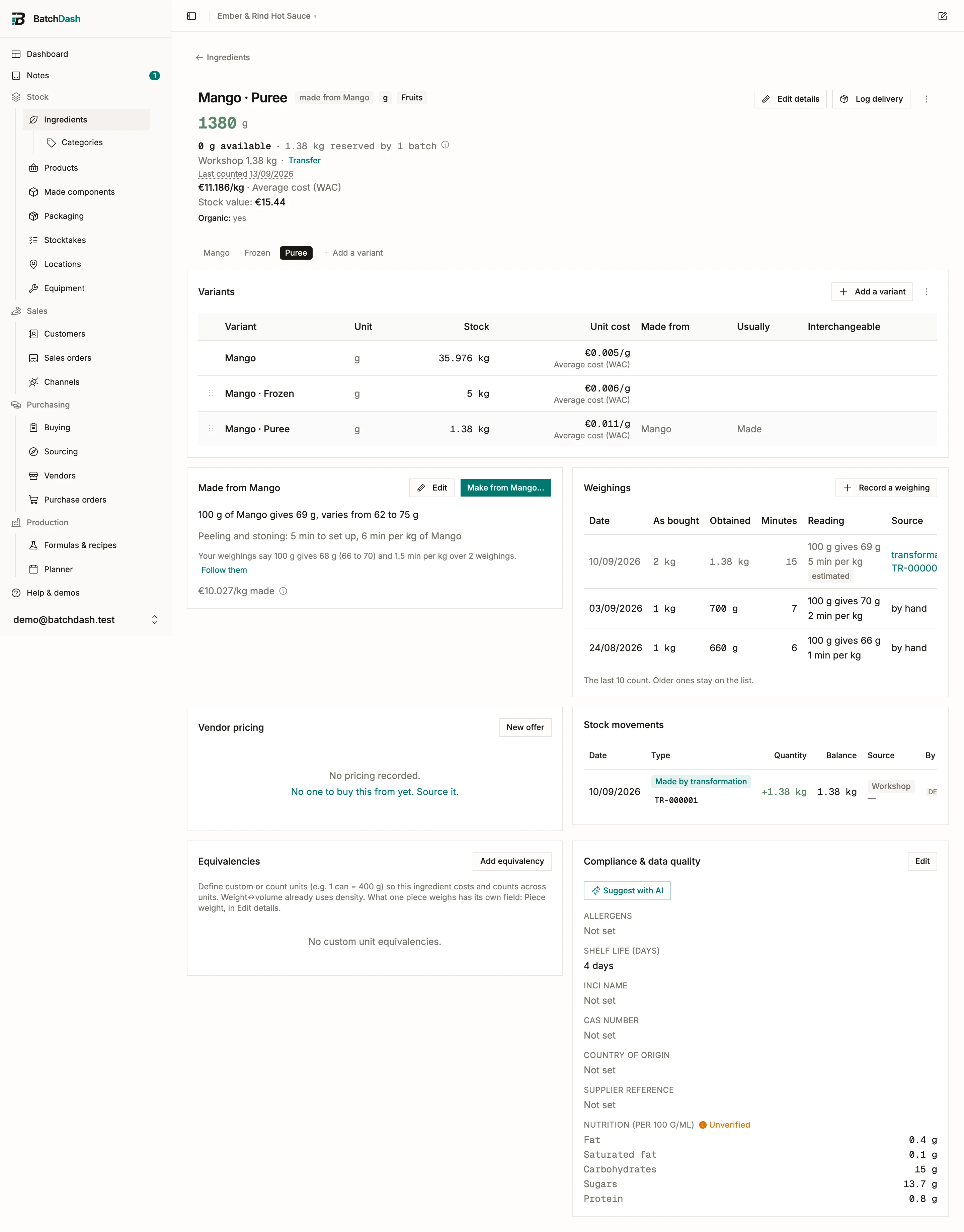
On an ingredient with variants, the page opens with a switcher naming every variant, and a Variants card lists them with their stock, their cost and how each is sourced. That card is also where you reorder them and copy the declaration fields from one to all the others, for the day an allergen list or a label name is corrected.
Adding one
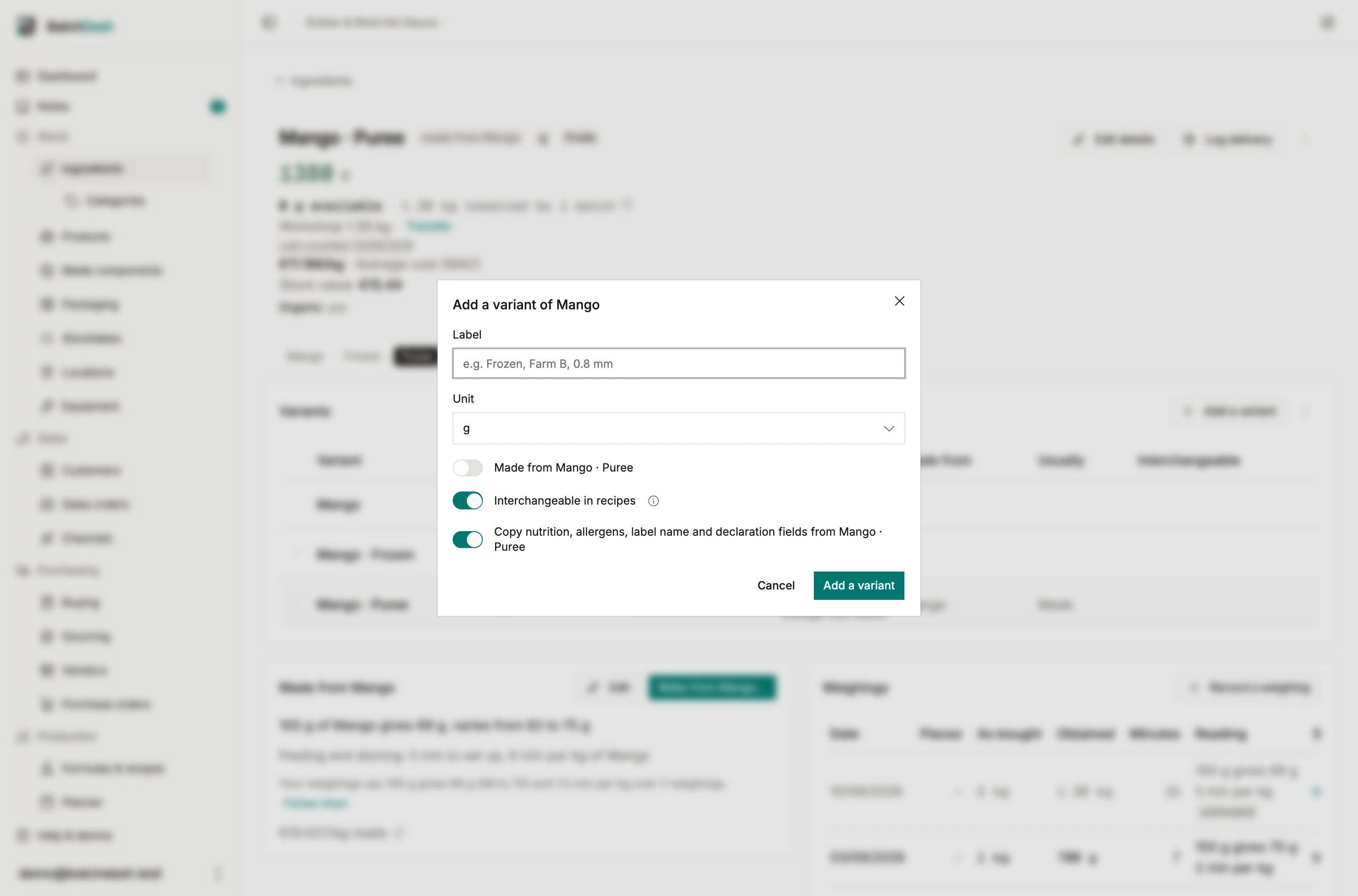
Section titled “Adding one”Add a variant on the ingredient page asks for a label and a unit, and whether the new variant is made from the one you start from. Everything on the declaration side is copied over: category, allergens, nutrition, INCI and CAS, label name, shelf life, custom fields, parts and measures. Copied, then edited on each variant: pitted cherries do not stop being cherries, but a frozen mango’s shelf life is not the fresh one’s.
The unit is the variant’s own. Passion fruit is counted in pieces; its pulp is weighed. The two meet through mass, which is why a counted variant needs a piece weight before anything can be made from it.
An ingredient you already have can join another with Make this a variant of… in the ⋮ menu. Only its name changes; its stock, offers, recipes and history stay exactly where they were. The merge dialog offers the same when two duplicates turn out to be two forms of one thing.
A form made from another
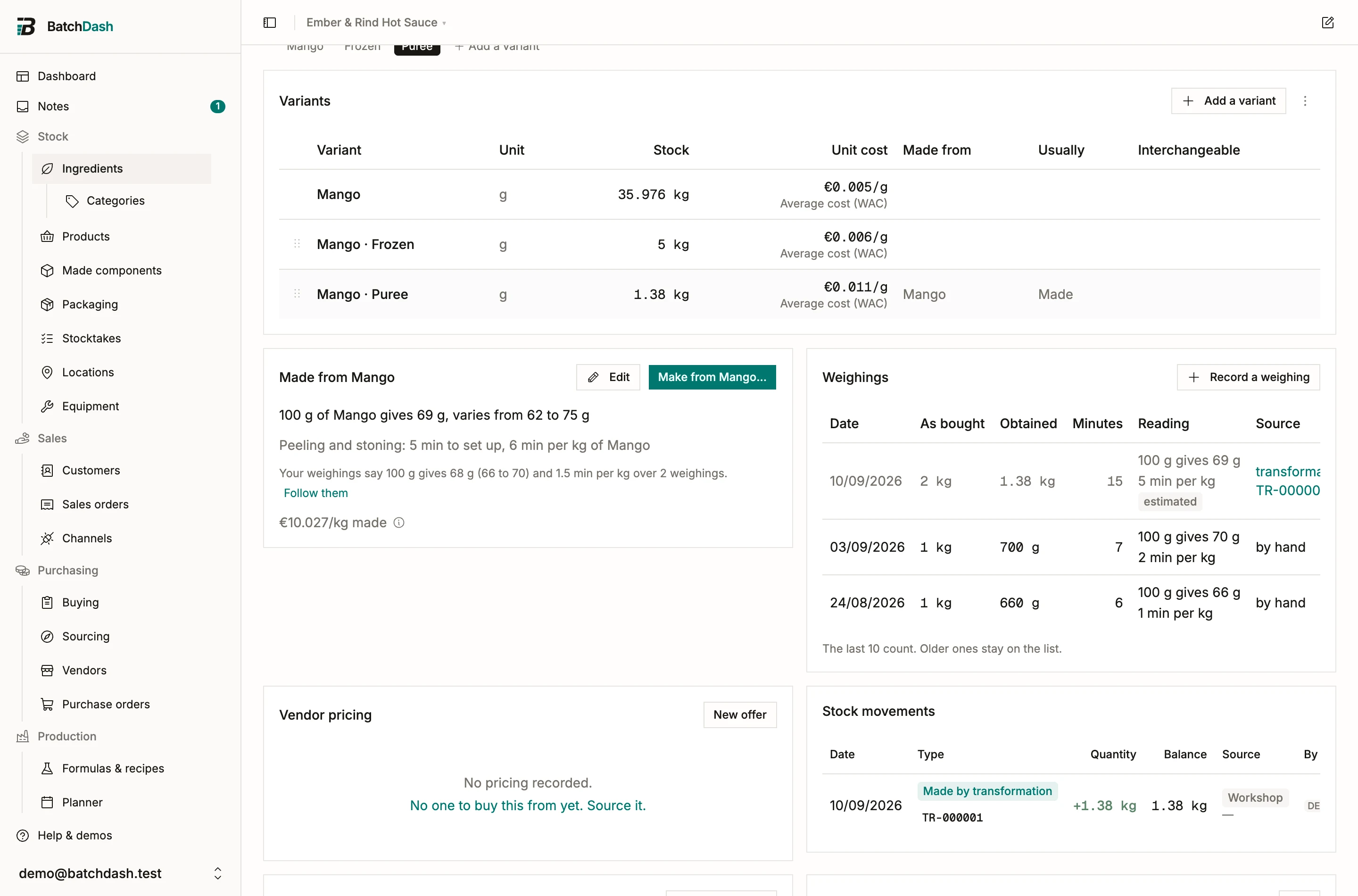
Section titled “A form made from another”Some variants you make yourself. Pitted cherries come from cherries, mango puree comes from mango, the pulp comes out of the passion fruit. Say so on the variant’s Made from card, in three figures: what 100 g of the source gives (100 g of mango gives 69 g of puree), the range a lot falls in (62 to 75, because fruit varies), and the time, “Peeling and stoning: 5 min to set up, 6 min per kg”.
Those figures give the variant a made cost: the source’s cost divided by what it gives, plus the time at your rate when your cost policy counts labor. It sits beside the bought one whenever there is an offer, and one switch says which of the two prices your recipes: Usually bought or Usually made. It is also the switch a batch follows when it runs short.
The range does one more thing. A recipe costed on a ranged variant shows a cost band, cheap end to dear end, and a batch making from a ranged source buys a little more than the average lot needs, so a poor lot still makes the batch. Yield is the same idea one level up.
A variant created without a figure can ask for one: AI enrichment proposes what 100 g of the whole ingredient gives for a form it knows, pitted, peeled, pulp, with a typical range. Accept it and the link is complete, with the figures written as if you had typed them.
Recording a transformation
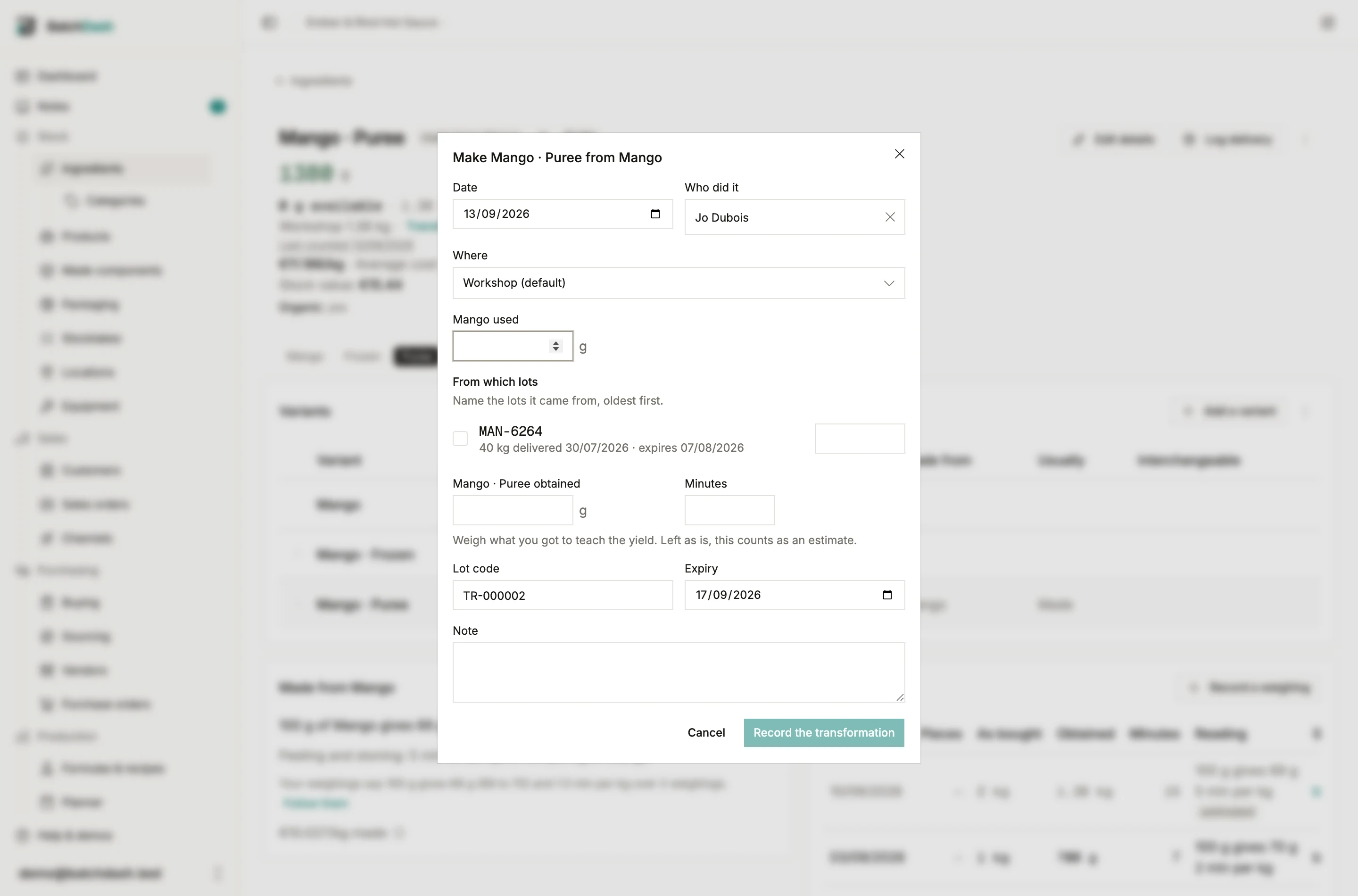
Section titled “Recording a transformation”When you pit a crate of cherries or peel a case of mangoes, record it: Make from Mango… on the puree’s page. What went in (2 kg of mango, and from which lots), what came out (1.38 kg of puree), how long it took (15 min), who did it, and the lot code the puree will be known by, TR-000001 unless you type one. The lots are the source’s recent deliveries, one row each with the vendor, the quantity and the date. Two suppliers can stamp the same code on their crates, so you tick the crate you emptied and the record keeps that delivery.
Stock moves the way it did on the bench. The mango leaves at its average cost, the puree arrives at what it cost to make, labor included under your policy. The transformation is a record with a reference of its own, it traces both ways, and it can be undone while nothing has used what it made.
It is also a weighing. Every transformation writes down what 100 g of the source gave and how long it took, on the variant’s Weighings card, beside the ones you type by hand and the ones a batch captures. The card says what your last ten weighings put the yield and the time at, and offers Follow them: press it and the link’s figures move with each new weighing. Until you do, they stay what you typed. On a counted ingredient the same card teaches the piece weight, and a delivery you counted against a scale counts as a weighing too.
A batch that makes a variant on the day
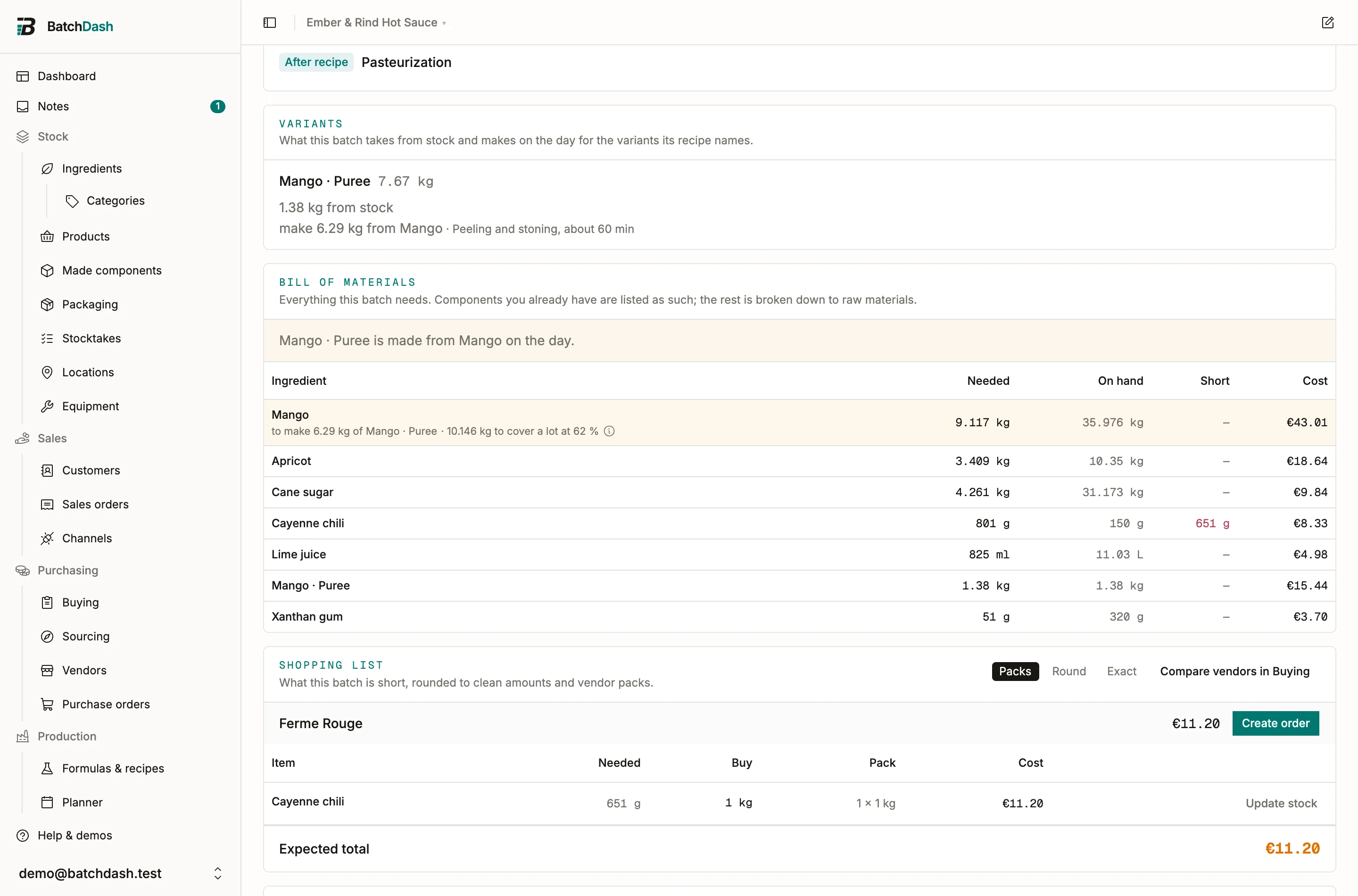
Section titled “A batch that makes a variant on the day”A batch short of puree does not stop. Its bill of materials shows the puree it takes from the shelf, then a tinted row for the mango it will peel and stone on the day, “to make 6.3 kg of Mango · Puree”, with the cover figure a poor lot would need beside it. The recipe sheet lists the operation in a block of its own, the time joins the estimate, and while you run the batch the capture row has an Obtained box: weigh what the source gave, all of it, and that weighing teaches the yield the way a transformation does (executing a run).
The shopping list and Buying read the same plan. A short variant you usually buy says what making it would take and what that costs beside the offer; a short source you make from says what it is for and what buying the variant ready-made would cost. Either line has a switch.
Two suppliers, kept apart
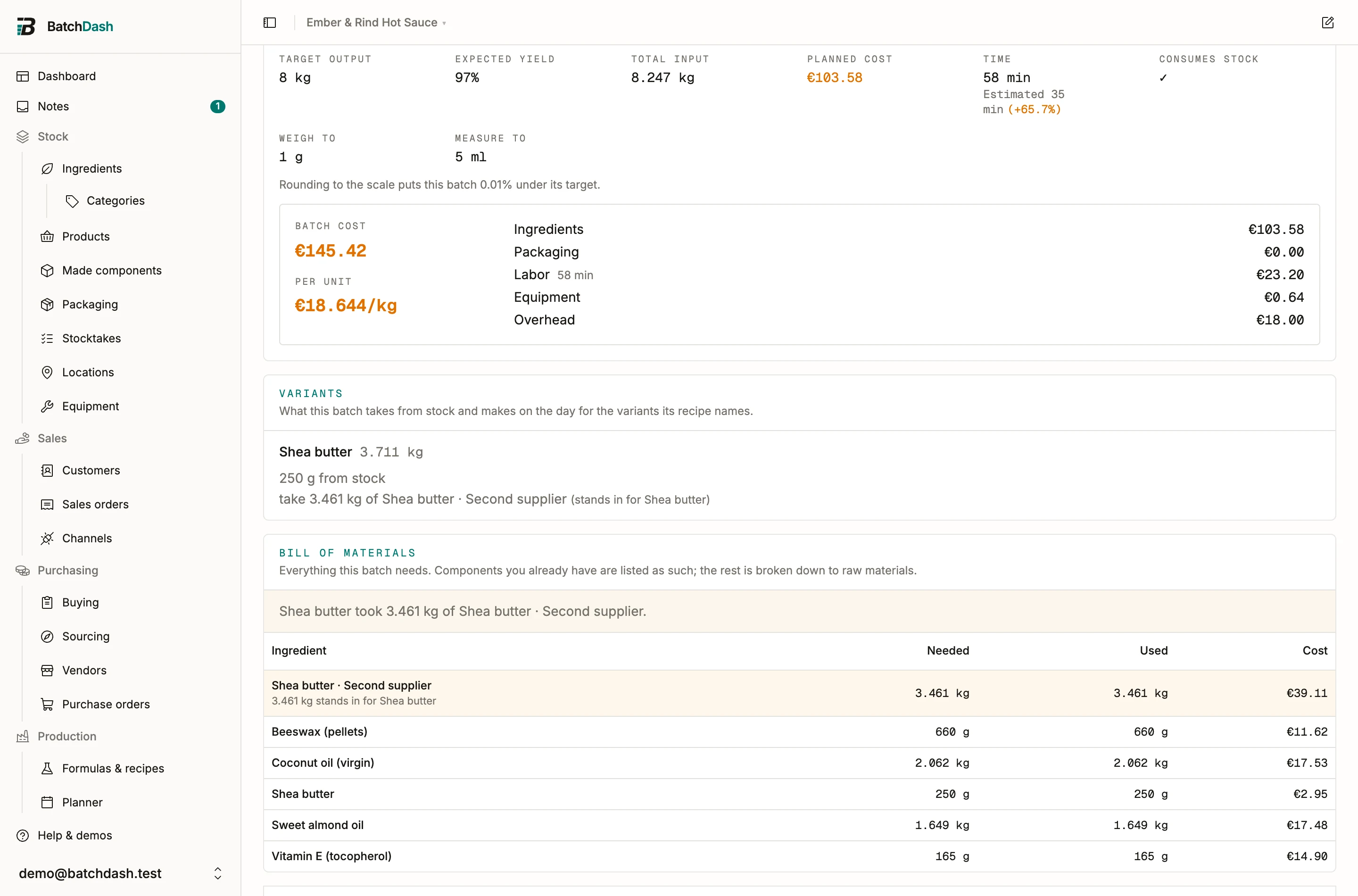
Section titled “Two suppliers, kept apart”Shea butter from two suppliers is two variants, two stocks and two prices, and a batch should not stop because the first shelf is down to its last 250 g. Mark them interchangeable in either one’s details, and a batch short of one takes the other, on a row of its own: “3.46 kg stands in for Shea butter”. Nothing is swapped quietly.
The batch’s Variants card is where you see and change that. Each line naming a variant says where the batch gets it, its own shelf, a stand-in, a make, or a shortage, and you can decide otherwise per line. A stand-in whose allergens or INCI differ from the one the recipe named is planned, said out loud, and waits for your word before the batch can close. The app never confirms that for you.
A recipe line can also say what it allows: this variant only, any variant of the ingredient, or the interchangeable pool, which is the default. That is set from the line’s chip on the bench.
Parts or variants
Section titled “Parts or variants”A part is what one piece separates into on the bench, in the recipe, on the day: the yolk and the white, the zest and the juice. A variant is a thing you hold: a stock, a price, a shelf. Pitted cherries you keep in a tub are a variant; the pits you throw away as you cook are a part.
A component recipe is still the right tool when something is added, or when the work has steps worth a record: roasted peppers with oil and salt, a fermented mash. A transformation is one ingredient becoming one form of itself, with nothing added.