
Categories and custom fields
A category groups ingredients that share a shape: chilis, essential oils, dairy. Beyond filtering the list, a category defines the custom fields its ingredients carry, so a chili record can ask for a Scoville rating and an essential-oil record for a batch certificate number, without either polluting the other.
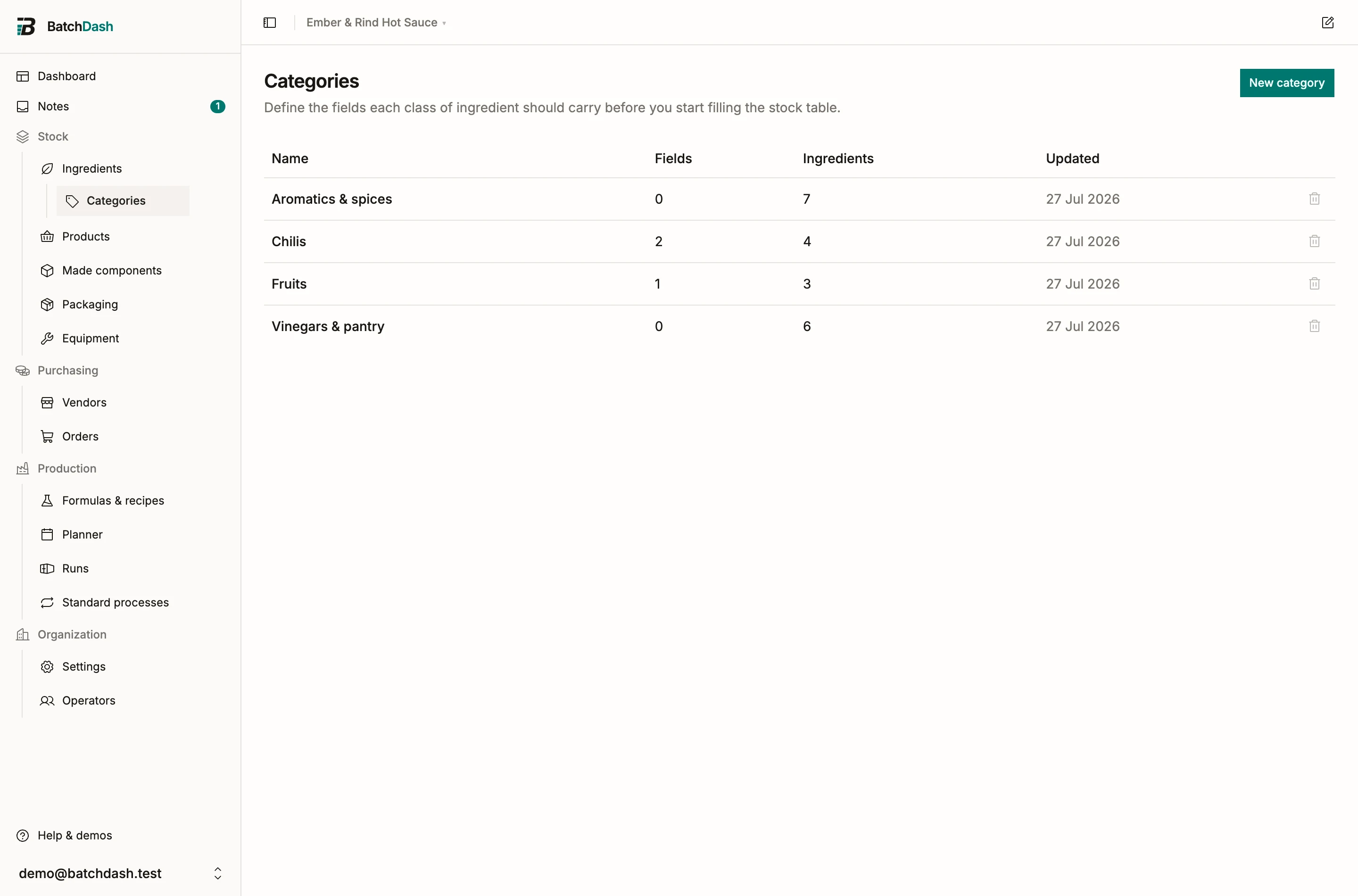
Create a category
Section titled “Create a category”- Open Categories and click New category.
- Name it (“Chilis”) and click Create category. You add the fields on the next screen.
Renaming is always possible. Deleting is blocked while ingredients still use the category.
Add custom fields
Section titled “Add custom fields”On the category page, click Add field and set:
- The Field name: “Scoville”, “Origin”, “Organic”.
- The Type: Text, Number, Yes / No, or Select (one option per line).
- Show in inventory table if the value deserves a column of its own.
Fields appear on every ingredient in the category, in the order you define. Drag them, or use Move up and Move down; the ingredient form preview beside the list shows exactly what the form will look like. Deleting a field hides existing values on ingredients without erasing them.
Fields as inventory columns
Section titled “Fields as inventory columns”Tick Show in inventory table and the field becomes a column on the ingredients list whenever you filter to that category. This is the payoff for a workshop with one dominant family: the hot-sauce maker filters the inventory to “Chilis” and reads Scoville next to Stock and Avg cost. Comparing heat sources becomes a glance instead of a side spreadsheet.
Assigning ingredients
Section titled “Assigning ingredients”Pick the Category when creating an ingredient, or later through Edit details on its page. An ingredient without a category simply carries no custom fields. To set one on many ingredients at once, tick them in the list and use Set category in the action bar; to assign categories while migrating data, see Importing ingredients.
One habit worth forming: create the category and its fields before entering a family of ingredients. Adding “Scoville” after typing thirty chilis means opening thirty records to backfill it.