
Planning a run
Planning a run answers two questions before you weigh anything: what exactly will this batch take, and do you have it in stock?
Create the run
Section titled “Create the run”- On the Runs page, click New run (or Run this recipe from the recipe itself).
- Pick the recipe and the version to run.
- Choose the kind: Test or Production. For a test run, tick Consume stock when completed if you want the trial to draw down inventory.
- Set the Target output and its unit. For a portion-based recipe, the field shows the equivalent mass. A recipe made in whole containers says so here too: ask for 10 portions of a quiche whose crust holds 8 and the field reads 10 portions is 1.25 batches, offering 8 portions and 16 portions. Click one, or plan the 10 anyway; see scaling rules.
- For a production run, choose the format under Produce as: a presentation such as a 250 ml jar, or Bulk component. Each presentation counts its own sellable units.
- Check the Reference. It is assigned from your organization’s pattern (RUN-000123 unless you changed the pattern); click Customize to type your own for this run. An organization that turned automatic references off types one here instead.
- Click Plan run.
With more than one location, the dialog asks where the batch is made, preset to your default: ingredients and components are drawn there and the output lot is booked there. You can change it while the run is planned.
A product’s replenishment rule can create the planned run for you; it lands in the list like any other, wearing a Planned by rule chip.
The bill of materials
Section titled “The bill of materials”The run page shows the Bill of materials: everything this batch needs. Each line shows Needed, On hand, Short, and Cost. Shortfalls are flagged as soon as the plan is computed, so you find out now rather than the morning you planned to produce.
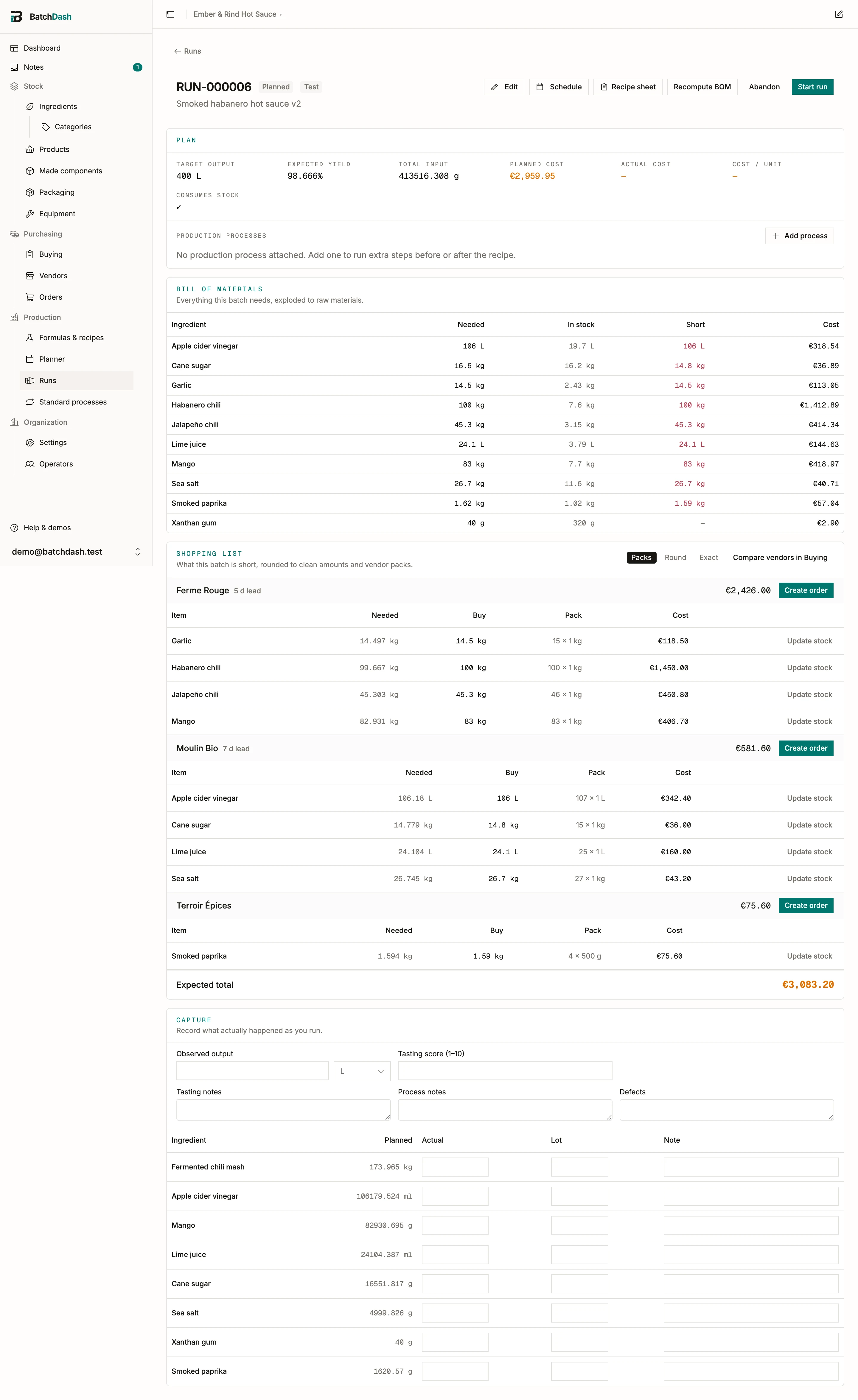
A component you already have is listed as itself, marked from stock, with the amount taken and what it cost. Everything else is broken down to raw ingredients. So a batch that draws its fermented mash from the walk-in shows the mash, not the chilies and salt that went into it last month, and the shopping list stops asking you to buy them.
If your organization recorded what its scale reads (Weighing), every amount here is already rounded to that step, and the sheets ask for the same figures. A line too small to round safely is tagged Weigh precisely instead.
Variants made on the day
Section titled “Variants made on the day”A recipe that names pitted cherries, with not enough of them on the shelf, makes the rest from cherries when the pitted cherries are made from them. The Variants card says how: “500 g: 200 g from stock · make 300 g from Cherries”. In the bill of materials, the Cherries row comes first, tinted, with what it is for under its name: “to make 300 g of Cherries · Pitted”. When the yield has a range, the row adds what to have on hand for a poor lot, “353 g to cover a lot at 85 %”, and the Short column says so when the shelf holds enough for an average lot and not that one. Reservation, cost and the ledger read the expected figure. The final recipe sheet lists the operation: “Pitting: 341 g of Cherries → about 300 g of Cherries · Pitted”.
A variant that is usually bought, and has an offer to buy it from, is not made: its shortfall goes on the shopping list as it always did.
Another supplier’s variant standing in
Section titled “Another supplier’s variant standing in”Short of the shea butter a recipe names, the plan takes from another variant of the same ingredient when both are marked Interchangeable in recipes and the recipe line allows it. Each one is its own row: “Shea butter 300 g: 100 g from stock · take 200 g of Shea butter · Supplier B”, the notice above the table says “Shea butter took 200 g of Shea butter · Supplier B”, and the capture card asks what you weighed of each. The batch record and its label read what went in.
The Variants card is where you change that before the batch starts. Per line: let the plan decide, this variant only, take it all from one sibling, or make it all from the source. The recipe line’s own chip still rules what the plan may reach for: Any interchangeable variant (the default), This variant only, or Any variant, which widens to every variant of the ingredient, interchangeable or not.
A variant the named one is made from never stands in for it. The two are joined by a yield factor, so a gram of one is not a gram of the other, and the make step is what bridges them.
A variant whose allergens or INCI differ is never swapped in silently. The plan proposes it, marks the line Needs a decision, and says what differs: “Shea butter · Supplier B differs from Shea butter (allergens). Confirm on the Variants card.” The batch cannot be completed until you press Use Shea butter · Supplier B anyway or pick something else. Nutrition figures that differ are a note, not a decision.
With more than one location, a sibling whose stock sits in another room is still planned, and the card offers the move: “Move 200 g of Shea butter · Supplier B from Cold room to Kitchen for this batch.” Move it now books the transfer and plans again.
An ingredient that comes in fixed pieces rounds up to the next step whatever your scale says, because a whole egg is not divisible. A batch that works out at 0.6 of one asks for 1, the whole egg goes in, and the row is tagged whole pieces with the figure it came from. Nothing is written off; the batch is that much richer, and the run says how far whole pieces moved it off its target.
Components you already have
Section titled “Components you already have”When the recipe calls for a sub-formula you have in stock, the Components from stock card offers to take it rather than make a fresh sub-batch.
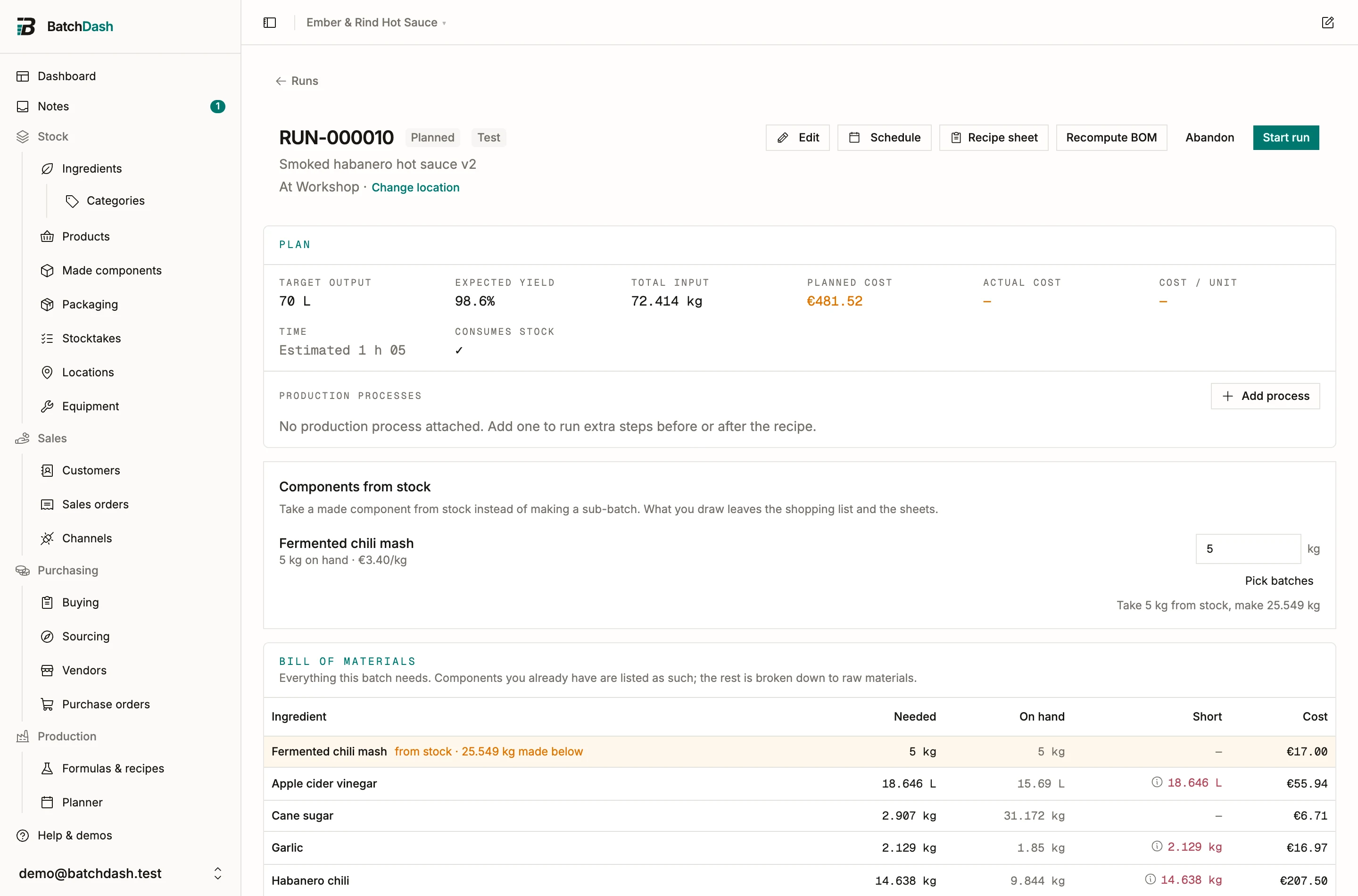
The line reads Take 1 kg from stock, make 1.33 kg. Cover the whole need, take what is on hand and make the rest, or make all of it. Whatever you take drops out of the shopping list and off the sheets, and the sheet for that component says why it makes less than the recipe calls for.
Choose batches goes further: name the tubs. Use up the 100 g of MASH-24-031 that is nearly empty and make the other 1.9 kg fresh. Each row shows what is left, when it was made and its expiry, and Max takes all of one. Naming a batch is what lets the trace say which run used which tub instead of listing every batch that could have.
Drawing needs Consume stock when completed ticked. A run that consumes nothing makes everything, because nothing it does touches a shelf.
Stock other batches have spoken for
Section titled “Stock other batches have spoken for”Plan two runs against the same component and the first one holds what it took. The second sees 8.6 kg in stock · 1 kg held by other batches and will not plan against the kilo that is already promised.
The hold is a promise, not a movement: the tub is still physically on the shelf, and nothing leaves stock until a run completes. Abandon a run and its hold lifts on its own. Lots sitting at another location appear greyed: transfer them to the batch’s location first.
The shopping list
Section titled “The shopping list”Below the BOM, the Shopping list turns shortfalls into something you can buy. Pick a rounding policy: Exact (the raw shortfall), Round (clean amounts), or Packs (whole vendor packs, based on your vendor offers). Lines with an offer show the pack, the cost, and the lead time, and the list adds up to an expected total. From there:
- Create order builds a draft purchase order from the list.
- Update stock corrects an on-hand level when the shelf says otherwise. The list recalculates from it.
Items without a vendor offer still appear; buy those yourself, or add an offer to price them.
The list only shows while there is something left to buy. Once a shortfall is on an open order, its line leaves the list and the BOM row says so instead: 1 kg on order next to the Short column, in place of a red figure for stock that is already on its way. When everything is covered, the whole section disappears.
While the run is planned
Section titled “While the run is planned”Nothing is frozen yet. If you edit the recipe, receive a delivery, or change the target, click Recompute BOM to rebuild the plan from the current state of everything. The reference can still be corrected from Edit too. The snapshot and the reference only lock when you start the run.
A planned run is also where you attach a production process such as pasteurization, before or after the recipe.