
Planning production
Once a batch has a date, the planner checks it for you. Every production day is measured against what is on your shelves and what is already on order, in the order the batches actually run.
Put a batch on a day
Section titled “Put a batch on a day”A run has to exist before it can be scheduled. Plan it first from Production → Runs (see planning a run), then give it a day one of three ways:
- On the planner, click an empty cell and pick Production, then choose the run.
- Drag it out of the Runs without a date tray at the bottom of the board.
- From the run itself, use Schedule in the header.
Unscheduling is the same editor: open the entry and choose Unschedule. The run goes back to the tray and keeps everything else about it.
Runs a replenishment rule planned arrive in the tray on their own, marked “needs a date”.
The four verdicts
Section titled “The four verdicts”Each scheduled batch carries one of four verdicts, worked out by running down your calendar day by day and subtracting what each batch consumes.
| Verdict | What it means |
|---|---|
| Ready | Your stock covers it on the day. No badge, because there is nothing to decide. |
| At risk | It only works if a delivery lands first. Feasible, but it depends on somebody else. |
| Short | Something is missing even counting what is already on order. This is the one to act on. |
| Unverified | The recipe could not be fully resolved, so no honest verdict is possible. |
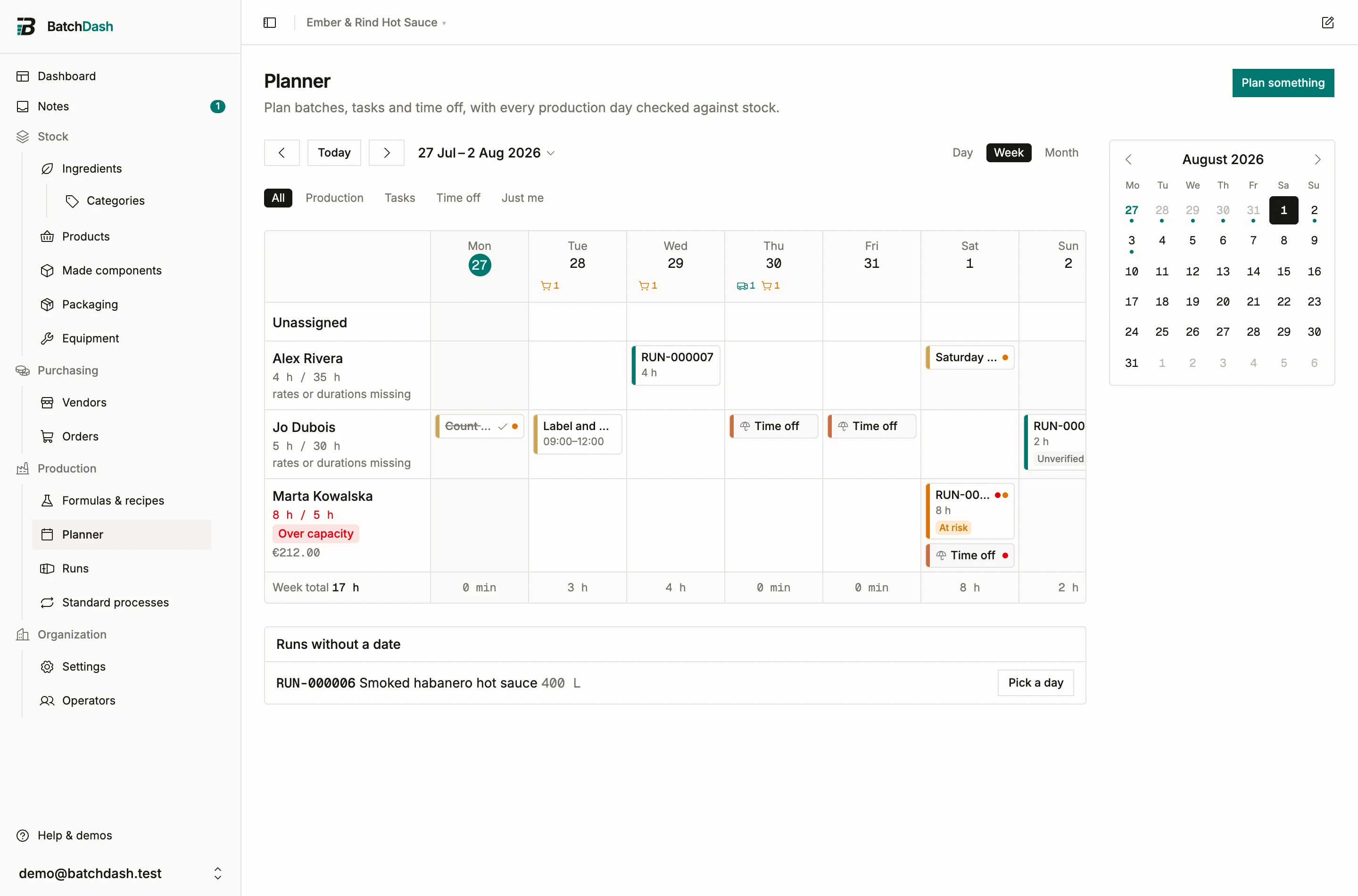
Two things worth knowing about how this is worked out. Batches are checked in date order, so an early batch that eats the last of an ingredient is what makes a later one short. And a delivery expected on the same day as a batch counts as arriving first, on the assumption you receive in the morning and produce after.
What will be missing
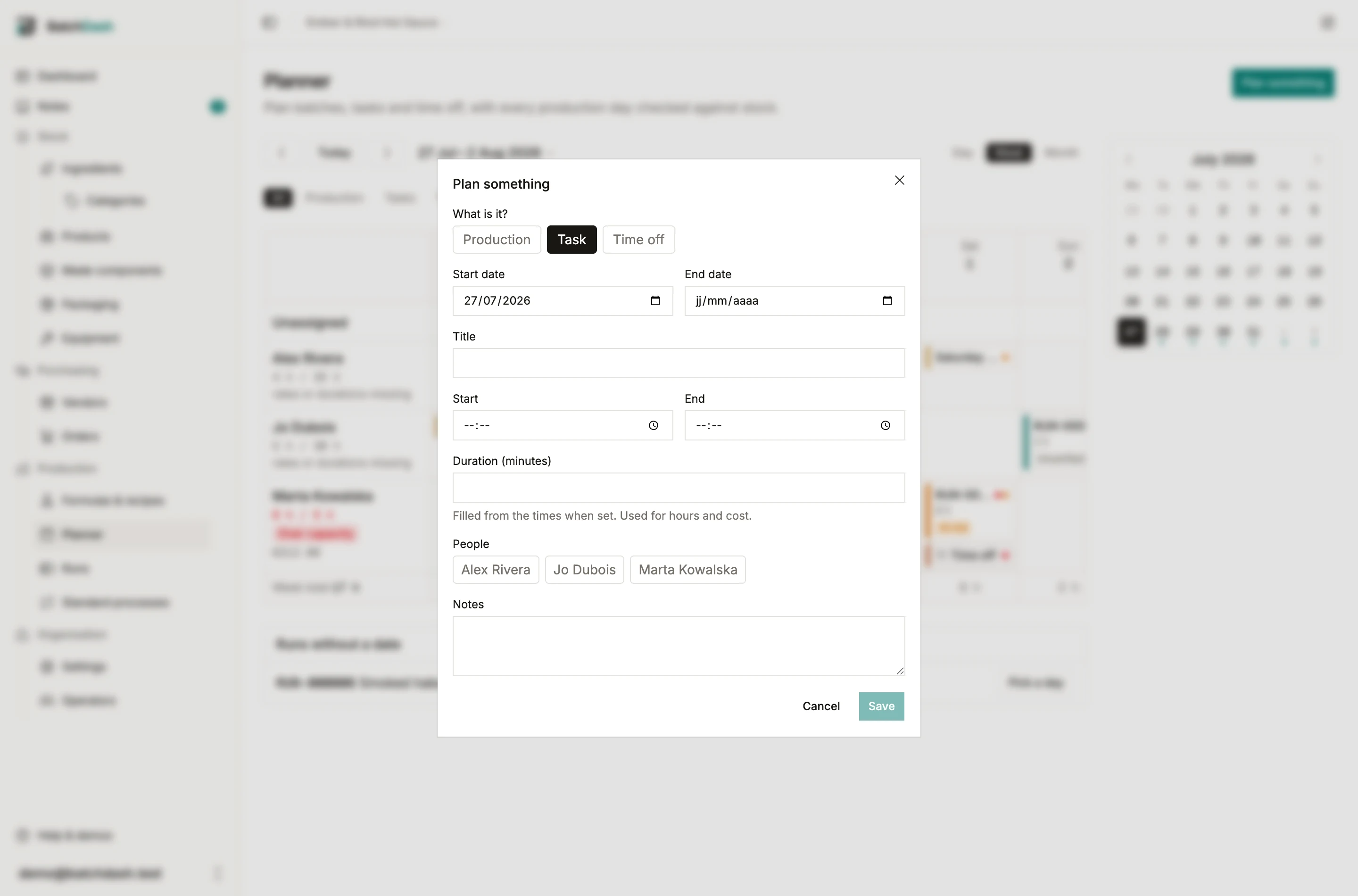
Section titled “What will be missing”Click a batch to open it. When it is at risk or short, the editor lists what runs out on that day and how much of it.
The last day to order
Section titled “The last day to order”A short batch produces an order-by date: the day it runs, minus the lead time on the cheapest offer for that ingredient, among the vendors Buying would buy it from. A vendor you only ever received from counts at the price you paid them, and has no lead time to subtract. The board shows a small cart marker on the day. Click it for the list.
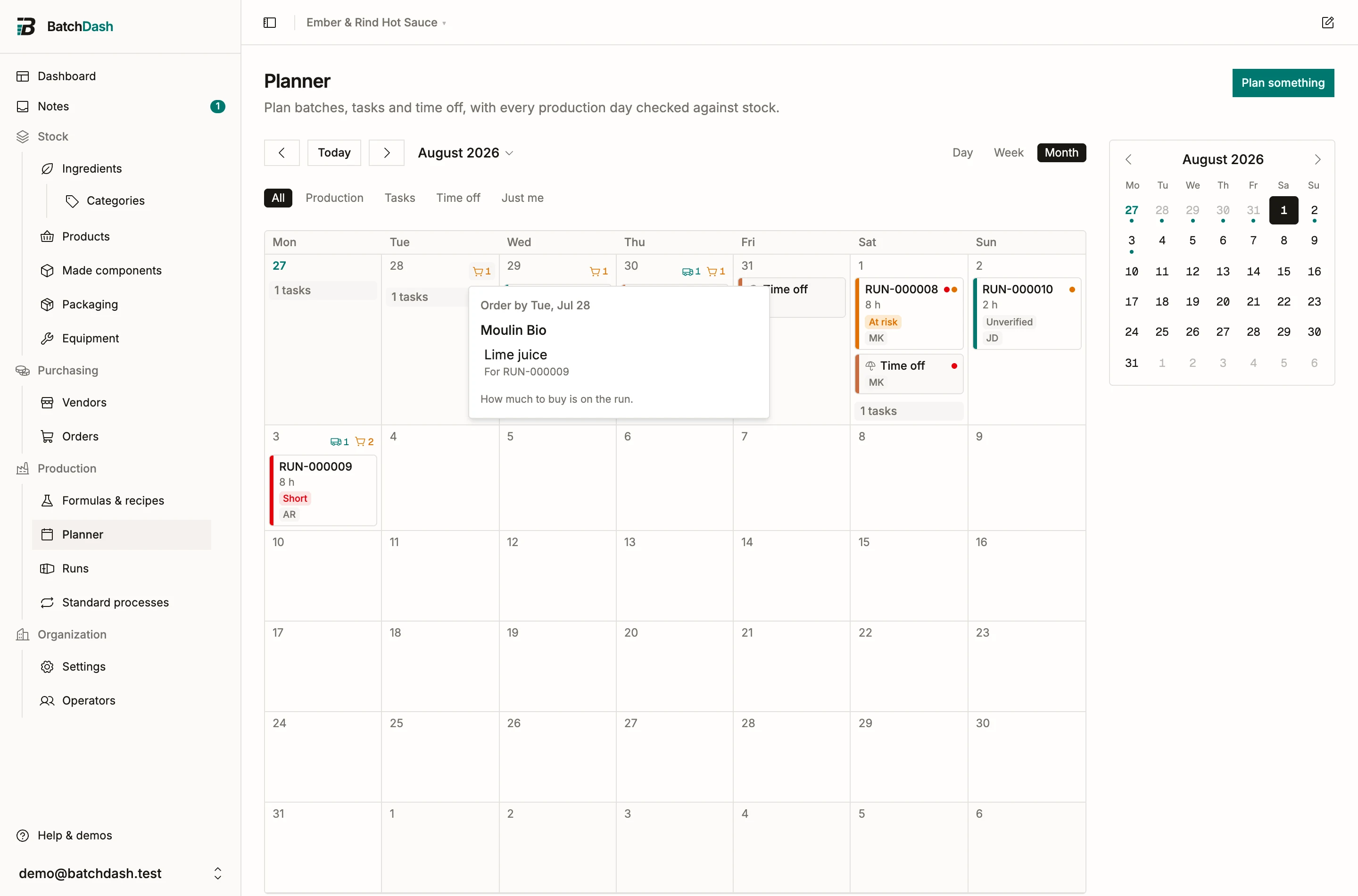
The panel groups everything by vendor, because that is how you actually place an order. Each line links to the batch that needs it, where the shopping list works out how much to buy in whole packs. The planner answers when and from whom. The run answers how much.
A few cases the panel spells out:
- Lead time unknown means the vendor offer has no lead time set, so the date is the batch day itself. Add a lead time to the offer to get a real deadline. A vendor you only received from always reads this way, since a price paid last time promises no delivery day.
- No vendor yet means nothing prices that ingredient, so there is no vendor to name. Add an offer on the ingredient, or log a delivery from the vendor you buy it from.
- Overdue means the order-by date has already passed. The marker turns red and the date clamps to today, since the answer is now “order it today”.
Deliveries
Section titled “Deliveries”Purchase orders you have placed show as a truck marker on their expected day, with the vendor and line count in the same panel. Only orders that are actually placed count: a draft never feeds the verdicts, and neither does an order with no expected date. A late delivery keeps showing on today, flagged overdue, because you are still waiting for it.