
Ingredients you count
Some things on your shelf are weighed and some are counted. Flour is weighed. Eggs are not: you have 40 eggs, not 2.2 kg of egg. Stock them in Units / Pieces and the count is what the ledger holds.
Counting is the easy half. The hard half is that everything else in the workshop still talks in weight. Your grower quotes 25 kg. Your recipe says 3.3% egg. The crate on the bench weighs 4.2 kg. One number bridges all of it.
The piece weight
Section titled “The piece weight”Piece weight is what one of them weighs. It sits on the ingredient’s Edit details, right where density sits on something you measure by volume, and it only appears on an ingredient stocked in Units / Pieces.
Fill it in and four things start working:
- A recipe can call for egg by weight while your stock keeps counting eggs.
- A vendor can quote by the kilo and the offer still stores a pack size in pieces.
- A delivery weighed at goods-in can be turned into a count.
- Costs read per piece, which is the only figure that makes two offers comparable.
Leave it empty and nothing breaks. The ingredient behaves exactly as it always did: you count it, you buy it by the piece, and the screens that would convert simply do not offer to. The ingredient’s own page says so, with a line under the header offering to fix it.
With ingredient variants, the piece weight can also follow your weighings. Every time you count pieces against a scale (a corrected delivery count, or a weighing typed on the Weighings card), a line under the header says what the last ten weighings put one piece at, “Your weighings say 52.4 g each over 4 weighings.”, and offers Follow them. Once you press it, the piece weight moves with each new weighing and shows read-only in Edit details; Type them instead hands it back to you. The weighings themselves, and the forms an ingredient can be made into, are in one ingredient, several variants.
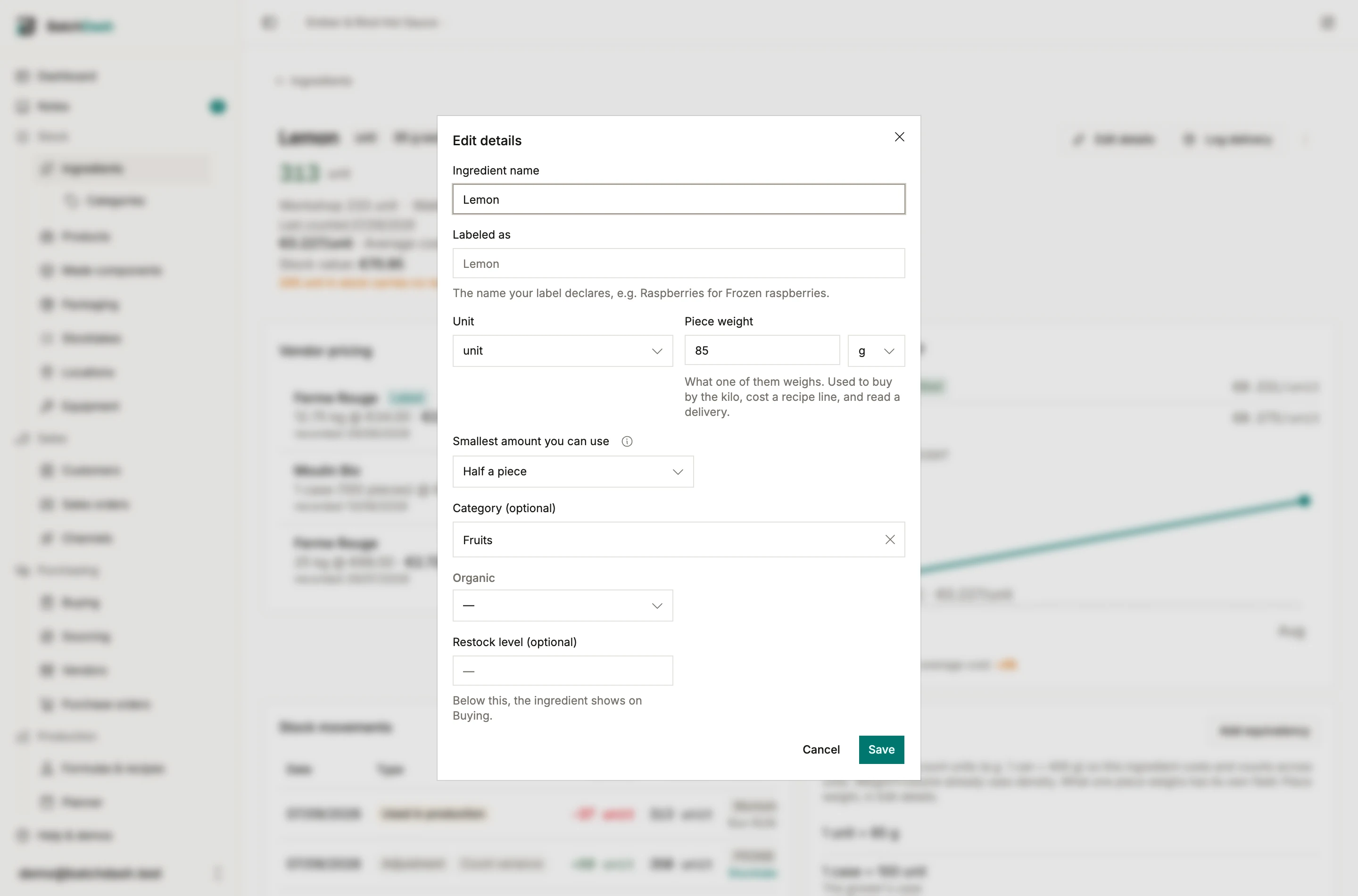
Smallest amount you can use
Section titled “Smallest amount you can use”An egg cannot be quartered, but beaten it halves fine. A lemon divides freely. A sachet of yeast is spoiled the moment you open it. Smallest amount you can use is where you say which, and it changes two things:
- A batch never asks for part of one. A recipe that works out at 0.6 eggs asks for 1, and the batch’s line says where the 1 came from. The whole egg goes into the batch, so the batch is slightly richer than the recipe said and the run tells you by how much.
- When the pieces are most of the batch, the batch goes to them. A cake of 100 g of flour and two eggs, asked for at 156 g, works out at 1.85 eggs. Rounding the eggs up and leaving the flour where it was would print 2 eggs beside 92.3 g of flour, a recipe you never wrote. So the sheet is built at the 169.3 g two whole eggs make, and it says so: Adjusted from 156.3 g: this batch is sized to its pieces. It goes the other way too, and by the same rule: 1.2 eggs is nearer one than two, so that batch comes down a little instead. The rest of the recipe keeps its ratios, so the sheet is the bench. A garnish never does this: one egg in a kilo of brioche is 0.6 of one, and the brioche stays a kilo.
- Stock steps by the same amount. A delivery, a count, an adjustment, a transfer or a captured amount that falls between two steps is refused, in those words: Count this in whole pieces. Count this in halves. The inputs step by the amount you chose, so on a phone the number pad opens instead of the decimal one for something whole.
Choosing does not rewrite a balance that is already between steps. The page says “Stock is 6.47, between two amounts you can use. Count it to correct the balance.” until a stocktake or an adjustment settles it.
Say half a piece for an egg you beat before you use it, and a batch may then ask for 1.5 of them rather than rounding up to 2. Say a whole piece for a jar, a sachet or a mould.
Buying by the kilo, by the case, or by the piece
Section titled “Buying by the kilo, by the case, or by the piece”With a piece weight, the pack-size unit on a vendor offer opens up. It offers pieces, any pack you have named for that ingredient, and the units of the piece weight’s own family. So a grower who sells 25 kg crates is recorded the way they quote:
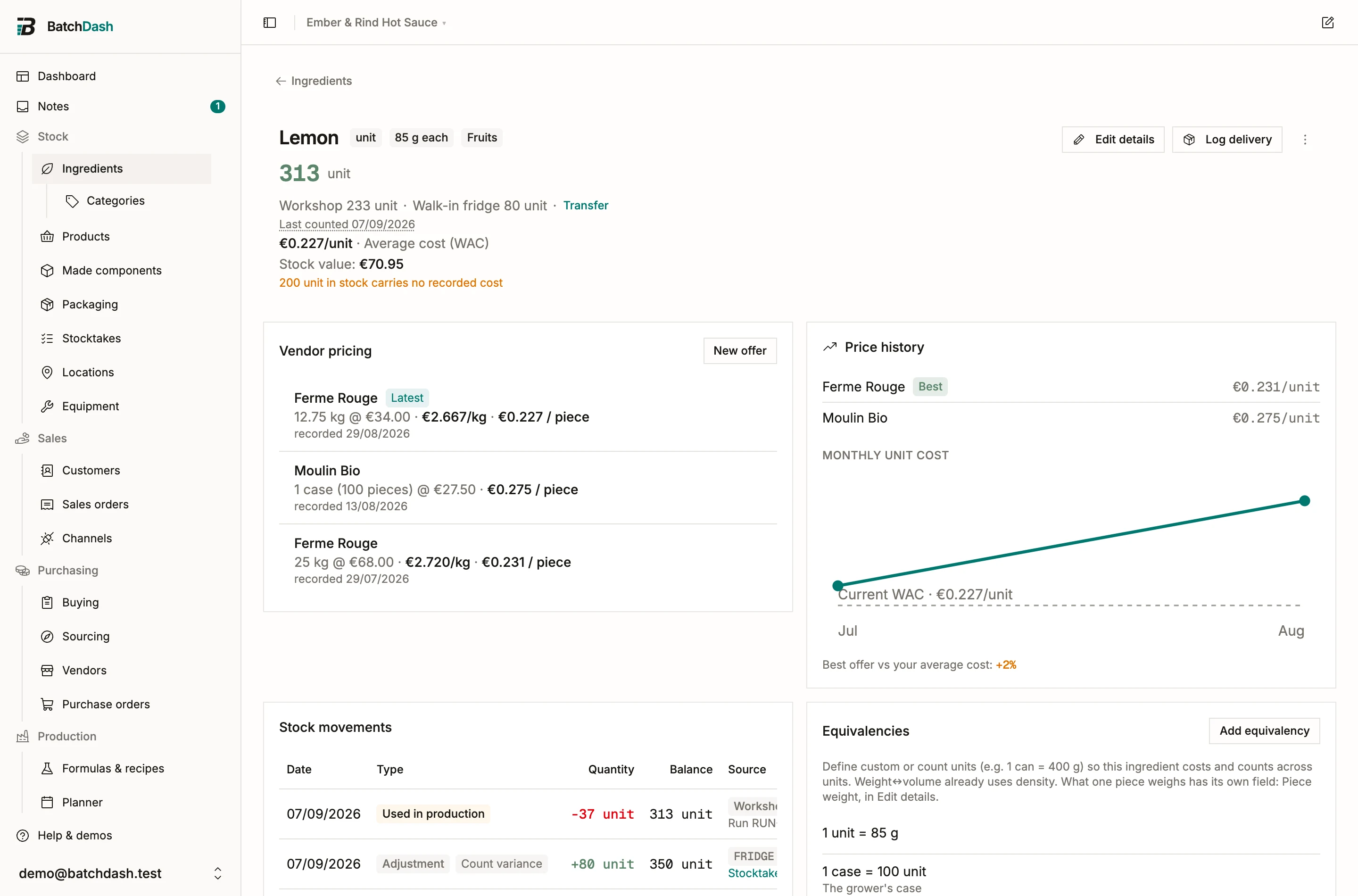
25 kg @ €68.00 · €2.720/kg · €0.231 / piece
The second figure is the one that decides. A count cannot be rescaled the way 1600 g becomes 1.6 kg, so 294 lemons for €68.00 and 100 lemons for €27.50 need the per-piece price side by side before either looks cheap.
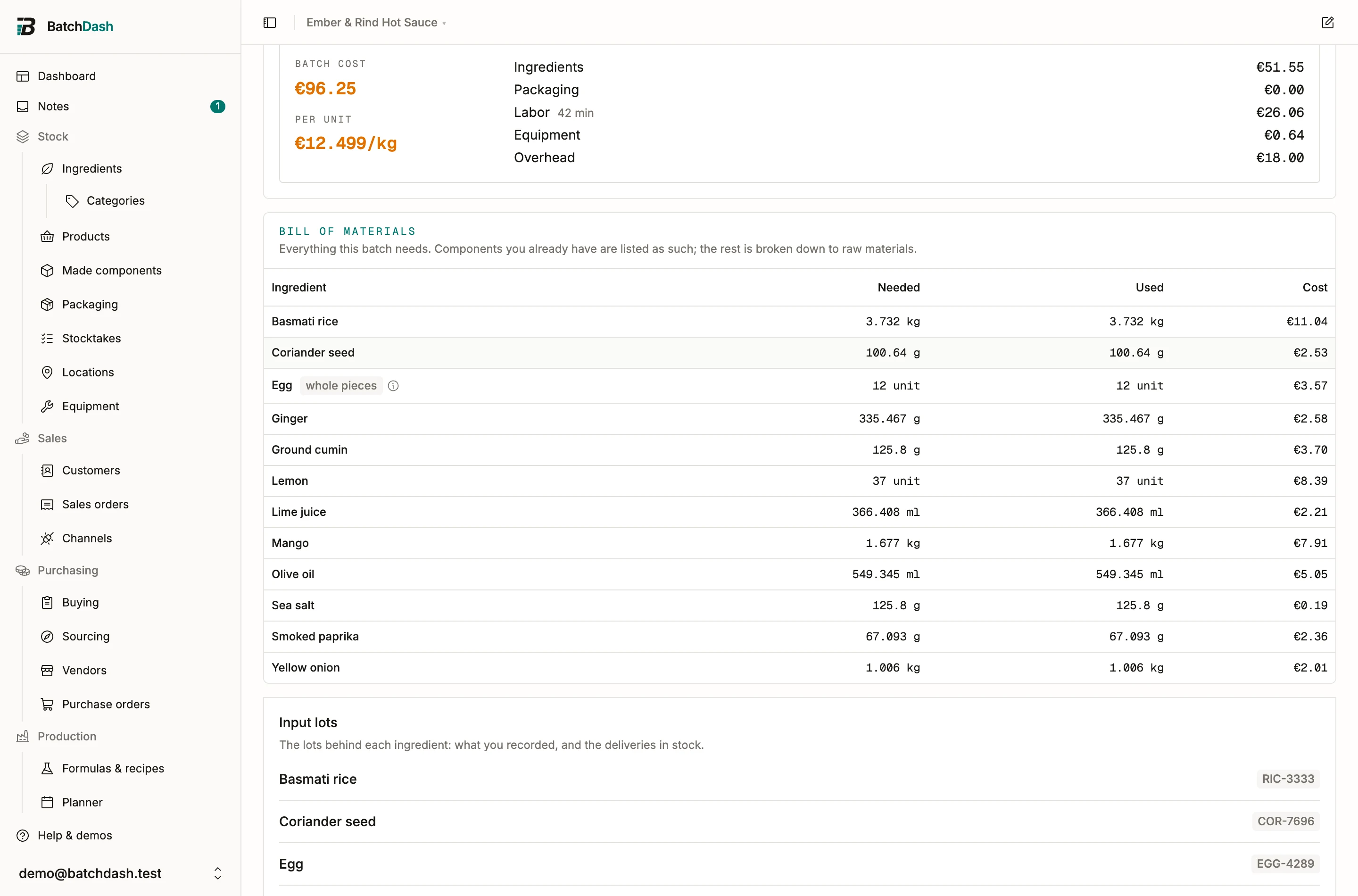
A pack is a named measure on the ingredient, added in the Equivalencies card: “1 case = 100 unit”. Name one and it joins the pack-size units, so an offer typed as “1 case” reads back as “1 case (100 pieces)”. On a batch’s shopping list a quote against that offer counts in cases too, because that is what you ask for at the counter.
Purchase order lines work the same way. Order 25 kg of lemons and the line reads “25 kg (294.118 unit)” at €2.720/kg: what you asked the vendor for, and what lands on the shelf when it arrives.
Counting what arrived
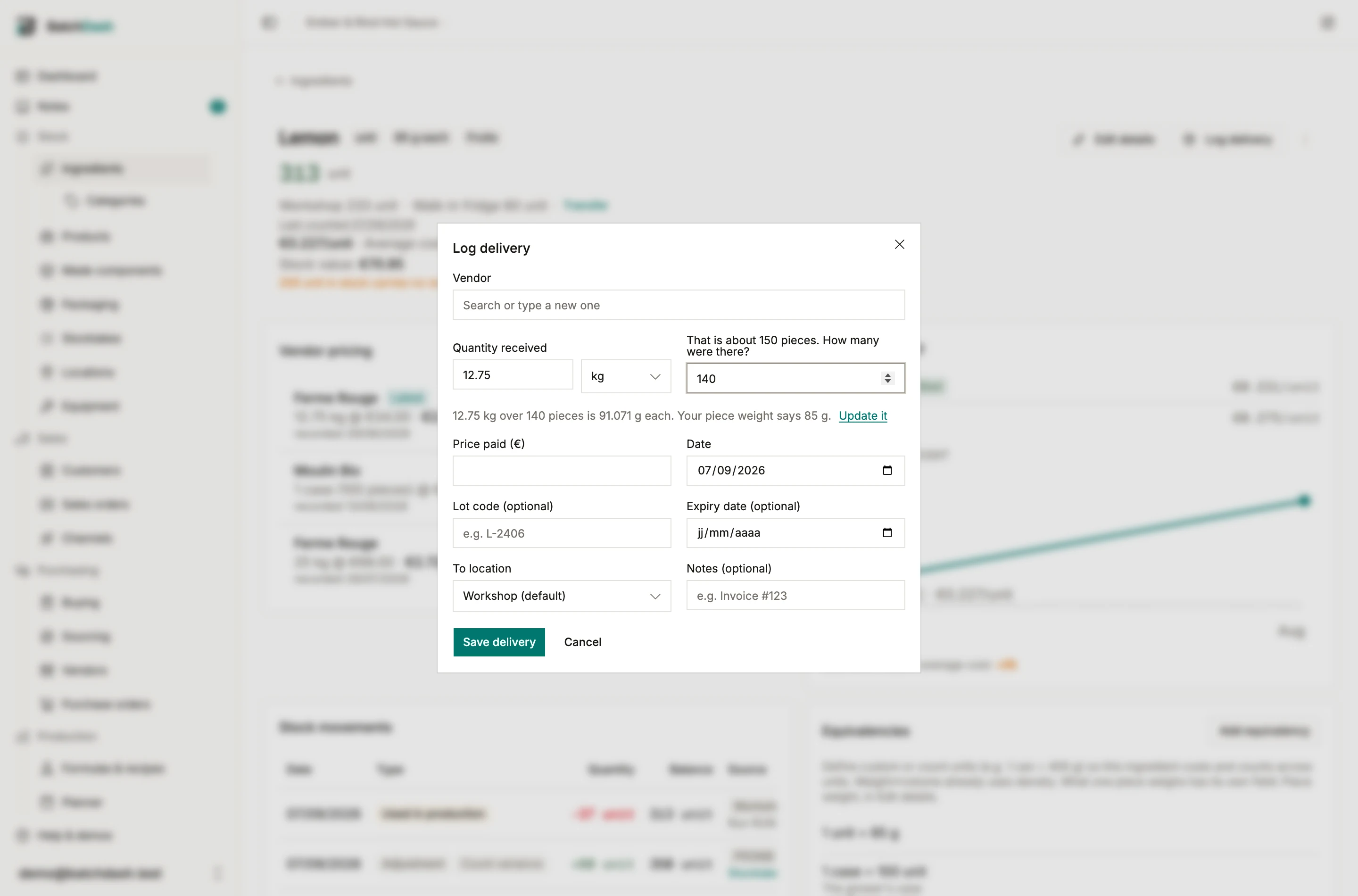
Section titled “Counting what arrived”The crate was weighed, not counted. Log the delivery in kilos and the dialog asks the only question that matters:
Quantity received 12.75 kg That is about 150 pieces. How many were there? [ 150 ]
The count is what goes into stock, onto the purchase line and onto the price snapshot. The weight is not lost: it rides on the snapshot, so the price history still reads per kilo beside per piece.
When the weight and the count disagree with your stored piece weight by more than 2%, one line offers to fix it, with the arithmetic in view:
12.75 kg over 140 pieces is 91.071 g each. Your piece weight says 85 g. Update it
Nothing happens without the press. A crate of unusually small lemons should not quietly reprice every recipe that uses them, so the correction is yours to make, once, on the ingredient itself. Under 2% the line does not appear: being 1% out is not a question worth asking.
When the piece weight is missing
Section titled “When the piece weight is missing”Everything above is gated on that one field, so the tell is always the same: the unit choice is not there.
- On the ingredient page, a line under the header says what filling it in would let you do, and offers to open the form.
- On a purchase order line, the field says Add a piece weight to Lemons to order it by weight.
- On a batch, a warning names the ingredient: Lemons has no piece weight, so it cannot be converted from the recipe’s grams.
- Adopting a sourcing quote or importing a price list in kilos is refused with the same fix: Add a piece weight to this ingredient to price it in kg.
Fill it in and every one of those screens starts working, with no other setting to find.