
Ingredients you break down
Three eggs, two bowls, one crate. The custard wants the yolks, the meringue wants the whites, and what you buy is eggs. Without a way to say that, you have two bad options: invent an “Egg yolk” ingredient nobody sells you, or put whole eggs in the recipe and let the shell into your percentages.
Parts are the third option. You describe what an egg separates into, once, on the ingredient. Then a recipe asks for the yolk, and the batch still buys eggs.
Describe the parts on the ingredient
Section titled “Describe the parts on the ingredient”Open the ingredient and add its parts: a name, a share of the weight as bought, and whether it is thrown away.
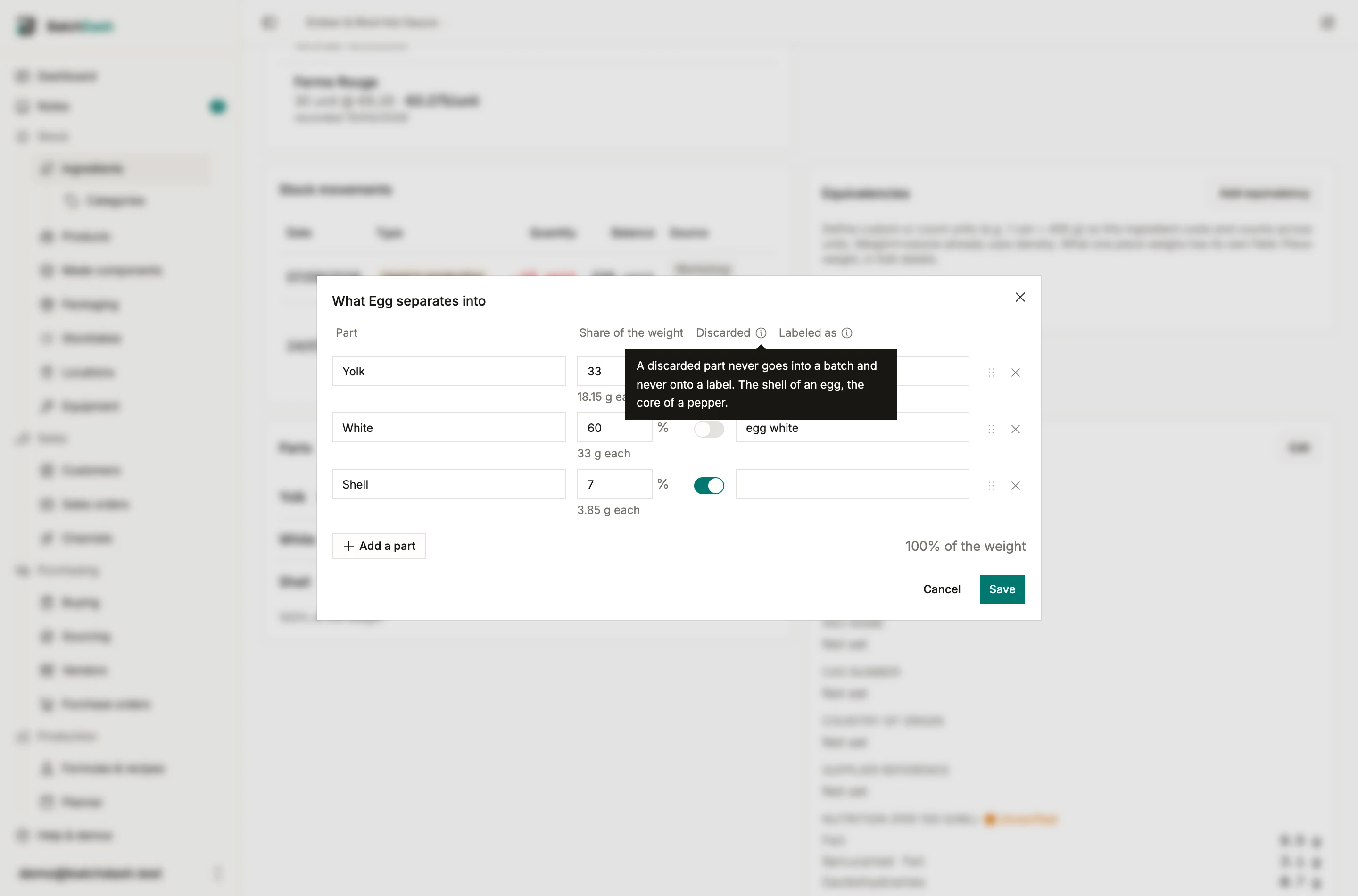
An egg is a yolk at 33%, a white at 60% and a shell at 7%, and the shell is discarded. The shares are of the weight as bought, so they are scale-free: correct the piece weight at the next delivery and every yolk in every recipe follows, with nothing to re-save.
Shares do not have to reach 100%. What they leave unnamed is lost on separation, which is honest for a lemon where a little juice stays in the fruit.
“Labeled as” is what the part declares under on a label. Leave it blank and the part declares under the ingredient’s name.
Ask for a part in a recipe
Section titled “Ask for a part in a recipe”On the bench, a row of an ingredient with parts carries a small chip. It reads whole by default, and the menu lists the parts.
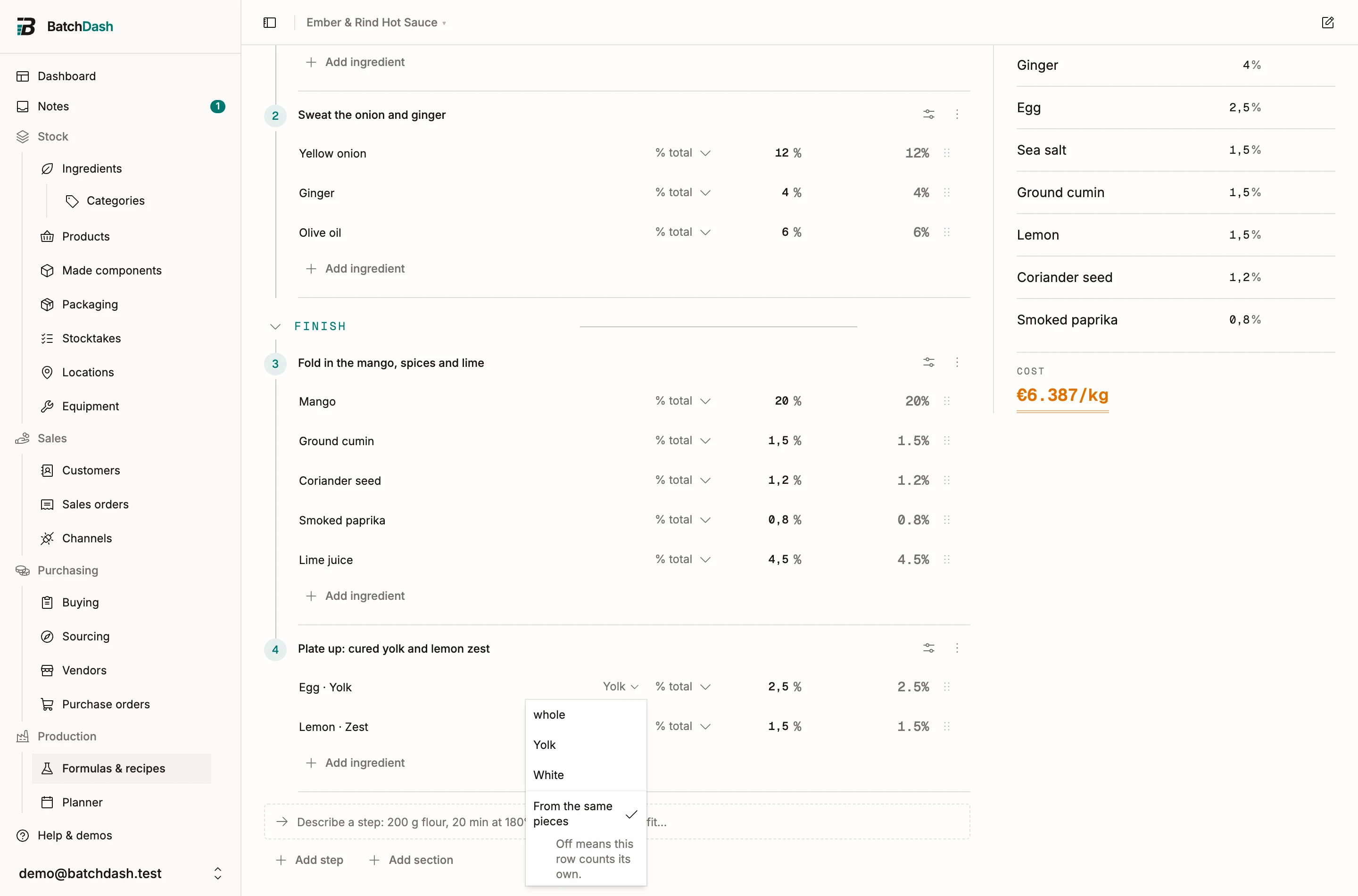
On a whole row, a weight is the egg as bought: type 100 g and the line reads 100 g beside the 93 g that go in. Cracked the eggs onto the scale? Pick whole, net weight on the chip: the 100 g is what went in, and the line buys the 100 ÷ 0.93 = 107.5 g it takes.
You can also type it. “3 yolks” in the omnibox finds the egg’s yolk, and the picker lists an ingredient’s parts under it.
What the amount means. A count is a count of whole items: “3 yolks” is the yolks of three eggs, because that is what a cook means. A weight is the part’s own weight: “50 g of yolk” is 50 g of yolk, and the egg line behind it is 50 ÷ 0.33 = 151.5 g.
Type a share instead of an amount and it is a share of the product: “egg 10%” means ten grams of egg in a hundred of product, and the batch buys as many eggs as that takes.
The same eggs, wherever the recipe uses them
Section titled “The same eggs, wherever the recipe uses them”This is the part worth reading twice.
Ask for 10 whites at one step and 8 yolks at another, and the recipe cracks ten eggs. Not eighteen. Every white goes in, eight of the ten yolks go in, and two yolks are left over. It is how a pastry kitchen already works, and it is what the app assumes without asking.
The rule in one line: you crack as many as the hungriest part needs.
If you genuinely want two eggs, one for its white and one for its yolk, clear From the same pieces in the chip’s menu. That row then brings its own. It is rare enough to live in a menu, and it is the only way to say it.
What the panel tells you
Section titled “What the panel tells you”The recipe’s ingredient list shows one line for the egg, with what you buy and what goes in:
Eggs 82.6% 10 pieces · 475.2 g in 8 of 10 Yolk in · 10 White in 2 Yolk left over · 10 Shell discarded
The percentage is a share of what goes into the batch: 475.2 g of white and yolk in a 575.2 g batch. Ten eggs is what you buy, what sits in stock and what the cost is struck on. The two lines under the name reconcile them, counted in pieces because that is how you would say it out loud. An ingredient bought by weight reads in grams.
Shells, lost shares and left-over yolks are in no percentage anywhere. A formula’s shares add up to 100% of the product, which is the first thing a formulator checks.
What the sheet prints and the batch buys
Section titled “What the sheet prints and the batch buys”The recipe sheet asks each step for what it takes: “Egg white 2.273 kg”, in grams even for something you count, because two thirds of an egg is not something to weigh out. Every part row names the batch’s own egg count, so two steps can never be read as two sets of eggs.
The mise en place lists the eggs. The bill of materials lists the eggs. Stock falls by eggs, and the cost is eggs. The sheet’s input figure is what goes into the product, and beside it is what was bought when the two differ: “Input 1.223 kg · 1.3 kg as bought”. A left-over white costs the batch what it cost to buy, because it did; the cost of every gram of product carries it.
What the label declares
Section titled “What the label declares”The label declares what is in the jar. A part declares under its own “Labeled as” name, or under the ingredient’s when it has none:
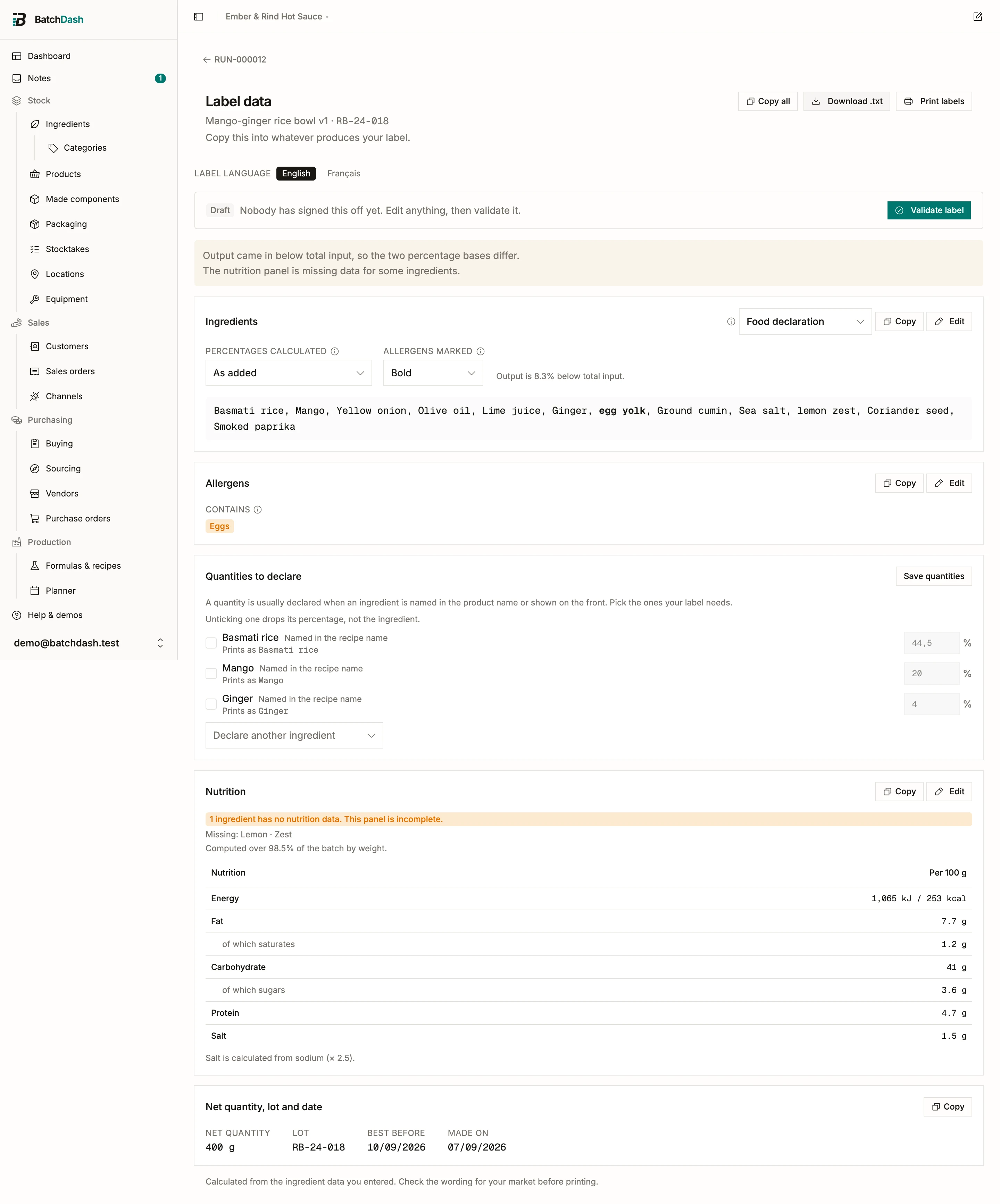
Name both parts “egg” and they become one line, summed. Name them “egg yolk” and “egg white” and they stay two. The shell, the lost share and the left-over yolks declare nothing: they are not in the jar.
Allergens are the ingredient’s. A yolk is egg.
Nutrition is the part’s own, or missing. The yolk’s fat is not the egg’s, so a part with no figures of its own is named on the incomplete list rather than filled in from the whole ingredient. Give the part its figures and the panel completes.
Prep yield: the peeled carrot
Section titled “Prep yield: the peeled carrot”Parts are not only for things you separate into bowls. A carrot with “Peeled 88%” and “Peel 12%, discarded” is the same feature with one part in the pot.
Add 2 kg of carrots, whole. The pot gets 1.76 kg, and the line reads 1.76 kg in, 2 kg as bought, with its percentage read on the 1.76 kg. Weighed the carrots after peeling? Pick whole, net weight on the row’s chip and type 1.76 kg: the same two figures, reached from the other end. The peel is in no percentage; it is in the cost. You never separate anything: describing the parts is enough. This is what a kitchen calls yield on prep.
A form you could also buy or keep on the shelf, like peeled carrots you prepare ahead, is a variant; see one ingredient, several variants.
What parts are not
Section titled “What parts are not”Not a transformation. Roasting a vegetable changes it and has a yield and a method. That is a component recipe, not a part.
Not a measure. “A dozen” and “a case of 100” are ways of counting the same egg. Those are equivalencies.
Not a separate ingredient. If you buy liquid egg white by the carton, that is its own ingredient, stocked and priced in its own right. Parts are for what you break down yourself.