
Co-products and by-products
A batch can make more than one thing. Cheese leaves whey, a chili mash leaves brine, a lavender distillation gives an essential oil and a hydrosol. BatchDash puts each of them into stock, gives each its part of what the batch cost, and follows each one wherever its lot goes.
What comes out of a recipe
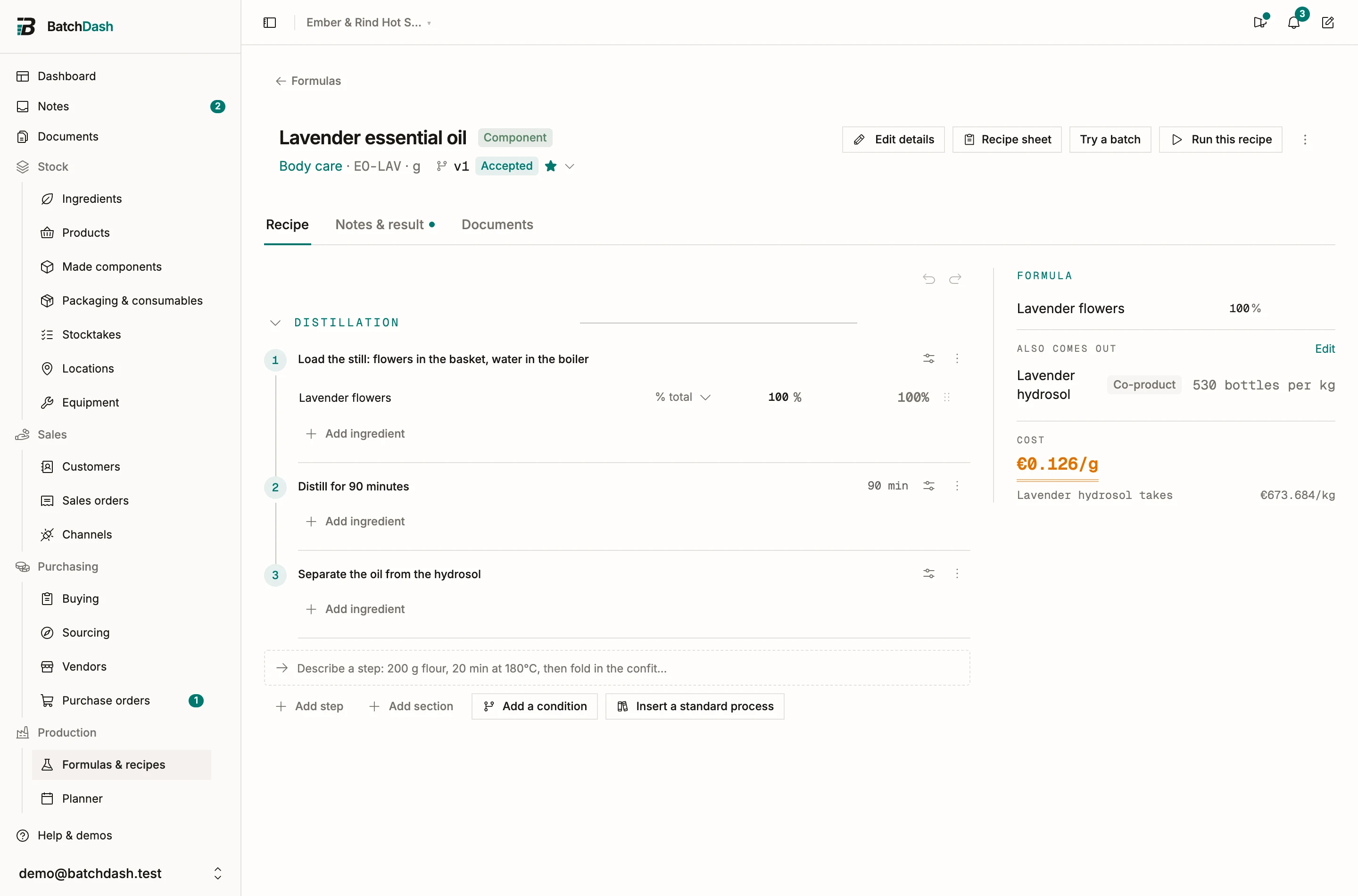
Section titled “What comes out of a recipe”On the recipe page, the ⋮ menu has Also comes out…. Once a recipe has outputs, its panel shows them under Also comes out, with Edit beside the title.
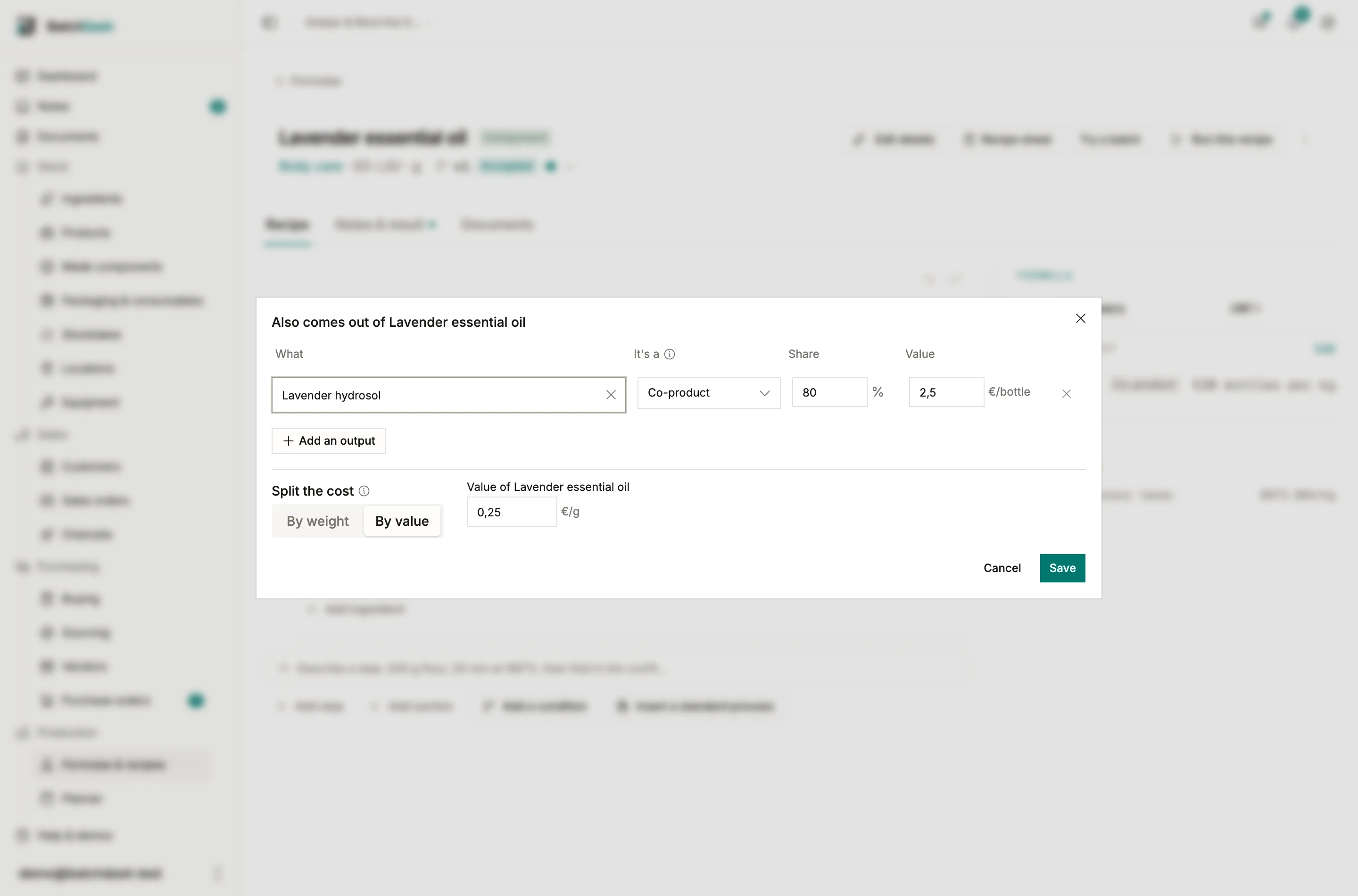
The dialog, Also comes out of followed by the recipe’s name, lists one row per output, four at most:
| Field | What it holds |
|---|---|
| What | The item it goes into: an ingredient, a made component or a product. Type a name to find it, or create it from the list. |
| It’s a | By-product or Co-product. The tip beside it says what each does to the cost. |
| Share | How much comes out, as a share of what goes into the batch, so it grows with every batch’s size. |
| Value | What one unit of it is worth, in your currency per the unit it is stocked in. It starts from the product’s wholesale price or the ingredient’s current cost. |
The unit an output is stocked in is the item’s own, so a product filled in jars counts in jars.
A recipe cannot put out what it uses. If it comes to use an output later, whey added as a line or to a sub-recipe it uses, the panel says so under that output, and batches leave it out, with no credit, until you remove it.
A by-product is something you get without aiming for it, often worth less: the batch counts it at the value you give it, and the recipe’s own product pays the rest. A co-product is a product in its own right that you set out to make at the same time: it takes its share of the batch cost. With a co-product on the list, Split the cost asks how: By weight, each paying in proportion to what it weighs, or By value, each in proportion to what it is worth, with a Value for the recipe’s own product too.
Keeping a left-over part
Section titled “Keeping a left-over part”A recipe that uses part of an ingredient says what is left: “2 whites left over”. Keep beside it opens the dialog with a by-product row for that part already filled in. The row reads What is left of the part and follows it: change the number of eggs and the whites follow. Type a share instead unlinks it. See ingredient parts.
How the cost splits
Section titled “How the cost splits”Take a batch of 100 L of milk that cost €120 and made 10 kg of cheese and 85 L of whey.
| How the whey is listed | What the whey takes | The cheese’s cost |
|---|---|---|
| By-product at €0.10/L | €8.50, its 85 L at the value you gave it | €111.50, so €11.15/kg |
| Co-product, by weight | about 90 % of the batch, since it weighs most | €12.63, so €1.26/kg |
| Co-product, by value, the cheese at €14/kg and the whey at €0.20/L | €12.99, its €17 of €157 | €107.01, so €10.70/kg |
The cost breakdown on the recipe shows the split under the batch cost: “Whey takes €12.99”. Splitting by weight suits outputs worth about the same per kilo; when a light, valuable product comes with a heavy, cheap one, split by value. A product counted in pieces splits by weight once a piece has a weight; until then, split by value.
A by-product with no value counts at zero: it goes into stock at no cost, and the recipe’s product pays for the whole batch. When the by-products are worth more than the whole batch cost, they take all of it, and the recipe’s product costs nothing.
Finishing a batch
Section titled “Finishing a batch”A batch planned from the recipe plans each output for its own size. While the batch runs, What came out has a row for each output beside the product, to type what was actually made.
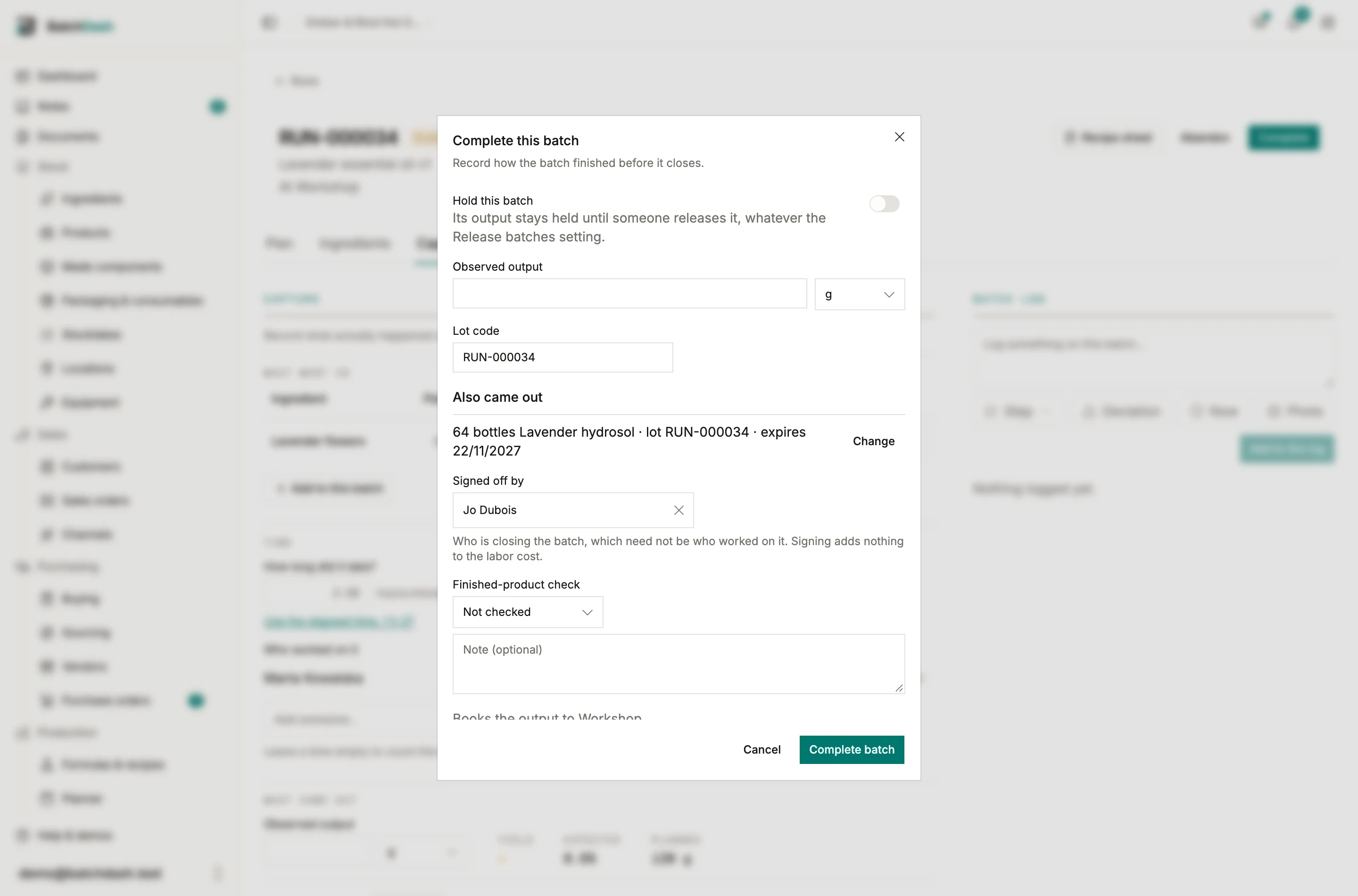
Complete lists them under Also came out: “85 L Whey · lot RUN-000041”, with the expiry when the item has a shelf life. Every output takes the batch’s lot code; Change on a line sets another quantity, lot code or expiry for it alone.
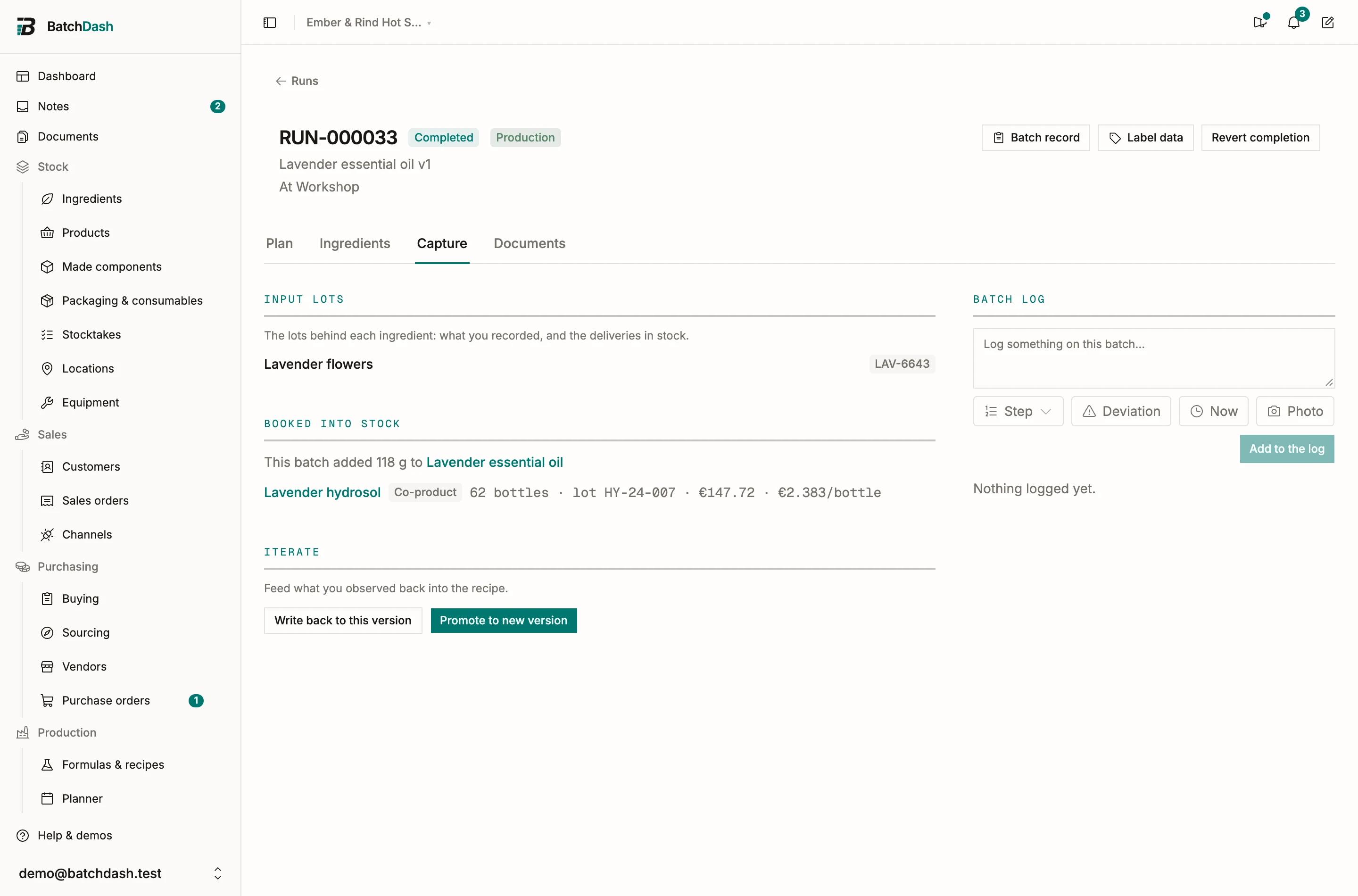
Completing the batch splits its cost and puts every output into stock under its lot. The batch page shows each of them under Booked into stock, with its share of the cost for whoever sees costs. The cost card reads Split between the outputs, and the printed batch record carries an Also came out table: planned, made, lot, expiry, share of the cost.
A product or made component that comes out in a format of its own takes that format’s packaging when the batch completes, as the batch’s product does, and the completion is refused if those jars are short.
A sub-recipe made in the batch
Section titled “A sub-recipe made in the batch”A recipe can use another that lists what comes out of it: a tart with a custard that keeps the whites. When the tart’s batch has no custard in stock to draw and makes it itself, the whites come out of the tart’s batch. It plans them from what goes into the custard, lists them under What came out and Also came out “via Custard”, and puts them into stock when the batch completes.
They take what the custard’s own split gives them, which is what the tart’s recipe already took off the custard’s cost, so the batch costs what the recipe said. A custard drawn from stock put its whites out with its own batch, and the tart’s batch has none.
A held batch
Section titled “A held batch”A batch held at completion holds every output with it: a product or a made component sits in stock as Held. An ingredient output does not go into stock yet. It reads Waits for release and goes in at the release, with the cost completion gave it.
On a held batch, an ingredient output waiting for release has Don’t stock it, for whoever can decide on batches: “It never enters stock. What it cost counts in Shrink and waste, with the discarded batches.” See holding and releasing.
Trace and recall
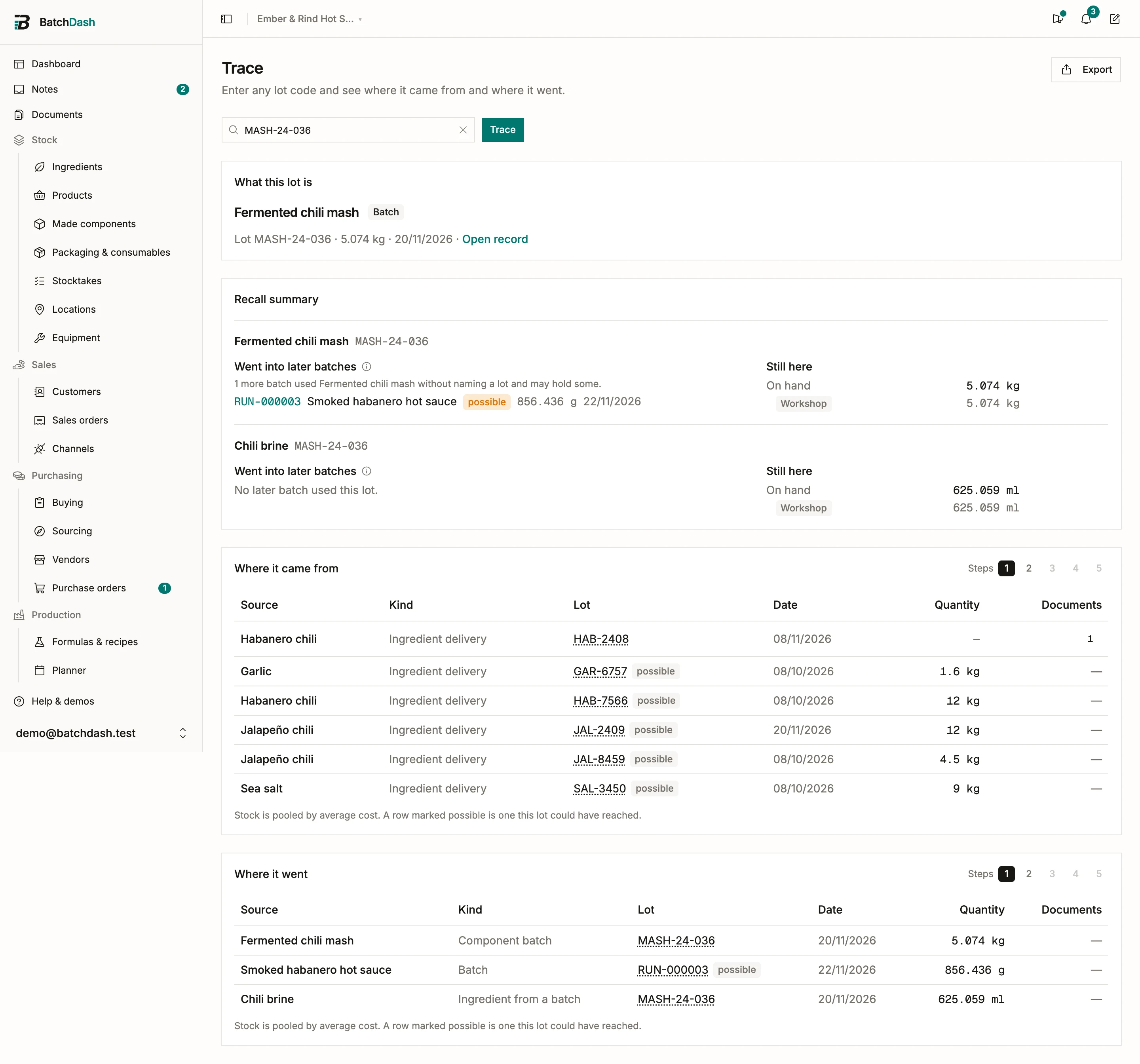
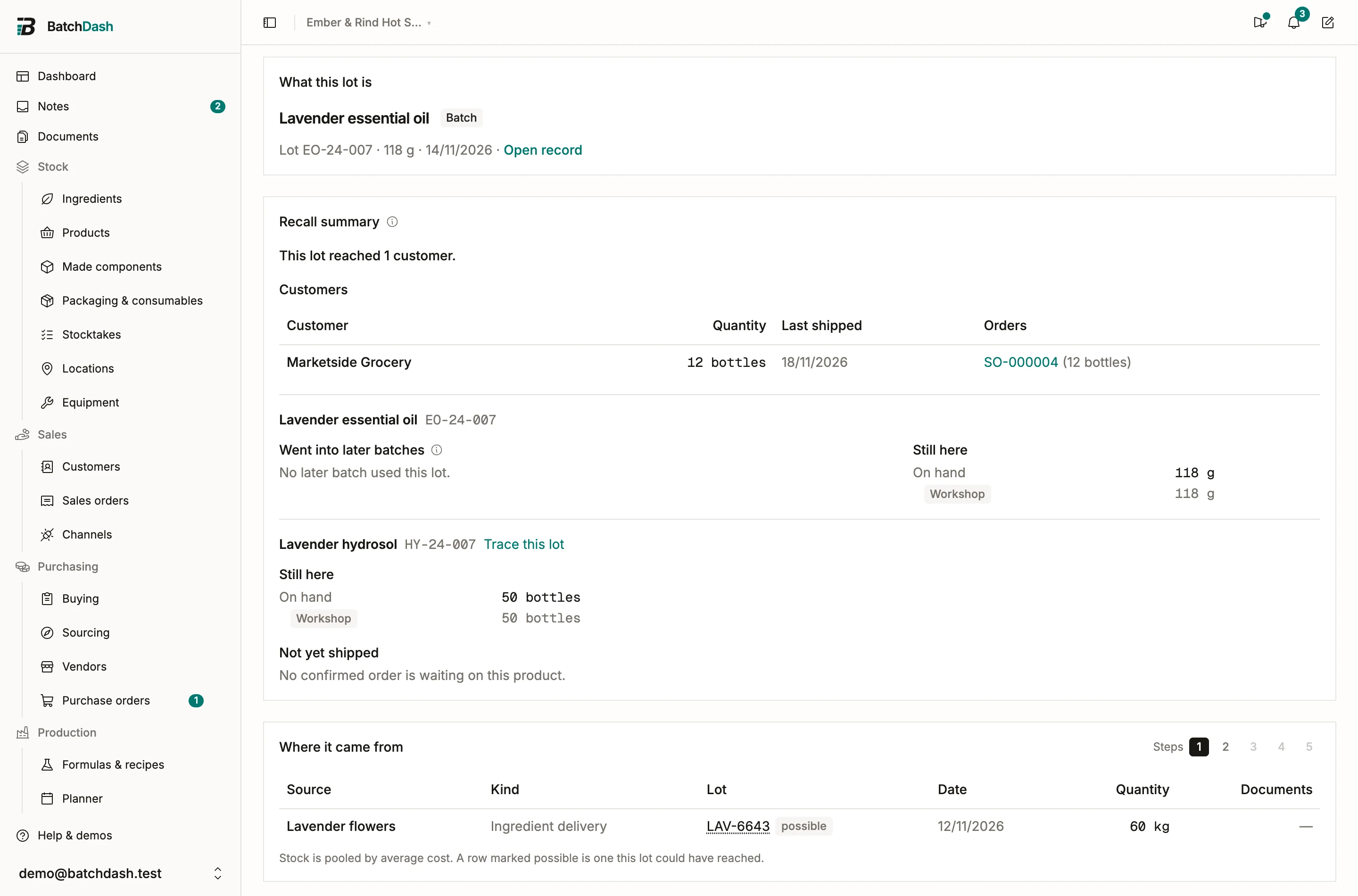
Section titled “Trace and recall”An ingredient a batch put out is a lot of its own: the trace calls it Ingredient from a batch. Traced from the milk, the trail reaches the batch, then the cheese and the whey, then the batches that used the whey. A lot that came out beside another product says so on its card: “Came out of RUN-000041 with Tomme”. See traceability.
The Recall summary of a batch answers for each output in its own unit: the cheese in kilos, the whey in liters, never one figure. Customers are one row each, saying what they received of which. An ingredient or a component says which later batches used it, under Went into later batches: the batches that named its lot, each leading to its own trace, then every batch that used the item without naming a lot, oldest first, marked possible.
Planning and buying
Section titled “Planning and buying”What a planned batch will put out is counted as coming stock:
- The planner credits it once the batch that makes it has taken what it needs, so a batch after it that uses the whey stays at risk until the whey is made. A held batch’s whey counts from today. See the planner.
- Buying shows it as From batches beside On order: a batch that uses the whey buys only what the batches making it don’t cover. See buying.
- A replenishment rule counts a co-product’s units in what is planned, so it does not plan a batch the cheese batch already covers. See replenishment rules.
- A made component put out beside a product feeds the runs that use it, like a batch of the component itself. Its page lists that batch as “Made alongside” the batch’s product.
A batch never counts what it makes itself for what it uses.
Reports and exports
Section titled “Reports and exports”The Production output report gives each recipe’s row its own cost: what the batches cost less the shares their other outputs took. Each output is a line under it, with its role, its quantity in its own unit and its share, and the packs filled from its lots under it. See reports.
The Runs list’s Export has a second file, Batch outputs: one row per output of the batches listed. The full export carries it, and the outputs of every recipe too. See exporting your data.
Who can do what
Section titled “Who can do what”Listing what comes out of a recipe takes the right to manage recipes. Capturing and completing take the right to manage runs, and Don’t stock it the right to decide on batches. Values, shares and costs show only to people who see costs.